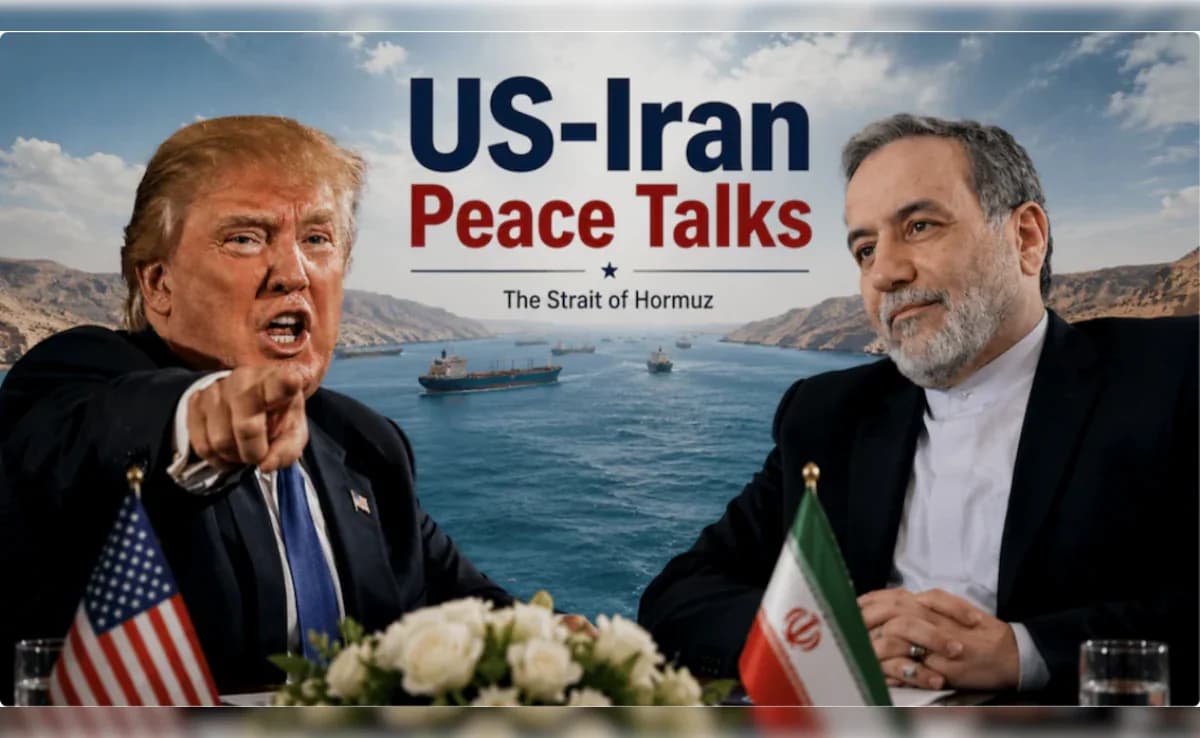
Iran has hinted at its willingness for a long and multi-stage truce in what could emerge as a likely breakthrough in peace talks between the US and Iran, according to Al-Arabiya reports. Tehran has requested a gradual and safe opening of the Strait of Hormuz and agreed to a long nuclear freeze instead of complete dismantlement - marking a significant shift from previous positions. The Iranian position includes conditional transfer of enriched uranium to Russia instead of America, while Tehran will also back off from demanding compensation for the war. This represents a substantial change from Iran's previous stance, with the country now showing flexibility on key nuclear and economic demands.
US President Donald Trump has escalated his military rhetoric against Iran through an AI-generated image posted on Instagram captioned 'It was the calm before the storm' - a clear signal of potential military action. The image, showing Trump alongside a US Navy admiral amid rough seas, has fuelled speculation that Washington could resume airstrikes on Iran. Trump has now warned Iran that the 'clock is ticking' and threatened consequences if its leaders do not act quickly, writing on Truth Social: 'TIME IS OF THE ESSENCE!' The president told French media that if Tehran failed to reach a peace agreement with the US, it would face 'a very bad time' - 'If they don't, they're going to have a bad time. A very bad time. They had better make a deal.' This latest signal follows Trump's Situation Room meeting on Tuesday to discuss military options against Iran, where military planners had been considering high-impact options including seizing Kharg Island and targeting Iranian military assets that threaten free passage through the Strait of Hormuz. The administration has convened multiple meetings focused on Iran from April through May 2026, driven by what officials have characterized as a Strait of Hormuz 'crisis' and a ceasefire that has effectively stalled.
A drone strike has sparked a fire at an electrical generator at the Barakah Nuclear Power Plant in Abu Dhabi, though no injuries were reported, radiological safety levels were unaffected and the Federal Authority for Nuclear Regulation confirmed the plant's essential systems are operating normally. Meanwhile, Saudi Arabia reported intercepting three drones, highlighting the escalating regional tensions. Brent crude futures climbed $2.03, or 1.86 per cent, to $111.29 a barrel, after touching $112 earlier - the highest since 5 May. US West Texas Intermediate crude was at $107.73 a barrel, up $2.31, or 2.19 per cent, following a rise to $108.70, its highest level since 30 April. Prestige Economics' Jason Schenker warned that 'the longer the conflict with Iran persists, the greater the risk of protracted oil price scarring, which could keep interest rates higher for longer.'
The Pentagon has prepared a series of military target plans should Trump ultimately decide to move forward with more strikes, including targeted strikes on energy and infrastructure sites in Iran, according to sources familiar with the talks. Trump met with top members of his national security team on Saturday to discuss the path forward on the Iran war, with Vice President JD Vance, Secretary of State Marco Rubio, CIA Director John Ratcliffe and special envoy Steve Witkoff all attending the meeting at the president's Virginia golf club. The gathering occurred just hours after Trump arrived back in Washington from a high-stakes visit to China, a nation with close ties to Iran. Trump and his team held off on deciding how to proceed with Tehran during his visit to Beijing, with several administration officials telling CNN they wanted to see how the talks between Trump and Chinese leader Xi Jinping played out before determining a path forward. Trump is expected to meet again with his national security team regarding the war early this week, as the administration continues to weigh its options amid reports suggesting Trump is weighing renewed military action if Tehran refuses to reach a peace deal. Israeli Prime Minister Benjamin Netanyahu spoke to Trump in a phone call, with reports indicating Israel is coordinating with the US about a possible resumption of attacks - Netanyahu told his cabinet: 'our eyes are also open' when it comes to Iran, and 'we are prepared for any scenario.'
Iran has responded sharply to Trump's latest signals, with Iranian armed forces spokesperson Brigadier General Abolfazl Shekarchi warning that any new attack on Iran would result in the United States receiving 'even harsher and more severe blows,' adding that American interests and forces would face 'new and devastating attack scenarios' if Washington acted on its threats. Iran's defense ministry spokesperson Reza Talaei Nik also said Iranian armed forces were 'fully prepared to respond to any threat or aggression,' as Tehran intensified both military and political messaging regarding Gulf shipping security. The escalation comes as Iranian state television appeared armed during live programs, with presenters on at least two channels receiving basic firearms training from masked Revolutionary Guard members. Mohsen Rezaei, a military adviser to Iran's supreme leader, warned: 'Our armed forces' fingers are on the trigger, while diplomacy is also continuing' - he warned the US blockade was an 'act of war' and said confronting it was Iran's right. A member of Iran's Expediency Council has warned the US to lift its blockade on Iranian ports 'before the Sea of Oman becomes your graveyard' - Mohsen Rezaei said the US blockade was causing 'greater the damage to countries around the world will be' and that 'It is America that must prove itself now.'
The urgency behind Trump's military signals is driven by US domestic law requiring congressional approval to continue military operations beyond 60 days from February 28, 2026 - the date marked as the onset of the current hostilities. The 60-day congressional authorization window creates an artificial deadline that could force action, as the administration believes it may need to act before requiring formal congressional approval. This timeline compression significantly impacts the potential timeline for any military strikes against Iranian targets. Trump has suggested that in his mind the 60-day clock to get Congressional approval, resets, though this remains a controversial interpretation of the legal framework. The latest developments suggest the administration may be preparing to act before this deadline expires, with reports indicating Trump is weighing renewed military action if Tehran refuses to reach a peace deal. A two-day meeting of foreign ministers from the Brics nations concluded in New Delhi without a joint statement because of 'differing views among some members' on the Middle East situation, highlighting the challenge of maintaining unity within the bloc as it seeks to expand its influence.