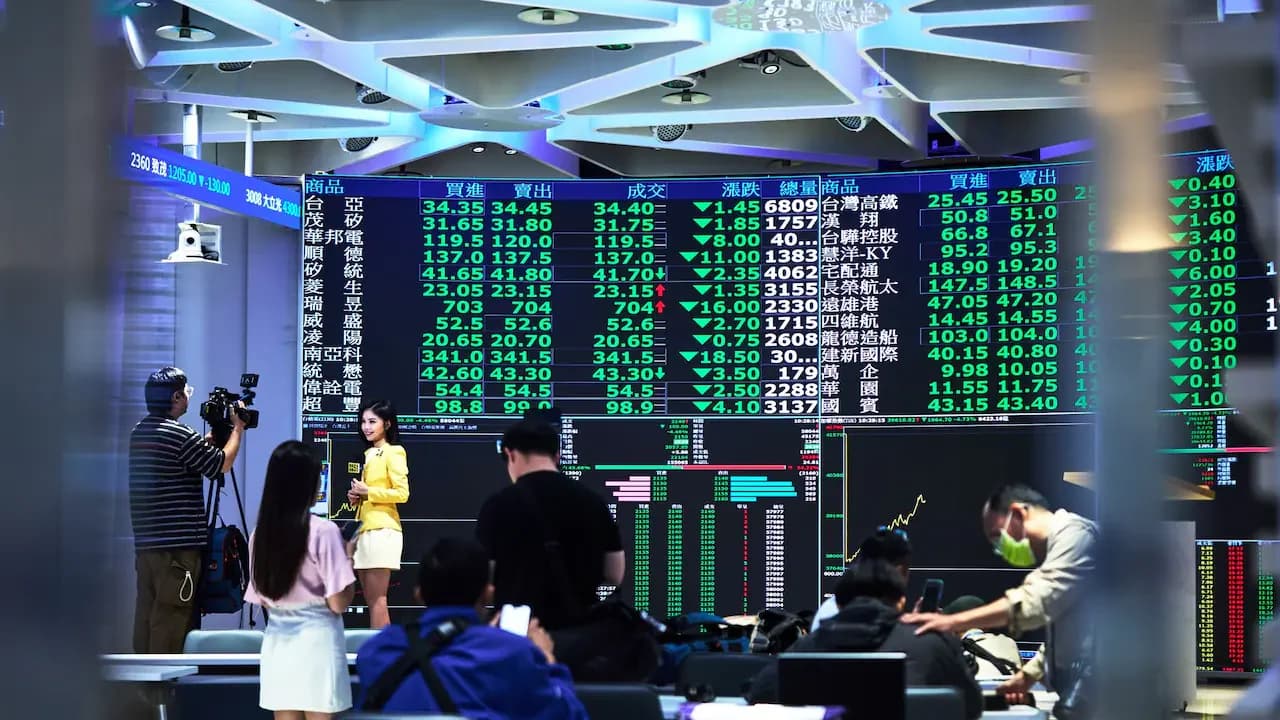
Taiwanese shares experienced a dramatic rebound on Monday, November 9, with the Taiex Index surging 4.9%, marking the most substantial gain since July 31 and ending a seven-session decline that had pushed the technology-heavy market into bear territory. According to reports from CNBC TV18, this rally came after Taiwan's market regulator and finance ministry announced measures to restore investor confidence. The Taiex opened at 40,347.28 and reached a high of 41,399, successfully reclaiming the 40,000-point mark and closing in on 41,000. Taiwan Semiconductor Manufacturing Co. and MediaTek Inc. led the gains, rising at least 4% each, with other heavyweight stocks including Delta Electronics, Hon Hai, and ASE Technology Holding also posting significant gains. The market's strong open clearly suggests that the stabilization measures are overpowering any impact from concerns over an investigation into Nvidia Corp.'s chief executive officer Jensen Huang.
The catalyst for the rebound came from the National Stabilization Fund's tenth market-rescue authorization, as reported by BigGo Finance. The fund's executive secretary was empowered to deploy funds as needed to carry out stabilization tasks, with the emergency committee meeting after Friday's close citing large-scale foreign fund withdrawals since October and the risk of irrational collapse in investor confidence. This marks the tenth intervention episode in the fund's history, with previous episodes showing mixed results - the market rallied 6% on average in the following week and 22% over one year, though six out of nine times experienced additional 5% to 28% drawdowns within six months after fund activation. However, according to Goldman Sachs, only NT$0.76 billion to NT$122.7 billion were actually deployed in the past 9 instances versus the National Stabilisation Fund's NT$500 billion usable capital, suggesting the actual deployed capital could be limited despite the fund's readiness to intervene.
The Financial Supervisory Commission announced new measures to stabilize the market after Friday's market close. As reported by BigGo Finance, the regulator will cap the volume of intraday short-sale orders for borrowed securities at 3% of a stock's average daily trading volume over the preceding 30 days, reduced from 30% previously. Additionally, the minimum margin requirement for short-selling activities will be raised to 130% from 90%. Goldman Sachs notes that the fund tends to buy large-cap tech or financials with heavy index weighting in previous interventions, which could explain the market's strong response to the stabilization measures.
The rebound was significantly boosted by US semiconductor stocks' strong performance on Friday, with the Philadelphia Semiconductor Index jumping 379.11 points, or 4.21%, to 9,390.25. As reported by BigGo Finance, TSMC's ADR soared 6.33% in a single session to $375.44, equivalent to more than NT$2,460 per share for the Taiwan-listed stock at current exchange rates - a notable premium to Friday's cash close of NT$2,135. Other semiconductor giants also surged, with AMD up 11.04%, Micron jumping 5.12%, and NVIDIA rising 2.78%. This US tech rally provided crucial momentum for Taiwan's semiconductor-heavy market, with wider strength in Asian equities on Monday also lifting investor mood despite concerns over the Nvidia investigation.
Veteran Taiwan stock analyst Li Yung-nien noted that today's rally was driven by three positives: the National Stabilization Fund's rescue, the Financial Supervisory Commission's stabilization measures, and Friday's rebound in US tech stocks. However, as reported by BigGo Finance, he cautioned that the TAIEX has already surged more than 1,600 points in a short period, and chasing at these levels carries risk. He does not recommend investors rush in, suggesting for those completely in cash who want to participate, they should consider market-cap ETFs such as Yuanta Taiwan 50 (0050.TW), entering in small, staggered tranches, with an overall principle of staying on the sidelines rather than chasing highs. Homin Lee, senior macro strategist at Lombard Odier, noted that while the National Stabilisation Fund announcement provides a sentiment boost, the actual deployed capital could be limited, suggesting investors should focus on the long-term semiconductor sector trajectory rather than short-term developments.