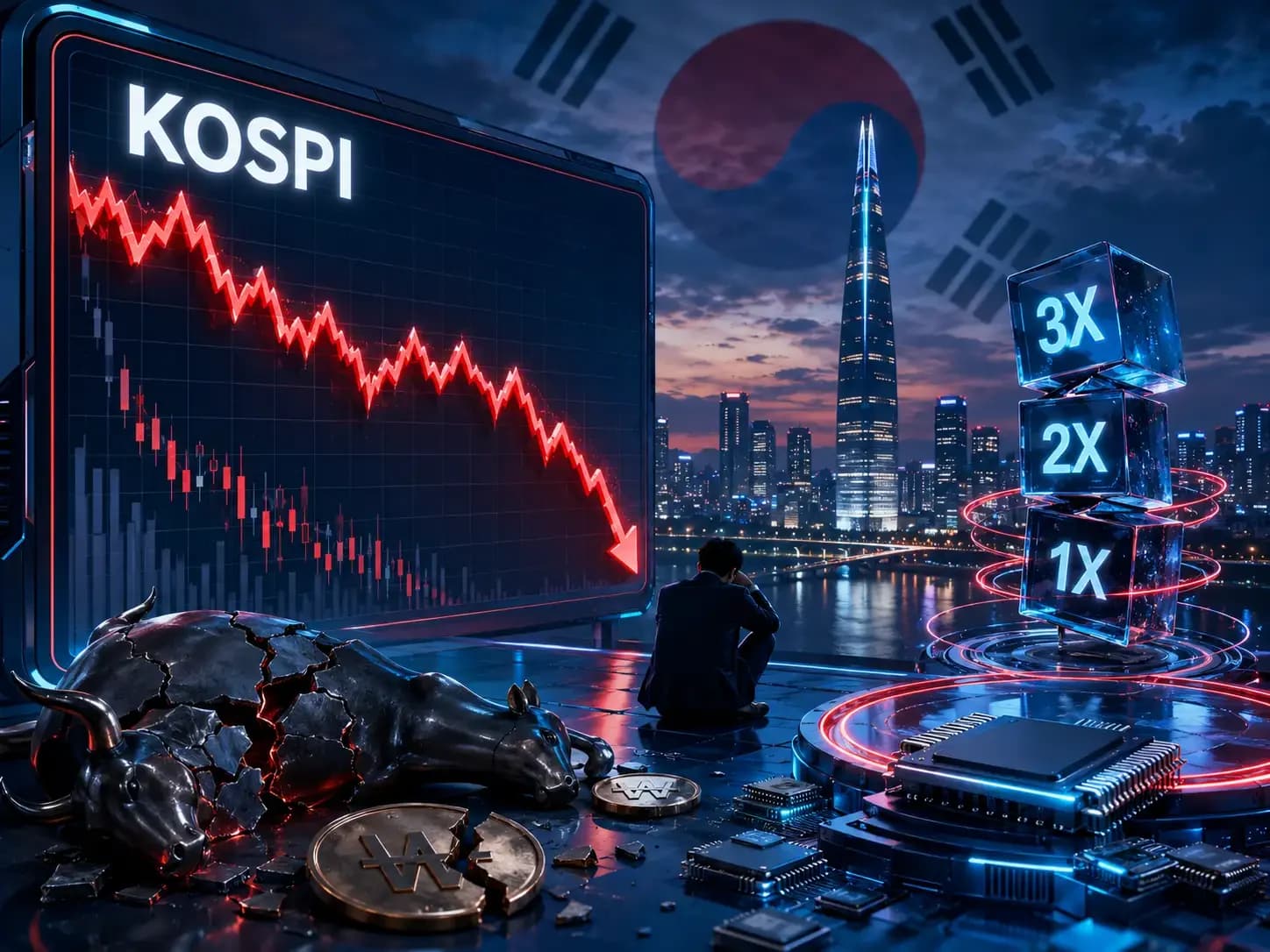
South Korea's Kospi index experienced another dramatic swing on Monday, plunging over 5% after surging a record 18% in the previous session, as investors resumed selling heavyweight chipmakers amid high volatility. According to The Economic Times, Samsung Electronics and rival SK Hynix, two major chipmakers which account for more than half of the Kospi index, shed around 8% each, with the index closing at 6,257. The latest selloff may have been driven by profit booking after the sharp rise, amid prevailing concerns and fragile sentiment around AI investment, along with the outsized influence of leveraged retail bets on the heavyweight chipmakers. Kospi remains 45% up in 2026 so far, though it has fallen more than 33% from its June peak of 9,386, highlighting the extreme volatility that has characterized the market since the initial surge. As per Bloomberg, the Kospi's near 40% tumble in just 27 trading days is comparable to China's market crash in 2015, making it the world's most volatile stock market this year.
South Korea's retail traders, long known for embracing risk, have been rattled by July's punishing reversal in the Kospi index, which capped a 22% loss for the month - the steepest decline since the global financial crisis. According to The Economic Times, some investors like Kim Han-kyung, a Seoul resident in her late 30s, have resolved never to invest again, while others are comparing the $3.9 trillion market to a casino. Kim, who started investing in Korean stocks for the first time in early May, stated "That was the era of the Kospi mania. I got completely swept up in the frenzy. Now, I'm honestly scared. I've engraved two rules in my mind now. First: don't invest in the Korean stock market. Second: follow the first rule." The backlash comes after retail investors piled about 78 trillion won ($54.2 billion) into Kospi shares over May and June, only to be caught in the dramatic volatility that followed. Kim Dong Woo, a 33-year-old who has been trading stocks for more than seven years, noted "Such volatility level still shows the market is not functioning normally."
South Korea's Finance Minister Koo Yun-cheol on Wednesday apologized to lawmakers during a parliamentary session, accepting demands for an apology after retail investors suffered heavy losses from leveraged stock bets. According to CNBC, the minister acknowledged that recent rule changes sparked a surge in speculative trading. President Lee Jae Myung recently stated "Our domestic stock market is quite unstable." He noted that since the country's stock market experienced a historically unprecedented massive surge in such a short period, it would require time and fluctuation to stabilize. The Financial Services Commission (FSC) is now considering stricter rules governing access to these leveraged ETFs, with Vice Chairman Lee Eog-weon indicating that regulators are examining whether investment should be restricted to professional investors only. "If necessary, there is a way to raise the investment requirements up to professional investors," Lee stated, as quoted by the Seoul Economic Daily. The government's response escalated significantly as alarm spread among top officials last week when the benchmark Kospi index plunged 40% from its peak a month earlier, according to people familiar with the matter. The heads of the country's two top regulators both canceled planned vacations, while Finance Minister Koo Yun Cheol apologized to irate lawmakers before calling an emergency meeting of key economic policymakers on Wednesday.
The Kospi index has crashed 40% in just over a month, with the index plunging as much as 9.8% on Wednesday, triggering a market-wide circuit breaker for a second straight session. The index briefly fell below the 6,000 mark, its lowest level since early April, and is now on track for a record monthly decline of about 35%. According to The Economic Times, South Korean retail investors have made net purchases of around ₹1,400 crore ($9.7 billion) in single-stock leveraged ETFs since their launch on May 27, compared with roughly ₹160 crore ($2 billion) invested by foreign investors. The speculative frenzy initially helped drive South Korea's stock market to record highs, with the Kospi skyrocketing over 122% since the beginning of the year to hit a lifetime high of 9,386 in June on the back of a global AI frenzy. However, sentiment reversed sharply as chip stocks came under pressure, dragging the benchmark Kospi index down nearly 33% from its June peak. The biggest losses have been concentrated in leveraged ETFs tracking semiconductor giants Samsung Electronics and SK Hynix, which had previously rallied on optimism surrounding artificial intelligence-driven demand for chips.
The market volatility has sparked widespread protest among retail investors, with nearly 40 wreaths of condolence flowers laid in protest outside the National Assembly building in Seoul, according to The Economic Times. One ribbon on a white wreath read "Slaughtering retail investors" while another stated "Wait 'til payback time, I will repay next time I vote." The introduction of single-stock leveraged ETFs linked to the two major chipmakers seemed to further increase concentration risks, leading to the Kospi spiraling down massively. Korean regulators have introduced measures to cap the impact of these highly volatile financial products, though investors remain sceptical about whether these curbs will be sufficient to weather the current market downturn. Jung Eui-jung, head of the Korean Stockholders' Alliance with 64,000 members, stated "Retail investors are furious with the government. The level of anger and criticism is at its peak."
Despite the current volatility, analysts believe the market's underlying fundamentals remain strong. "We believe these factors led to amplified volatility despite resilient corporate fundamentals. As market 'deleveraging' progresses and foreign selling pressure eases, the next leg of Korea's rerating is likely to be supported by corporate share buybacks and treasury-share cancellations, particularly from large-cap companies," international brokerage analysts stated, adding that this should become a new structural source of demand and help Kospi re-rate toward a 10,000-11,000 target. Billy Leung, investment strategist at Global X ETFs Australia, noted that "The near-term path will likely stay volatile given how much leverage remains in the system, but the demand backdrop underneath the volatility is still strong." William Bratton, Head of Cash Equity Research, APAC, BNP Paribas, stated "Our discussions with investors suggest a high degree of frustration that the underlying fundamental story is being overwhelmed by the current level of market volatility." Analysts from Eurasia Group wrote that "Seoul will learn to live with stock market volatility. Large daily fluctuations are mostly divorced from market fundamentals, though; corporate profits remain at record highs." However, as per Bloomberg, the Kospi is starting to look seductively cheap, trading at a decade-low of 5.5 times forward earnings, but the recent selloff and government's clumsy attempts to lift the Kospi have traumatized a new class of investors and stigmatized the market.