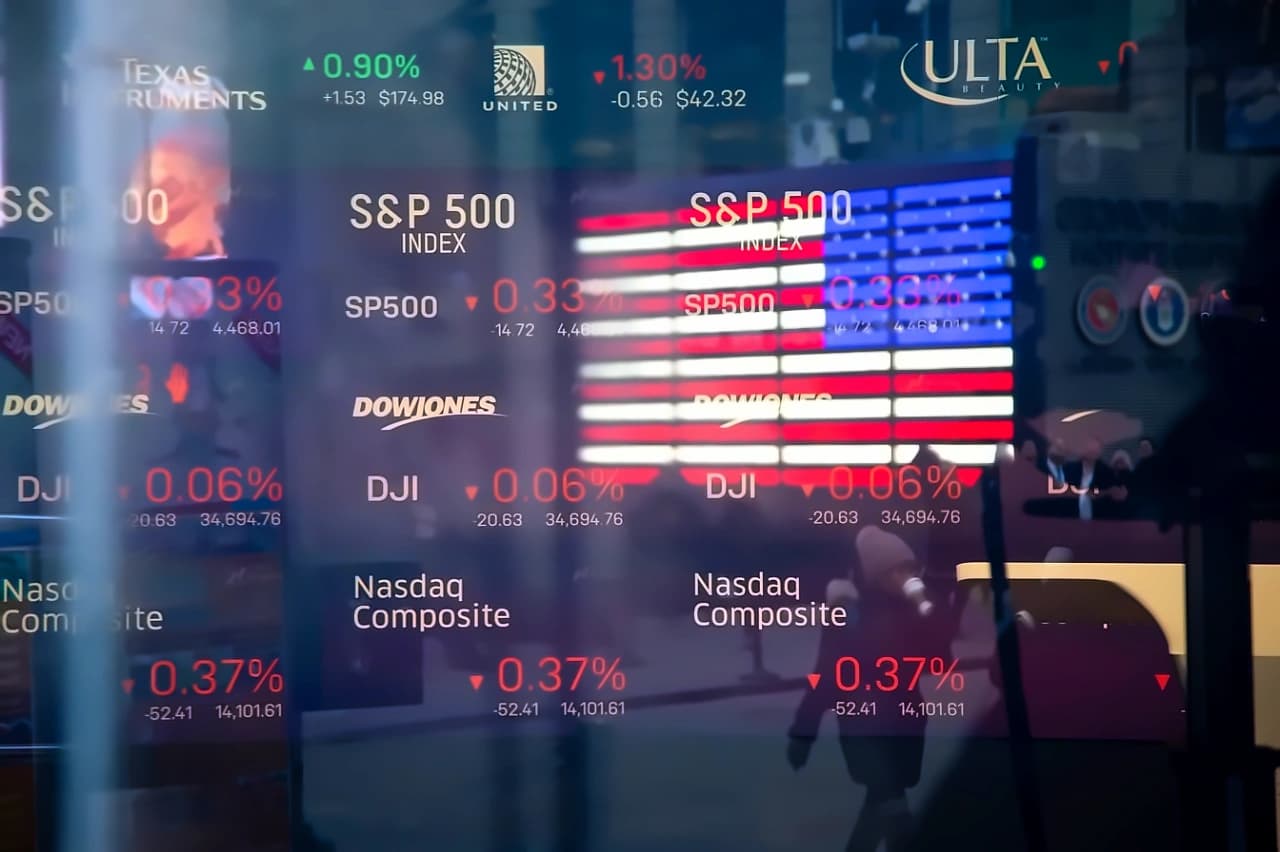
Wall Street opened on a strong footing on Monday, with US stocks trading near record levels as easing oil prices and optimism over progress in US-Iran talks helped support investor sentiment. According to reports from The Times of India, the S&P 500 edged up 0.1%, remaining within 1.3% of the all-time high it touched earlier this month, while the Dow Jones Industrial Average rose 220 points, or 0.4%, and the Nasdaq Composite slipped 0.2% in early trade. The recovery came after markets retreated on expectations that the US Federal Reserve could still raise interest rates later this year to tackle persistent inflation. As per CNBC TV18, markets were also subject to their quarterly "Triple Witching" phenomenon on Thursday, where notional options worth $7.5 trillion faced expiry. The benchmark S&P 500 advanced 1.1% to notch a 0.9% weekly gain, while the Nasdaq Composite climbed 1.9% to end the week up 2.4%, demonstrating strong momentum despite initial volatility. According to Baystreet.ca, the S&P 500 has risen 0.8% week to date, heading for its 11th winning week in 12, with the Dow also on track for an 0.8% gain for the week, while the NASDAQ has jumped 2%. Every major index notched weekly gains, with the S&P 500 rising 80.48 points to 7,500.58 and the Nasdaq Composite surging 496.28 points to 26,517.93.
Investor sentiment received a significant boost after weekend talks between the United States and Iran, with US Vice President JD Vance saying the discussions had created a "good foundation for a successful final deal". According to The Times of India, the official Memorandum of Understanding between America and Tehran, which was signed late Wednesday night (EST) allows Iran to resume oil exports by waiving US-backed sanctions, while Tehran has agreed to dilute its stockpile of highly enriched uranium during negotiations. This development provides significant relief to markets concerned about geopolitical tensions, with the agreement starting a 60-day negotiating process aimed at reaching a final settlement over Iran's nuclear programme. Markets are closely watching developments in West Asia as a lasting agreement could ensure uninterrupted oil shipments through the Strait of Hormuz, a critical route for global energy supplies. As per CNBC TV18, markets cheered the formal signing of the peace deal, with the focus shifting to the reopening of the Strait of Hormuz and the 60-day negotiating period between the two parties. According to Baystreet.ca, oil prices dropped after Vice President JD Vance said tankers loaded with more than 12 million barrels have moved through the key Strait of Hormuz passageway, following the Washington and Tehran interim agreement to end the war and reopen the Strait of Hormuz.
The US-Iran agreement had an immediate impact on oil markets, with Brent crude oil falling 2.8% to USD 78.34 a barrel, moving closer to the roughly USD 70 level seen before the conflict. According to The Times of India, Brent crude fell $1.19 to $78.36 a barrel, while US benchmark crude dropped $1.56 to $74.45 a barrel. Despite the decline in oil prices, Treasury yields moved higher as investors assessed the possibility that the Federal Reserve may need to raise interest rates later this year to contain inflation. As per CNBC TV18, "Oil is flowing" US President Donald Trump wrote in one of his Truth Social posts on Thursday, with oil prices having given up nearly all the gains it made during the war. Kpler confirmed that three Saudi tankers carrying six million barrels of oil made its way out of the Strait of Hormuz. The decline reflects market optimism about the potential reopening of the Strait of Hormuz, one of the world's most important energy chokepoints. According to BMO Capital Markets analyst Ian Lyngen, "The progress toward releasing oil supply from the Persian Gulf has supported equity prices, lower energy costs have also eased forward inflationary concerns and led to meaningful declines in longer-dated Treasury yields." Prices for crude oil are still above roughly $70 per barrel from before the war, but are well below the $100-plus price from a few weeks ago. Energy companies lost ground, with Exxon Mobil falling 2.1% and Chevron declining 2.2%, while airlines had some of the bigger gains, with American Airlines rising 3.7% and United Airlines up 2.1%.
Despite the positive market sentiment from geopolitical developments, higher bond yields emerged as a concern for equity markets globally, particularly for richly valued technology stocks that have rallied on enthusiasm surrounding artificial intelligence. According to The Times of India, the yield on the benchmark 10-year Treasury note rose to 4.49% from 4.46% on Thursday, reflecting concerns about inflation and the outlook for interest rates. According to CME Group data, traders are now pricing in nearly a 90% probability that the Fed will raise its benchmark rate at least once before the end of the year, up sharply from 57% a week ago. Economists expect a key inflation report due on Thursday to show consumer inflation accelerated to 4.1% in May from 3.8% in April. The technology sector benefited significantly from the semiconductor rally, with nine of the 18 members of the Fed's rate-setting committee signalling support for higher interest rates this year, including six who backed two or more quarter-point increases, though markets are also assessing signals from the Federal Reserve after its latest policy meeting.
Among individual stocks, SpaceX fell 6.1%, extending losses for a third straight session after a strong run following its much-publicised stock market debut. The stock slipped below USD 174 after initially listing at USD 135 per share. However, healthcare major AbbVie gained 4.9% after announcing an agreement to acquire Apogee Therapeutics and its pipeline of treatments for dermatological, respiratory and immune-related diseases. Apogee Therapeutics surged 46.9% following the announcement of the deal, valued at about USD 10.9 billion. Outside the US, Britain's FTSE 100 rose 0.5% after Prime Minister Keir Starmer announced he would step down as Labour Party leader and leave office within weeks. Asian markets extended their rally, with Japan's Nikkei 225 climbing 1.5% to a fresh record high, led by technology stocks benefiting from the artificial intelligence boom, while South Korea's Kospi also gained 0.7% to reach a record level, supported by AI-related companies. According to LPL Financial's chief technical strategist Adam Turnquist, "While investors are welcoming the agreement as a constructive step for geopolitical risk, uncertainty remains elevated around potential flare-ups, the pace of shipping normalization, control of the waterway, the cost of access, and the path forward for Iran's nuclear program."