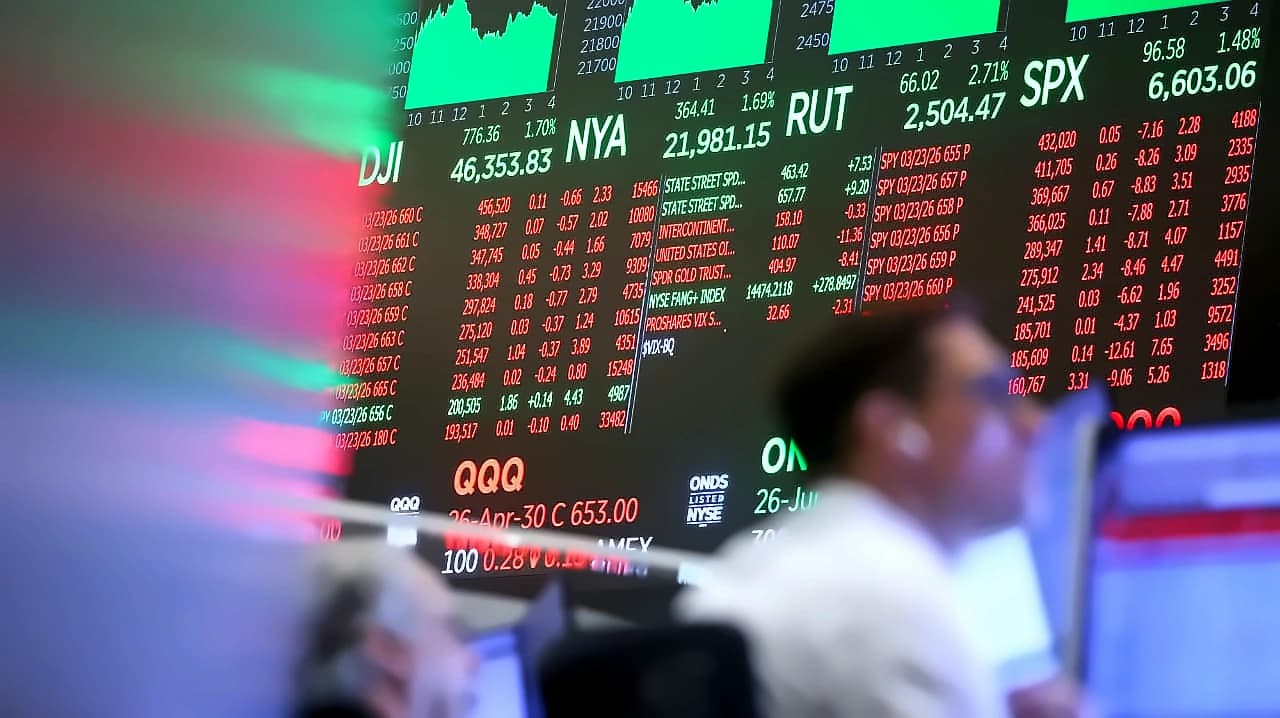
US stocks ended lower on Friday as Federal Reserve Chair Kevin Warsh reinforced the central bank's commitment to bringing inflation back to its 2% target, raising expectations for a possible September rate hike. The S&P 500 lost 19.23 points, or 0.25%, to 7,711.76, Nasdaq Composite dropped 138.93 points, or 0.52%, to 26,402.42. As reported by Reuters, Warsh's first speech at Jackson Hole offered little support to hopes that the Federal Reserve could ease its stance on inflation, instead pushing traders to increase bets on a rate hike next month. Without confidence that inflation was heading clearly and with sufficient speed toward the Fed's 2% goal, the central bank would have "more work to do," Warsh stated, adding that recent inflation data did not point to a change in trend. Mark Hackett, chief market strategist for Nationwide, noted that "Why the market is modestly reacting is he (Warsh) is very adamant that the 2% inflation target is going to remain. He is reiterating the hawkishness, but in a more of a consistent way than an incremental way."
Monday's session was dominated by a tech-led pullback after megacap stocks dragged indexes lower, with Alphabet falling 5% on AI concerns over high-profile exits, Amazon dropping nearly 5%, Meta losing 2.3%, and Microsoft declining 3%. The selloff extended beyond major tech names, with SpaceX plunging 16% for its third straight session and extending its three-day slide to nearly 24% after an initial post-IPO rally. SpaceX also announced a senior unsecured notes offering, while Bloomberg reported that the company is seeking to raise at least $20 billion in investment-grade debt to fund AI ambitions. Palantir Technologies (PLTR) fell nearly 7% on Monday to $119.50, closing at its lowest level in more than a year amid broader software and AI-disruption worries. However, chip stocks offered some relief, with Micron rising nearly 7% ahead of earnings, AMD gaining more than 2% and Intel adding 5%. D-Wave Quantum (QBTS) shares rose 7% overnight, extending the quantum-stock rally sparked by White House executive orders, while Hims & Hers Health (HIMS) snapped a four-session winning streak and ended 5% lower after rival LifeMD announced an exclusive telehealth program. Nvidia shares slipped 4.6%, while Marvell Technology tumbled 10.3% on doubts over the timing of revenue from its AI chip agreement with Alphabet's Google, despite the company raising its 2027 revenue forecast. Most megacap stocks were higher, with Alphabet gaining 1.7% making the S&P 500 communication services sector the biggest boost to the index, and Apple also rising 1.6%.
Stocks slipped midday after Federal Reserve Chairman Kevin Warsh delivered a speech that soothed investor concerns about the central bank's willingness to tackle inflation, while traders bet on a higher likelihood of interest-rate hikes this year. As reported by Reuters, Warsh's remarks came at the end of a week that had already kept markets focused on the outlook for interest rates, with corporate results from Nvidia and Salesforce adding another layer to investor sentiment. "We were encouraged by Warsh's speech. But talk is cheap," Aditya Bhave, head of U.S. economics research at Bank of America, said in a note, according to Reuters. Bhave said Warsh would need to deliver a rate hike in September unless August jobs and inflation data came in very soft, otherwise he said Warsh would probably lose credibility. "There's been somewhat misguided thoughts among investors that this would soften a little bit. Clearly, that's not the case," Bhave noted. Traders are now split between a rate hike and a hold in September, as they were before inflation data this month painted a mixed picture. US bond yields edged higher ahead of Federal Reserve chair Kevin Warsh's appearance at the Jackson Hole Symposium on Friday, with the US 10-year Treasury yield rising 1 basis point to 4.68%, while the two-year yield increased 1 basis point to 4.24%. Mohamed El-Erian flagged the unusual setup of rising bond yields and falling oil prices, citing "expectations for a more hawkish Fed, inflation concerns" and "the prospect of large and growing corporate and government bond issuance." The yield on 10-year Treasuries advanced five basis points to 4.73%, reflecting the market's response to Warsh's hawkish stance. Fed Chairman Warsh noted that additional monetary policy steps may be needed if inflation does not fall to the target level, reinforcing the central bank's commitment to its inflation target.
The University of Michigan's final consumer sentiment reading stood at 51.7, compared with the 51 estimate from economists polled by Reuters, adding another data point for investors weighing the outlook for the economy and Fed policy. Tuesday's catalysts include flash PMIs, Richmond Fed data, ADP weekly employment, Treasury bill and 2-year note auctions, and May money supply. Tuesday's catalysts include flash PMIs, Richmond Fed data, ADP weekly employment, Treasury bill and 2-year note auctions, and May money supply. US consumer sentiment fell in August on a worsening economic outlook, according to the University of Michigan's survey, as reported by Bloomberg. Oil fell after U.S.-Iran talks in Switzerland produced a roadmap toward a final deal within 60 days, with Brent crude settling 3.31% lower at $77.90 a barrel and WTI falling 2.32% to $74.82. However, Iran said the Strait of Hormuz "will never return to its previous state before the war," while Tehran also pushed back on new nuclear commitments, saying it "has not accepted any new commitments." Vice President JD Vance said the talks made "a lot of good progress" and had laid "a very good foundation for a successful final deal."
As earnings season draws to a close, S&P 500 firms have managed to grow their earnings by nearly 32% year-over-year, according to Bloomberg Intelligence data. Kevin Gordon, head of macro research and strategy at Schwab Center for Financial Research, questioned the view that AI is automatically deflationary, noting that CPI software prices have "clearly broken out" over the past six months and increased at a "59% annualized pace." On Stocktwits, retail sentiment toward the SPDR S&P 500 ETF Trust (SPY) and the Invesco QQQ Trust (QQQ) was 'neutral' amid 'normal' message volume, while sentiment toward the SPDR Dow Jones Industrial Average ETF Trust (DIA) was 'bullish' amid 'normal' message volume. Infleqtion (INFQ) shares jumped 13% overnight after U.S. President Donald Trump signed two executive orders to fast-track U.S. quantum development, including a goal to build a scientific quantum computer by 2028. For the week, the S&P 500 gained 0.49%, the Nasdaq rose 0.85%, and the Dow climbed 0.53%. In Asia, Japan, Hong Kong and Australia were all close to the flatline in early trade, while MSCI's gauge of regional shares fell 0.7%. Australian shares are poised for a modest rebound on Friday after technology stocks lifted Wall Street, though renewed interest rate concerns are likely to remain a key influence on sentiment.