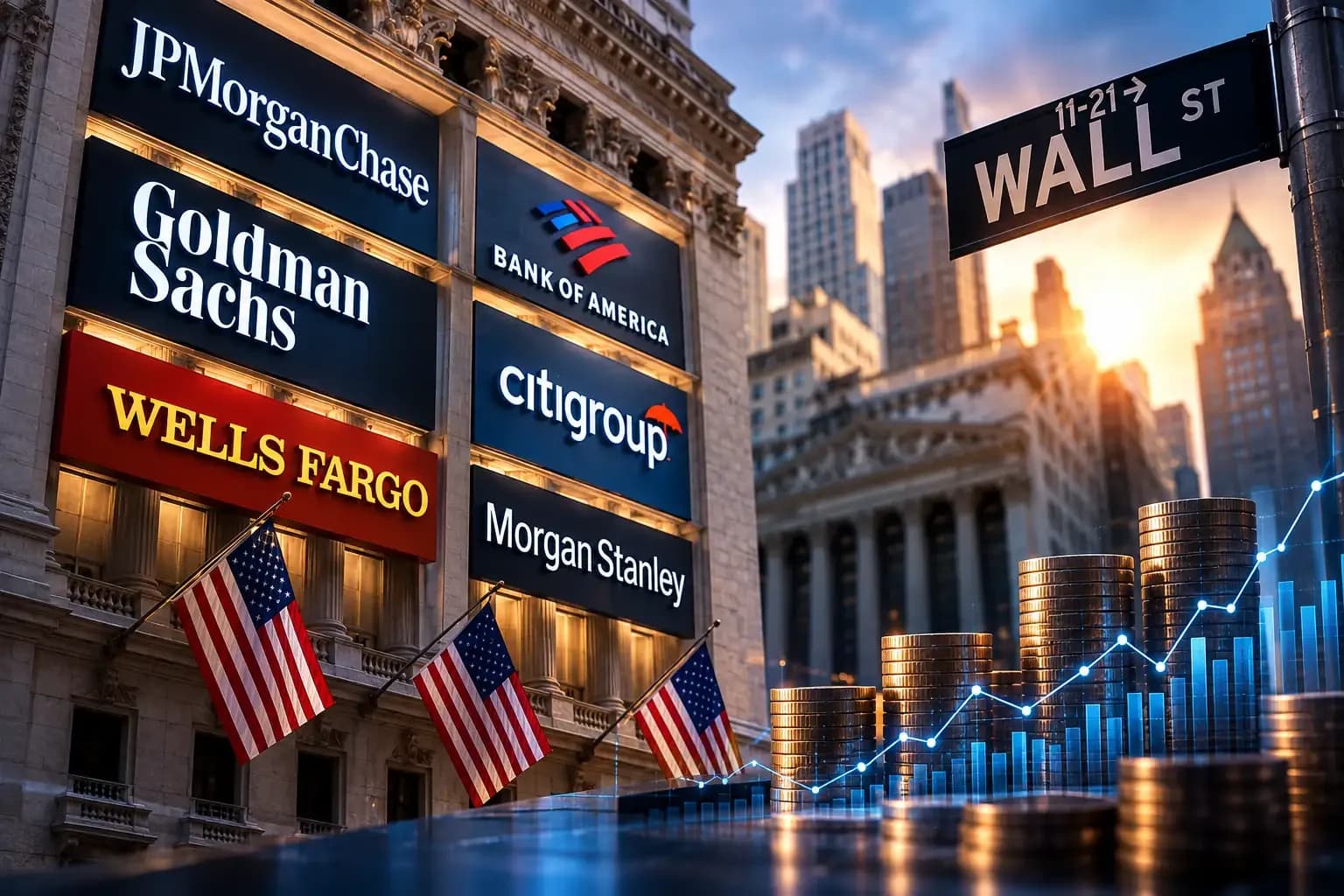
JPMorgan Chase traders have shifted to a "tactically cautious" stance on US stocks for the next few weeks, following Federal Reserve Chairman Kevin Warsh's hawkish comments that strengthened expectations for interest-rate hikes this year. As reported by Bloomberg, traders led by Andrew Tyler, head of US market intelligence, moved away from their bullish view ahead of the Fed's Sept. 16 policy decision, citing uncertainty over the interest-rate outlook. "We are moving to a tactically cautious / neutral view, which is to say that equity-market fundamentals remain strong, but that near-term variables are likely to cause markets to chop sideways," Tyler wrote. Despite near-term risks, JPMorgan expects the broader market backdrop to remain supportive, helped by economic data and corporate earnings. The US 10-year Treasury yield rose above 4.75% on Monday for the first time since January 2025, with swaps now implying nearly a 70% probability of a quarter-point Fed rate hike next month.
Wall Street analysts have overwhelmingly interpreted Federal Reserve Chair Kevin Warsh's Jackson Hole speech as decidedly hawkish, with major financial institutions reinforcing the hawkish interpretation. Deutsche Bank called the speech "a little surprising" and said it "lean[ed] in a decidedly hawkish direction," while Nomura noted "the sensitivity to near-term inflation data is high" and that Warsh was "implying policy may need to react if disinflation is not occurring with speed." Wells Fargo's Gary Schlossberg was very direct in his interpretation, stating "He's telling the market, do not expect cuts any time until we have this thing (inflation) completely under control and do prepare yourself for hikes." The market's verdict matches the yield curve flattening observation, with Cyrus Amini of Hyphen Wealth Management confirming "the short end of the yield curve rose while the long end moved down," calling it "consistent with a Fed hike." CNBC noted the speech "puts Warsh more clearly at odds with Trump's demand for lower rates," highlighting the political dimension of the central bank's stance.
The monthly U.S. employment report, due on September 4, will be a focal point for investors as it could influence Federal Reserve interest rate strategies. According to The Economic Times, employment for August was expected to have climbed by 58,000 jobs, with the unemployment rate at 4.1%, according to a Reuters poll. However, July's nonfarm payrolls showed a drop of -23,000 jobs with more than -100,000 in downward revisions, leaving market participants trimming expectations for a rate hike in September. Market strategist Amanda Agati noted that the last jobs report gave the market and investors pause, though she doubts there was a breakdown in the labor market. "The last jobs report gave the market and investors a little bit of pause," Agati said, adding she would be looking for "either confirmation of that trend that we saw in the last report, or maybe a bounce back to prior months." Worker pay was virtually flat over the month with the 12-month increase in average hourly earnings sliding to +3.2%, the lowest since May 2021. The Fed itself notes that "employment growth in any given month is almost as likely to be negative as it is to be positive" and that "it would not be unusual for there to be one or more months in 2026 with declines in total payroll employment as large as -100,000 jobs," even if economic output was growing at potential output growth rates.

The S&P 500 posted a weekly gain, putting the benchmark index slightly more than 1% away from its August 13 all-time high. With August coming to a close, the S&P 500 was last up more than 12% for the year, driven by strong corporate profit growth fueled by massive spending on AI infrastructure buildout. The Cboe Volatility Index hovered near its low point for the year, and daily market trading volume this week was well below its 2026 average, indicating relatively calm markets as summer ends. Strong corporate earnings have been a key driver, with S&P 500 second-quarter earnings on pace to have climbed 34.5% from a year earlier on an adjusted basis, according to LSEG IBES data. S&P 500 forward earnings per share rose to yet another record high last week at $396.05, with projections converging to match analysts' consensus 2027 earnings estimate of $412.46. Market strategist Michael Reynolds noted that the reporting season has demonstrated "really robust core earnings power," which could be constructive for what the rest of the year looks like. The S&P 500 has been volatile this year, with the war in the Middle East during March depressing stock prices as oil prices soared, followed by de-escalation lifting prices this spring. Despite the recent rally in the Magnificent-7 ETF, it still lags the Impressive-493 ETF since the start of this year, as investors suffer from AI fatigue and move into stocks of companies they understand.
Broadcom's quarterly results are anticipated right after Nvidia's stellar performance, which boosted sentiment for stocks that had been dented earlier in the month by rising Treasury yields. As reported by The Economic Times, Nvidia forecast a whopping 70% jump in revenue for its next fiscal year, a rare disclosure for the AI bellwether. Q2 revenues rose 48% year-on-year to $22.2 billion while AI semiconductor revenue grew at a staggering +143% to $10.8 billion. Management has guided Q3 revenue of around $29.4 billion, which would see growth reaccelerating to more than 80% YoY, with AI semiconductor revenue growth picking up the pace to more than double. Other tech company reports are due next week from Dell Technologies, Palo Alto Networks, Hewlett Packard Enterprise, and Snowflake. Market strategist Matt Stucky noted that "We're just wondering whether or not Broadcom offers the same type of visibility" as Nvidia's forecast, adding that "Continuing that momentum into September we think is something that's really noteworthy to watch." Global technology sentiment is likely to remain relevant for Indian IT stocks after Nvidia's strong results and upbeat guidance reinforced optimism around sustained AI investment, with upcoming earnings from Broadcom and Micron potentially influencing sectoral rotation.
Central bank decisions from Canada and New Zealand will be in focus this week. The Reserve Bank of New Zealand is likely to raise rates by 2bps to 2.75% at its meeting, with projections expected to show a 3% level for its benchmark OCR rate by the end of the year. In contrast, the Bank of Canada is expected to stand pat on rates after the collapse of trade talks with the US leading to a fresh round of tariffs. Canada and New Zealand have interest rate decisions in focus alongside global economic data including Japan's preliminary industrial production and retail sales figures, China's manufacturing and non-manufacturing PMIs, and Germany's preliminary CPI inflation data. The Eurozone CPI inflation will be watched ahead of an expected rate hike later this month by the European Central Bank, with flash estimates for August showing inflation ticking up to 2.9% from 2.8% in June. Other economic data in the coming week included reports on manufacturing and services sector activity, with the prior monthly reading from the Institute for Supply Management showing U.S. manufacturing activity increased to the highest level in more than four years. Crude oil prices will remain a key market driver this week, with developments around the Strait of Hormuz likely to influence geopolitical risk premium, as oil prices fell more than 5% last week, with Brent crude settling at $89.31 a barrel.