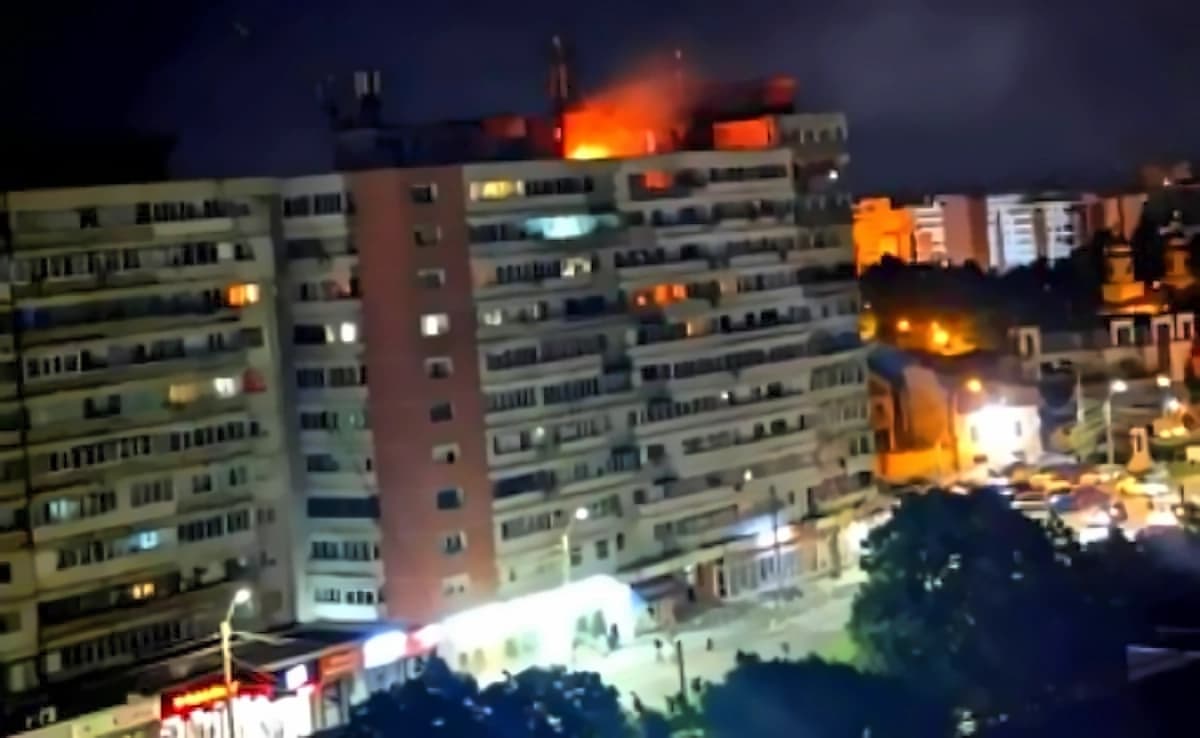
A Russian drone crashed into a residential apartment building in the eastern Romanian city of Galati, causing a fire and injuring two people with minor injuries. According to Romania's defence ministry, the drone's entire explosive payload detonated on the 10th floor of the residential building, requiring evacuation of approximately 70 people as the fire was extinguished. Photos from the scene showed charred and damaged brickwork on the roof of the 10-storey apartment block, which Romanian authorities said was hit by a drone that exploded on impact, tearing through a top-floor flat. This marks the first time a densely populated area in a NATO country has been hit causing injuries during Russia's war in Ukraine, representing a significant escalation as no one has previously been hurt in any of the drone incidents in which many landed in remote areas since the war started in 2022. General Gheorghe Maxim, a stand-in commander for the Romanian armed forces' joint staff, told a news conference that the strike in Galati wasn't "an attack from Russia against Romania," but "Romanians should understand that Russia is a threat to the security of the countries in the area."
Romanian defence systems had earlier detected the drone's intrusion near the northern border with Ukraine, with Brigadier General Gheorghe Maxim revealing that Romanian forces had only four minutes from detection to impact. The drone was in Romanian airspace for four minutes and flew at a low altitude for 10 km (6.2 miles), making it difficult for radar to detect, according to General Maxim. The Romanian Defence Ministry confirmed that two F-16 fighter jets were scrambled after the drones were detected, with a military helicopter sent to monitor the attack, with pilots authorized to shoot down any drones without endangering inhabited areas. However, the aircraft didn't engage or shoot at the drone to bring it down, with alert messages sent to residents of the affected areas. The incident marks the first reported direct impact of the ongoing Russia-Ukraine conflict on NATO territory and represents a significant escalation in airspace violations, with Russian drones having breached Romania's airspace 28 times since Moscow began attacking Ukrainian ports across the Danube River following its full-scale invasion of Ukraine in 2022.
The drone entered Romanian airspace during a wave of Russian strikes targeting Ukrainian port infrastructure near the Danube River, particularly around the strategically important port of Izmail. Ukrainian forces shot down 217 drones overnight on Friday, according to the country's air force, while Russia attacked with 232 drones and one ballistic missile, with strikes recorded in 14 areas. Ukrainian President Volodymyr Zelenskyy expressed support for Romania during a phone call with President Dan, stating they would 'be in constant communication with Romania and will continue to work together to protect life from all potential Russian threats.' Ukrainian President Volodymyr Zelenskiy said Kyiv was ready to support Romania 'in whatever way is necessary' as local authorities in southern Ukraine reported that Izmail port in the Odesa region had come under attack from drones early on Friday. Ukraine's Foreign Minister Andriy Sybiha said the incident 'proved once again that Russian aggression poses a real threat to the Black Sea region' and urged other countries to strengthen support for Ukraine. NATO Secretary-General Mark Rutte emphasized that 'NATO stands ready to defend every inch of allied territory' and will continue enhancing readiness to deter and defend against drone threats.
President Dan announced that Romania will expel the Russian consul in the Black Sea port of Constanța and shut down the consulate, with Moscow saying it 'won't take long' to respond. Russian Foreign Ministry spokeswoman Maria Zakharova said all accusations about Russian drones flying in Europe were unsubstantiated, while Russian Deputy Chair Dmitry Medvedev warned European leaders that drones would continue to stray into their countries and prevent their populations from sleeping peacefully. Finnish President Alexander Stubb condemned the drone strike, writing that 'Russia is crossing another line in its war of aggression against Ukraine.' European Commission President Ursula von der Leyen criticized the incident, stating that 'Russia's war of aggression has crossed yet another line' and that the EU will continue strengthening security along its eastern border. Estonian Foreign Minister Margus Tsahkna said the risk of such "serious incidents" was raised by 'Putin's increasing nervousness, driven by military setbacks.' US Ambassador to NATO Matthew Whitaker condemned the 'reckless incursion' and pledged the 'U.S. will defend every inch of NATO territory.'
In response to the latest incursion, Romanian President Nicușor Dan convened the country's Supreme Defence Council and requested 'measures to accelerate the transfer of anti-drone capabilities to Romania' from NATO. The country's foreign ministry said Bucharest had requested 'faster transfer of anti-drone capabilities' from NATO to enhance its defense readiness. NATO Secretary-General Mark Rutte expressed the organization's 'absolute solidarity' with Romania, telling President Dan that 'we will continue to enhance our readiness to deter and defend against any threat, including from drones.' Romania has remained cautious in downing errant drones but has adopted legislation allowing the army to shoot down drones entering its airspace as a last resort. A NATO spokesperson said on Friday that 'potential additional defensive measures are considered' as Romania has asked NATO allies to deploy additional anti-drone capabilities, with official sources saying Bucharest needs low-altitude radars and interceptor drones. Since the war started nearly 4 years ago, Poland, Croatia, Romania and non-NATO member Moldova have reported airspace violations and found drone fragments on their territory, prompting questions about the state of air defences on NATO's eastern flank.