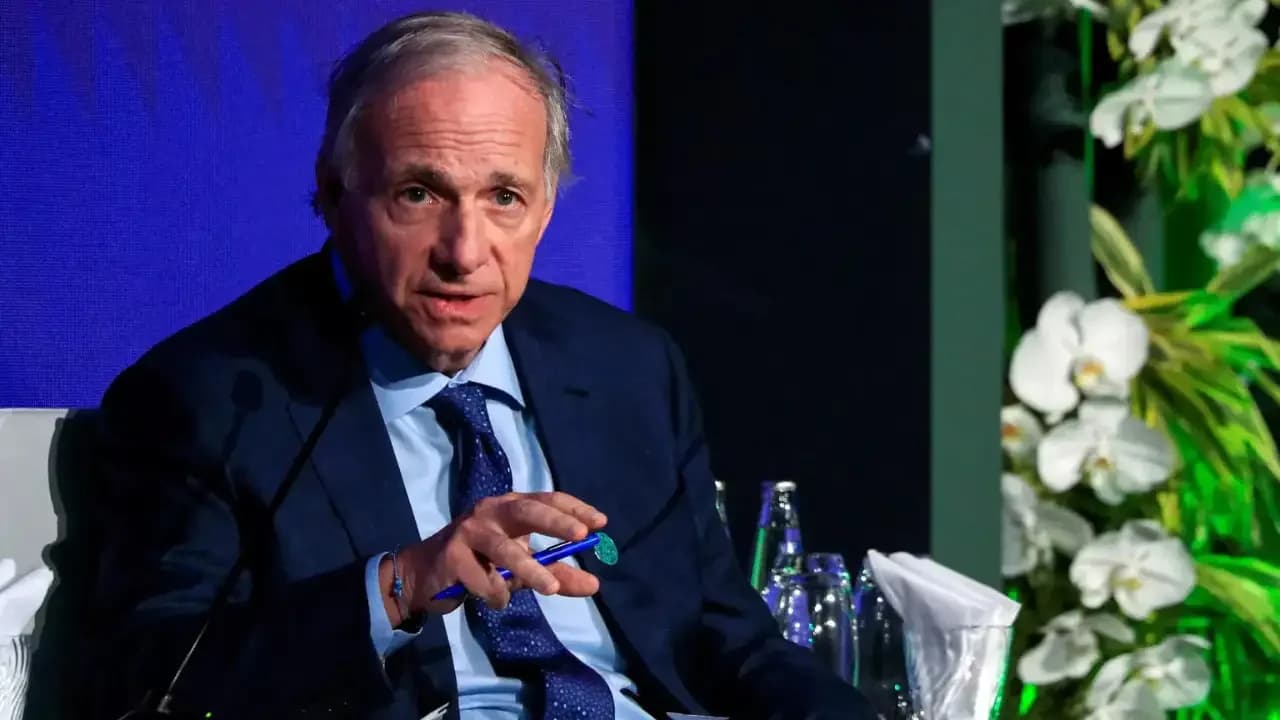
Ray Dalio, founder of Bridgewater Associates, has issued a stark warning about the current AI-driven market rally, comparing it to the speculative bubbles that preceded the 1929 crash and dot-com bust in 2000. During his appearance on The Diary of a CEO with Steven Bartlett, Dalio agreed with investor Jeremy Grantham's assessment that markets are facing 'the biggest investment bubble in American history'. As reported by The Economic Times, Dalio made these comments while emphasizing that 'wealth is not the same as money' - noting that while people are getting wealthy, they can't spend the wealth without selling it for actual money. When asked directly about bubble signs, Dalio responded 'Yeah. Yeah. Yeah. Classic signs that we're in [one].'
Dalio identified two primary forces that typically 'prick' a bubble: rising interest rates that make debt more expensive to service, and a surge in stock issuance as companies rush to capitalize on investor enthusiasm. According to The Economic Times, he provided a real-time example: 'A friend running an AI company told him he was raising hundreds of millions of dollars specifically because he expected a downturn—money he plans to use to buy struggling competitors once the market turns.' The billionaire investor noted that investor excitement around AI has pushed valuations higher, while companies linked to the theme are attracting large amounts of capital. These dynamics mirror patterns seen during earlier speculative periods when markets became vulnerable to excessive optimism. Dalio also cautioned that rapid equity issuance is one of the strongest factors behind a bubble, explaining that companies can raise relatively small amounts of capital while being assigned billion-dollar valuations, creating significant paper wealth without corresponding cash generation.
According to The Economic Times, SpaceX has completed what was described as the largest IPO ever, but its performance since listing has raised significant concerns. Since listing in June, the company has lost more than $500 billion in market value, posting four straight weekly losses and trading more than 50% below its intraday high. The stock recently closed at $108.37, below its IPO price, despite maintaining a market value of about $1.4 trillion. S&P projects negative free cash flow through 2029, while Moody's flags Elon Musk's concentrated voting power as a governance risk. Anthropic has confidentially filed for a listing expected as early as October, targeting close to $1 trillion, while OpenAI has filed separately and is targeting a debut some analysts peg above $1 trillion, though the timeline has slipped from late 2026 toward 2027 amid 'shifting market dynamics'.
As reported by The Economic Times, other major AI-linked companies are also moving toward public markets, with Anthropic and OpenAI reportedly moving toward valuations near or above $1 trillion. Dalio's comments add to a growing debate about whether the AI trade has moved too far, too fast. Goldman Sachs argued on Aug. 3 that 'there does not appear to be a valuation bubble...there may be an earnings bubble' in technology, while BCA Research's Peter Berezin has been arguing for months that the AI trade is 'primarily an earnings bubble rather than a valuation bubble'. Patterns from July 26-31 week showed Microsoft and Amazon rising 18% and 10% on strong capex credibility, while Alphabet fell 4% and Meta nearly 10%, despite all posting strong earnings - a sign investors are no longer rewarding spending simply for existing. This debate mirrors historical market cycles where investors were willing to pay very high prices for fast-growing companies during speculative periods.
According to The Economic Times, Dalio's warning aligns with concerns from other prominent market observers. Grantham has a long record of calling major market excesses, including the Japanese asset bubble, the dot-com bubble and the US housing bubble before the 2008 financial crisis. Grantham's January 2026 paper with financial historian Edward Chancellor found the market's price/book ratio and cyclically adjusted earnings multiples at extremes surpassed only in 1929, 1972, 1999–2000, and 2021 - each followed by a devastating correction. These experts' warnings suggest a broader consensus about potential market vulnerabilities in the current AI-driven investment environment. Dalio warned that when a bubble bursts, 'you have people at each other's throats', citing the U.K.'s six prime ministers in seven years as a symptom of governments lacking money and voters turning on each other over how to raise it. He also noted that bubbles are typically punctured by two factors—higher interest rates that increase borrowing costs and a wave of stock issuance as companies seek to capitalise on strong investor sentiment.