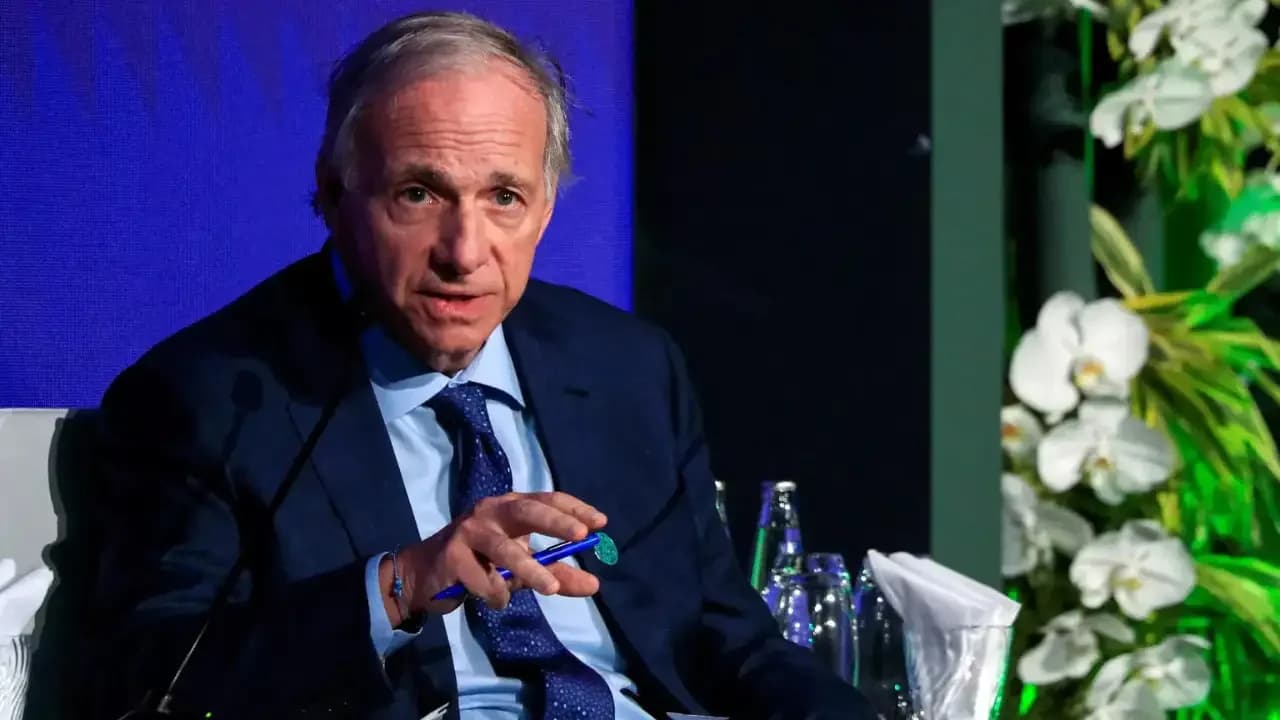
According to reports from Bloomberg, Ray Dalio warns the AI bubble will burst when investors sell paper wealth to raise cash for debts and taxes, not because the technology fails. The Bridgewater founder argues that liquidity demands, not earnings or technology, decide when a bubble finally cracks. In his latest television interview, Dalio emphasizes that the AI-driven market is "on such a path right now, although it is indeed a remarkable technology." He summarizes the mechanism as "the conversion of wealth into cash" - when asset holders need money, they are forced to sell off some assets to cash out, which triggers the decline. In his latest Investopedia Express interview, Dalio warns of "shocking developments" in the U.S. economy in the mid-2020s, comparing today's market environment to the dot-com tech bubble. He notes that current market conditions resemble the dot-com tech bubble, with the distinction that the leaders are not pre-revenue startups but established companies. "All great technology changes produce bubbles," Dalio stated, adding that "Nobody can get it exactly right. You have to either spend a ton of money to capture your market share and don't worry about whether it's too much or not, or you don't spend enough money and you lose your market share."
As reported by Bloomberg, Bridgewater estimates Alphabet, Amazon, Meta, and Microsoft could invest about $650 billion in AI infrastructure during 2026, marking a sharp jump from roughly $410 billion in 2025. This massive spending scale highlights the gap between AI firms' ability to mint trillions in valuations without holding the money to back them. According to Bloomberg, Dalio said major technology changes usually create bubbles because investors struggle to value the opportunity correctly, with companies often spending heavily to win market share even before the final winners are clear. The current AI cycle is harder to dismiss than earlier speculative booms because the leaders are not pre-revenue startups, but that strength also creates central tension - the companies most able to finance AI are also the companies whose market values carry the most index weight. As reported by Bloomberg, Nvidia, the clearest financial beneficiary of the buildout, reported fiscal first-quarter revenue of $81.6 billion for the period ended April 26, 2026, up 85% from a year earlier, with data center revenue reaching $75.2 billion, up 92% year over year. Despite these strong fundamentals, the rally has been so fast that investors are now debating whether AI stocks have gotten too expensive. According to Bloomberg, the rally has also sparked debate over whether valuations have become disconnected from underlying earnings potential, with companies racing to dominate the AI landscape facing difficult choices between spending aggressively for market leadership or risking losing ground to rivals. Chipmakers have been the hottest stocks on Wall Street, driven by demand for high-bandwidth chips used in AI data centers and taking the market to record heights, though this surge has set off concerns about overheated market conditions.

According to Bloomberg reports, Dalio ties the AI bubble risk to stretched government balance sheets, noting that the United States spends about $7 trillion against only $5 trillion in revenue, forcing more debt into an already strained bond market. He points to bond market stress as a parallel pressure, with long rates rising relative to short rates often signaling trouble. Dalio links these dynamics to a possible world order breakdown and rising structural inflation risk, with his bubble indicators now sitting near levels last seen in 2000 and 1929. The distinction between wealth and money matters far beyond AI stocks, reaching every risk asset from equities to crypto, where Dalio still favors digital gold Bitcoin over cash. "The pricking is the converting of wealth into money," Dalio explained, noting that "markets eventually move beyond future potential and focus on whether businesses can turn spending into earnings and cash flows."
As reported by Bloomberg, Dalio also pointed to a sensitive political window after the midterm elections and before the next presidential vote, warning that tax debates during that period could pressure wealthy investors if policymakers push for changes that require asset sales. He also identified outside shocks as potential accelerators of a downturn, specifically warning that any halt in chip exports from Taiwan would hit AI stocks hard because many AI companies depend on advanced semiconductor supply. These political and geopolitical factors add layers of complexity to the AI bubble scenario, creating multiple potential triggers for a market correction beyond just liquidity pressures. Dalio also warned that any halt in chip exports from Taiwan would hit AI stocks hard because many AI companies depend on advanced semiconductor supply, highlighting the vulnerability of the AI ecosystem to geopolitical disruptions.
In his latest Investopedia Express interview, Dalio offers surprising advice for investors preparing for market downturns rather than advocating panic selling. His approach centers on "15 good uncorrelated return streams, risk-balanced," which he calls the "holy grail of investing" - allowing investors to "maintain the same return as any one of those investments with [an] 80% reduction in risk." He tells newer investors to approach markets "with great humility" and view losses as "valuable learning opportunities." Dalio's "all-weather" system accounts for four fundamental scenarios: stocks excel when growth is rising, long-term government bonds perform best during falling growth, inflation-linked bonds like TIPS shine when inflation rises unexpectedly, and commodities often thrive in inflationary environments. The SPDR Bridgewater All Weather ETF (ALLW) began trading in March 2025, applying this diversified approach. Dalio emphasizes that "the risk of being wrong is the problem, and the world is filled with surprises," making portfolio construction more important than picking individual investments.