Oil prices extended gains as Brent crude futures rose to more than $93 a barrel, up from less than $72 early this month, according to Business Standard. The gains came after oil settled at a five-week high on Tuesday in the wake of US forces striking targets in southern and western Iran, while Iran attacked US facilities in Bahrain, Kuwait and Jordan. The US military announced Wednesday that it was conducting a 12th night of strikes against Iran as both sides increasingly targeted civilian infrastructure. US Central Command said the attacks were designed to "further degrade Iran's ability to threaten civilian mariners and commercial vessels transiting regional waters," as the Americans push to regain control over the Strait of Hormuz and restore the flow of international shipping. President Donald Trump warned earlier Wednesday that the US would destroy one bridge or power plant each time Iran shoots at a ship in the strait, writing on social media: "From this point forward, any time the Islamic Republic of Iran shoots at a ship in the Strait of Hormuz, whether it be by Missile, Rocket, Drone, or any other device or weapon, the United States will bomb and destroy ONE BRIDGE OR POWER PLANT."
US stocks experienced a significant rally on Monday, with the S&P 500 rising 0.63% and the Nasdaq climbing 1.02% as hopes for a 10-day US-Iran ceasefire emerged. According to Reuters, the total gain was estimated at roughly $550 billion, with tech stocks leading the advance. The rally came as mediators proposed a pause to revive the Islamabad Memorandum, the peace deal Pakistan and Qatar brokered in June, with Donald Trump and Iranian President Masoud Pezeshkian signing it remotely on June 17. However, the truce had collapsed in July when strikes resumed, making this latest proposal particularly significant for market sentiment. A senior Iranian official confirmed to Reuters on Monday that mediators have passed Iran a proposal to de-escalate the war with the U.S., suggesting a 10-day ceasefire to find ways to revive an interim deal reached last month. Iranian Foreign Ministry spokesperson Esmaeil Baghaei confirmed that mediators have been actively relaying messages from Washington, stating at a press conference in Tehran that "We have been informed by mediators. We have received messages, without going into details, but the main point is that the diplomatic apparatus has been active in recent days and ideas have been conveyed to us by certain mediators."
Yemen's Iran-aligned Houthis have added to supply disruption concerns by threatening to target vessels carrying Saudi oil through the Bab el-Mandeb Strait and announcing a naval blockade of Saudi Arabia, as reported by The Economic Times. The Bab el-Mandeb, located at the southern entrance to the Red Sea, has become an increasingly important route for Saudi crude exports as traffic through the Strait of Hormuz has dropped sharply since a ceasefire between the U.S. and Iran broke down earlier this month. Three oil tankers loaded with Saudi crude for China and India made U-turns in the Red Sea on Tuesday, heading towards the Suez Canal rather than braving the Yemeni coast following a warning from Yemen's Iran-aligned Houthi militia, according to Business Standard. ING commodity strategists noted that "This would force tankers to enter and exit the Red Sea via the Suez Canal, adding significant time and expense to voyages to Asia." Saudi Arabia has ramped up exports from Yanbu, its key Red Sea export hub, and roughly 2.5 million barrels a day are at risk from Houthi attacks, according to Rystad Energy. A news agency in Yemen that is run by the Houthis, SABA, said Tuesday that six ships in the Red Sea were forced to reroute after they received warnings from the rebel group, though The Associated Press could not immediately confirm the claim. Three Houthi officials said the group warned international shipping companies on Monday to avoid transiting through the Bab el-Mandeb Strait, with the officials speaking on condition of anonymity as they weren't authorized to speak to journalists.
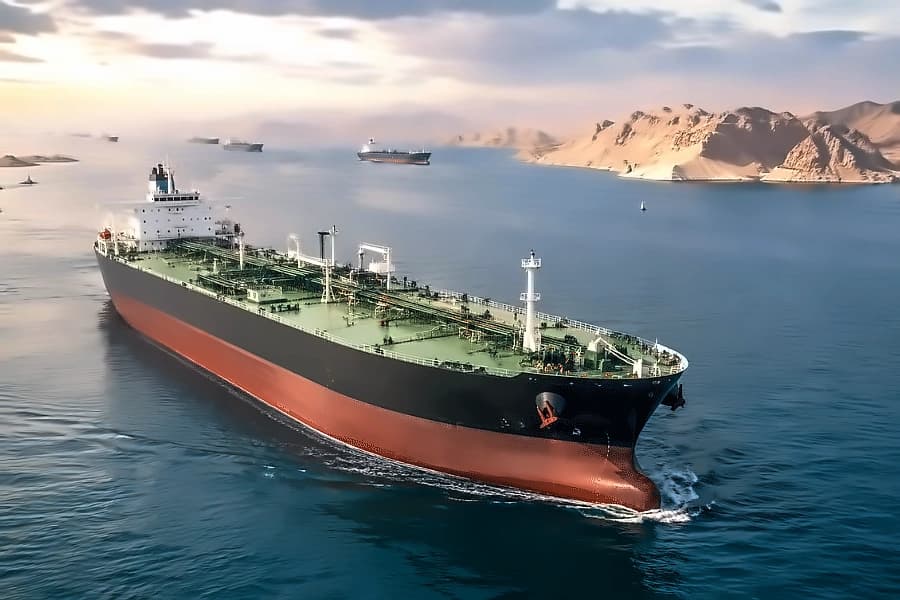
The Middle East conflict has significantly impacted shipping through the Strait of Hormuz, with visible traffic coming to a near standstill on Monday following Iranian attacks on vessels over the weekend. An oil supertanker called the Acheloos and a smaller fuel tanker were both struck in the waterway, according to Dynacom Tankers Management Ltd., the ships' manager. At least three oil products tankers and one very large crude carrier have entered the strait since Friday to load oil, showing the continued flow despite escalating tensions. Greek shipping company Dynacom Tankers reported that two of its managed vessels were hit by projectiles of unknown origin on Monday while sailing off the coast of Oman. A tanker in the Strait of Hormuz reported being struck by an unknown projectile, forcing its crew to abandon ship and board a lifeboat, the United Kingdom Maritime Trade Operations agency said on Tuesday as vessel crossings dropped further. ANZ analysts noted that "The supply narrative has become more bearish. The anticipated recovery in shipping has effectively stalled, with Strait of Hormuz transit volumes falling to single digits." To enforce the blockade in the strait, as of Tuesday US forces have redirected eight commercial vessels and disabled one, CENTCOM said, with the route close to Oman's shores being the one the US military has encouraged ships to travel to avoid Iran's control. US Central Command reported that its forces successfully completed the 12th consecutive evening of strikes against Iran at 8.15 pm ET on July 21, targeting Iranian military operations centres, maritime capabilities, aircraft hangars, drone storage facilities, and military logistics infrastructure. Iran has responded to US attacks by targeting energy infrastructure and desalination plants that provide drinking water in parched neighbouring Gulf countries, with Iranian state media reporting that US missiles struck locations late Wednesday near the cities of Ahvaz, Ramshir and Andimeshk in western Iran.
Beyond the Middle East, another supply risk emerged after the Caspian Pipeline Consortium suspended receiving oil from Kazakhstan following attacks on oil tankers at its Black Sea terminal. The Caspian Pipeline Consortium has stopped receiving oil from Kazakhstan after suspending loadings on Monday due to attacks on oil tankers at its Black Sea terminal blamed on Ukrainian drones, as reported by Business Standard. Russia blamed Ukraine for the attacks, while Ukraine did not comment, as reported by The Times of India. ING analysts noted that "The longer the suspension drags on, the greater the likelihood that Kazakhstan will be forced to curb upstream production." Separately, data from the American Petroleum Institute showed that US crude and distillate inventories rose last week, while gasoline stockpiles fell, market sources said, with the inventory data coming ahead of official figures from the US Energy Information Administration on Wednesday. Markets are now looking ahead to US inventory data for fresh direction, with analysts expecting crude stockpiles to have fallen by 0.5 million barrels in the week ended July 17. If confirmed, it would mark a second straight weekly decline, with the comparable week last year recording a draw of 3.2 million barrels, while the average decline over the past five years was 1.2 million barrels. The impact of the conflict is also being felt beyond energy markets, with a United Nations report released on Tuesday projecting that more than 500 million people could still face chronic hunger by 2030 despite recent improvements, with Africa expected to account for the largest share. International Fund for Agricultural Development (IFAD) President Alvaro Lario warned that prolonged disruptions to shipping and energy supplies could worsen food insecurity, with the expert also warning that if uncertainty continues, including around the Strait of Hormuz, could leave an additional 9 million to 18 million people facing hunger. ING analysts noted that "factoring in the renewed disruptions from the Persian Gulf, risks to Saudi crude exports from the Red Sea, and developments in the Black Sea, one may argue that Brent at just over $91 a barrel is undervalued. Particularly if these disruptions persist into August."