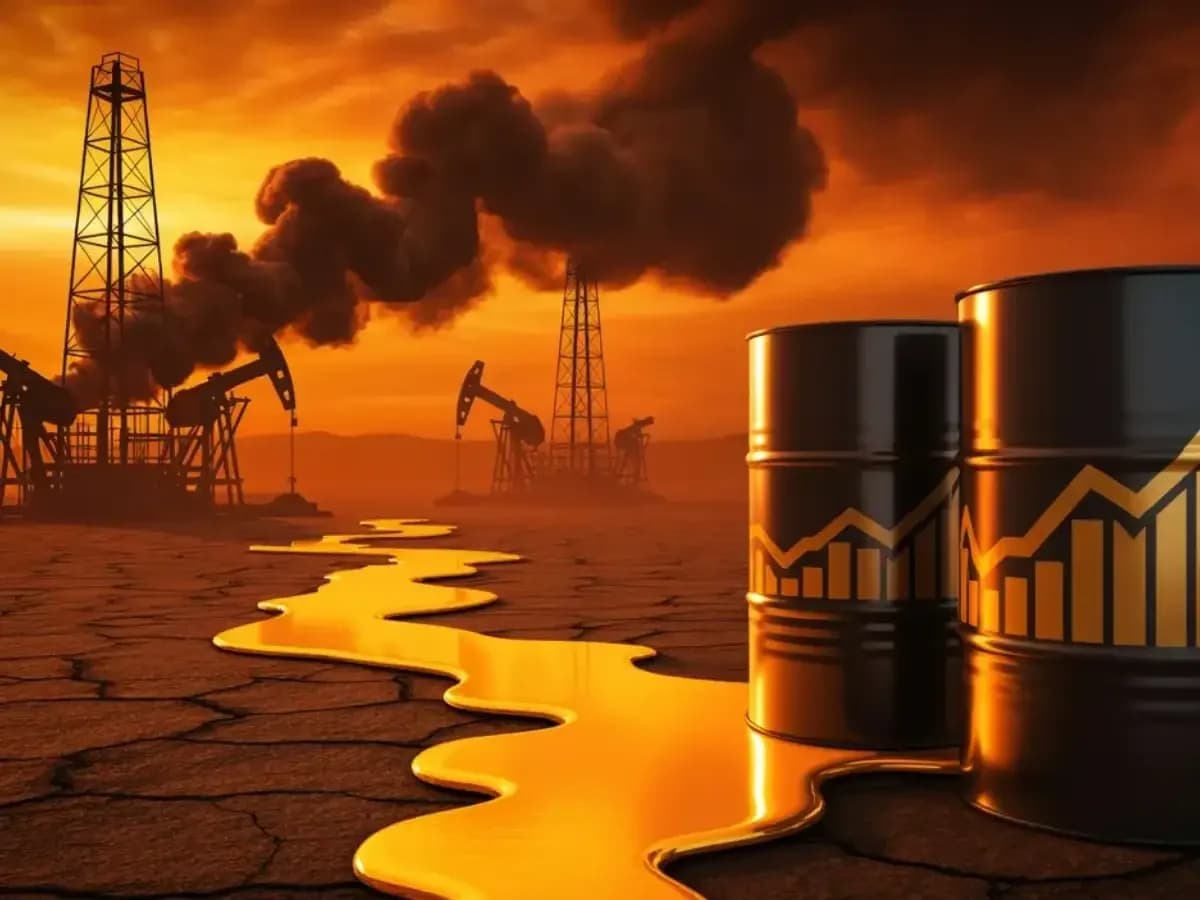
Crude oil prices climbed significantly on Friday, reaching their highest point in over a month as escalating hostilities between the United States and Iran intensified attacks across the Gulf region. Brent crude futures settled $3.87, or 4.59%, higher to $88.10 a barrel, while U.S. West Texas Intermediate futures rose $3.54, or 4.48%, at $82.49, with both benchmarks at their highest since mid-June. For the week, both benchmarks gained about 16%, with Brent on track for a third consecutive weekly gain and WTI set for its second. The latest rally followed a fresh wave of US strikes on Iran, with US Central Command confirming a new wave of strikes against Iran for the seventh consecutive night to further degrade Iranian military capabilities. Both benchmarks gained about 0.3% on Wednesday and were hovering near their one-month highs touched on Tuesday. Crude has surged to its highest in around a month as the escalation in tensions revives concerns over the energy supplies from the region, erasing part of the approximately 30% slump in the second quarter. Brent and US crude are on course to end the week more than 11% higher, marking their strongest weekly performance since April, as reported by The Economic Times.
The US military has intensified its operations against Iranian military targets, with the U.S. striking bridges and an airport in Iran and Tehran hitting a power and desalination plant in Kuwait on Friday, expanding the fighting beyond previous operations. According to The Economic Times, the two foes expanded fighting on Friday, with the U.S. striking bridges and an airport in Iran and Tehran hitting a power and desalination plant in Kuwait. Iran said it launched more strikes on U.S. facilities in the Middle East, including the first direct attack in Syria, after a seventh straight night of U.S. strikes on Iranian military facilities. For the first time since a memorandum of understanding paused fighting last month, the United States launched two big waves of air strikes in a single day on Wednesday, mostly on targets near Iran's southern coast, and kept firing on Thursday. In a statement, U.S. Central Command said U.S. forces began "a new wave of strikes against Iran for the seventh consecutive night to further degrade Iranian military capabilities" at 2 p.m. EDT (1800 GMT) or 9:30 p.m. in Tehran. Iranian missile and drone sites, naval capabilities and coastal defence systems were targeted during the operation, with the strikes aimed at weakening Tehran's ability to threaten commercial shipping through the Strait of Hormuz. The attacks marked another escalation in a conflict that has intensified over recent days, with US forces also striking targets further north in Iran and firing at a ship that Washington alleged was attempting to breach its naval blockade. Iran subsequently retaliated with missiles and drones targeted at U.S. military bases in neighbouring states, including a barrage at a recently expanded air base in Jordan. The fighting resumed less than a month after a June 17 US-Iran agreement intended to halt military operations, reopen the Strait of Hormuz and launch peace and nuclear negotiations. The strikes expanded to areas around Tehran for the first time in the latest round of fighting, with Iranian state media reporting US attacks around the capital as well as Semnan province, home to the country's ballistic missile production and space programme. Iranian media also reported strikes in Hamedan, Hormozgan, Khuzestan, Lorestan, Markazi, and Sistan and Baluchistan provinces. Iranian officials said the latest US strikes have already killed more than 35 people and wounded over 300. The US also launched another round of attacks on Iran on Thursday, a day after strikes reportedly hit an oil tanker near the country's main export terminal. President Trump announced that "Today we gave them a little daytime shot" as the US Navy fired on an oil tanker approaching Kharg Island, Iran's oil export hub, that ignored multiple warnings, specifically hitting the errant tanker's smokestack with Hellfire missiles.

The escalating US-Iran tensions have brought renewed focus on the Strait of Hormuz, which accounts for nearly 20% of global oil consumption passage, making it a pivotal factor in determining market course. As reported by The Economic Times, Iran has escalated its response to US military operations by instructing Yemen's Houthi rebels to close the Bab el-Mandeb Strait—a crucial gateway to the Red Sea for Saudi Arabia's oil exports—if Iranian power infrastructure comes under attack. This threat compounds existing disruptions through the Strait of Hormuz, the narrow waterway that carries roughly 20% of global oil supplies. Adding to oil supply concerns, Iran's leadership has told its Houthi allies to be prepared to close the Red Sea oil route if the U.S. strikes Iranian power infrastructure, three sources told Reuters. The collapsed truce between the U.S. and Iran has resulted in a sharp decline in oil flows in the strait as Iran targets vessels transiting through it. Given that so much of Saudi Arabia's exports have been redirected to the port of Yanbu via the East-West Pipeline to avoid Hormuz, any such development is a threat indeed, noted Tamas Varga, analyst at PVM Oil Associates. The renewed flare-up comes after Tehran effectively shut the Strait of Hormuz to shipping traffic when the US and Israel launched the war on Iran on February 28, driving up crude prices from about $70 a barrel to above $126 during the peak of the conflict. The latest flare-up has revived concerns over crude flows through the Strait of Hormuz, with the prospect of disruptions pushing crude prices close to a one-month high. Analysts say Iran has signalled it may use its Houthi allies in Yemen to shut the Bab el-Mandeb gateway to the Red Sea, opening a new front against Washington and putting two of the world's most vital energy arteries at risk. Fighting between the two countries resumed last week, disrupting a truce that had been reached in June after months of conflict. Iran also warned that it could target infrastructure across the region if the United States carried out President Donald Trump's repeated threats to strike Iranian bridges and power plants. "All the infrastructure in the region will be crushed under the steel blows of the powerful armed forces of the Islamic Republic of Iran" should Trump's threat be carried out, Col. Ebrahim Zolfaghari, spokesperson for Iran's Khatam al-Anbiya Central Headquarters, said. "Under no circumstances and in no way will we allow America, as a foreign and extraregional country, to interfere in the Strait of Hormuz," he added. "This is Iran's invincible red line."
Saudi Arabia has significantly redirected its crude export strategy to avoid potential disruptions through the Strait of Hormuz, with Saudi Arabia diverting more than 70% of its normal daily crude exports to the Red Sea port of Yanbu since the beginning of the war. According to The Economic Times, shipments from Yanbu averaged 4 million barrels per day in recent weeks, up from around 973,000 bpd in the same period last year. Given that so much of Saudi Arabia's exports have been redirected to the port of Yanbu via the East-West Pipeline to avoid Hormuz, any such development is a threat indeed, noted Tamas Varga, analyst at PVM Oil Associates. "The market is reacting to the increasing hostilities between Iran and the United States that have culminated this week with nightly attacks on Iranian infrastructure and retaliation by Iran on its neighbors' infrastructure," said Andrew Lipow, president of Lipow Oil Associates. "If more tankers come under fire and become damaged, we're going to see oil prices continue to move up as shipowners simply refuse to enter the Persian Gulf."
The escalating US-Iran tensions are creating ripple effects across global energy markets, with fuel markets in both the US and Europe showing signs of exceptional tightness, with refining margins for diesel and gasoline climbing to record levels. According to NDTV Profit, that squeeze has been compounded by lower Russian fuel exports after Ukrainian attacks on refineries prompted Moscow to restrict diesel shipments. Shipping activity through Hormuz remains under close watch, with while visible tanker traffic has slowed sharply amid heightened security risks, some exports continue via ship-to-ship transfers off the coast of Oman. Traders are also monitoring whether those alternative routes remain viable after Iran earlier this week targeted vessels involved in transporting crude from the United Arab Emirates. The impact is also being felt beyond crude markets, with the recent rise in crude prices affecting companies that rely heavily on fuel. United Airlines said it now expects nearly $6 billion in additional fuel costs this year compared with the estimate it made at the start of 2026, with higher oil prices weighing on its outlook for the third quarter and the full year. Meanwhile, the US Energy Information Administration said crude inventories fell by 1.7 million barrels in the week to July 10, compared with analysts' expectations for a 2.6 million-barrel draw. As India imports close to 85% of its crude oil requirements, a long-term rise in crude prices could increase the import bill, putting pressure on the rupee and raising inflation further. Coming to the global markets, as crude prices inch up, investors are worried about rising inflationary pressures again. Rising energy costs usually increase the chances of higher inflation as transportation and manufacturing expenses rise. This can potentially delay further interest rate cuts by the central banks. Geopolitical uncertainty also tends to push investors towards safe-haven assets such as gold and the U.S. dollar, while increasing volatility in global equity markets. Energy and defence stocks may benefit from higher oil prices, whereas sectors such as aviation, chemicals and logistics could face margin pressure.