Oil prices climbed around 2% on Tuesday, reaching their highest level in four weeks as the US-Iran conflict intensifies around the Strait of Hormuz. Brent crude futures gained $1.68, or 2%, to $84.98 per barrel, while US West Texas Intermediate (WTI) crude advanced $1.65, or 2.1%, to $79.79 per barrel. In the previous session, Brent had surged 9.6%, marking its biggest single-day jump since May 2020. The latest rally comes after both benchmarks climbed 5.5% last week, with WTI once again trading above $74 a barrel. July crude oil futures were trading at ₹7129 on the Multi Commodity Exchange (MCX) during the initial hour of trading on Monday, against the previous close of ₹6814, up by 4.62%, and August futures were trading at ₹7144 against the previous close of ₹6838, up by 4.47%. The renewed rise in crude prices comes after oil had surrendered all of its gains from the Iran conflict following the signing of a memorandum of understanding between the United States and Iran on the sidelines of the G7 summit in France last month.
US President Donald Trump announced the reinstatement of the US naval blockade of Iranian shipping as the conflict with Tehran intensifies, marking a significant escalation in Washington's response to Tehran's continued attacks on commercial vessels. The US Central Command confirmed it began a third consecutive night of strikes against Iran, while Tehran's semi-official YJC news agency reported seven explosions were heard in the port city of Bandar Abbas and two more on Kish Island early Tuesday. Trump has now demanded that the US must be reimbursed a 20% fee on cargoes, or over $30 million on full supertankers carrying oil, while stating that the US will be reimbursed by the countries it's helping to project the strait, citing Saudi Arabia, the United Arab Emirates, Qatar, Bahrain and Kuwait. KCM Trade chief market analyst Tim Waterer noted that "the latest escalation, including the U.S. reinstatement of the blockade and Iranian responses, has clearly injected fresh risk into the market." He added that "while a full closure hasn't occurred, the competing objectives of both sides have made the supply picture highly uncertain."
Iranian armed forces launched attacks on US military infrastructure in West Asia on Thursday, following US strikes on Iran's southern coastal and eastern provinces, according to a Reuters report citing Iranian media. The attacks included multiple explosions across southern Iran, including Bushehr, where one of the country's nuclear plants is located, along with Konarak, Choghadak and Bandar Abbas. A Reuters report citing an unnamed American official confirmed there had been no US attacks in recent hours, indicating the current phase of escalation. This latest development follows US forces striking approximately 90 Iranian military targets on July 8, including air defence systems, coastal surveillance assets, missile and drone storage sites, naval capabilities, and military logistics infrastructure along Iran's coastline. The previous day, US forces hit approximately 80 Iranian military targets on July 7, including more than 60 Islamic Revolutionary Guard Corps small boats, to impose heavy costs for Iran violating the ceasefire by attacking three commercial vessels navigating the Strait of Hormuz. The UAE Ministry of Defence confirmed that two United Arab Emirates tankers were hit by two Iranian cruise missiles in the southern lane of the Strait of Hormuz in Omani territorial waters on Monday, killing one Indian crew member and wounding eight others.
Iran's Islamic Revolutionary Guard Corps (IRGC) launched a new wave of retaliatory missile and drone attacks on Monday, targeting military bases used by US forces across the Gulf region. According to Upstox News Desk, the IRGC struck the Ali Al Salem and Ahmad Al Jaber military bases in Kuwait, both Kuwaiti installations that host US troops. The Guard claimed it had "completely destroyed" fuel storage tanks and Patriot air defense systems at Ali Al Salem, as reported by Iran's semi-official Fars news agency. The IRGC also attacked Bahrain's Sheikh Isa Air Base in the second phase of its retaliatory operation, targeting helicopter maintenance facilities, a hangar housing a P-8 Poseidon maritime patrol aircraft and a drone command-and-control center. Iran also claimed its forces hit Jordan's Prince Hassan Air Base, saying missiles and drones set fire to fuel storage facilities and weapons depots at the installation. Iran's army has targeted US assets in Kuwait with drones and also hit a hostile vessel with a cruise missile, as per its semi-official Fars news agency, who quoted an Army statement. Iran has reiterated that they will remain the only guardians of the strait of Hormuz, as per its Foreign Minister Abbas Araghchi, who wrote on "X", mocking Trump's 20% fee demand, calling it "too much" and adding that "we (Iran) will be fair." "They were just shipping oil out at unbelievable rates," said Jay Hatfield, chief executive officer at Infrastructure Capital Management. "We think we'll hang around this $80 level, unless there's some movement one way or another on the strait. But I don't think we'll go to, like, $90 or $100. And if the strait reopens, we'll go to $60 in a hurry."
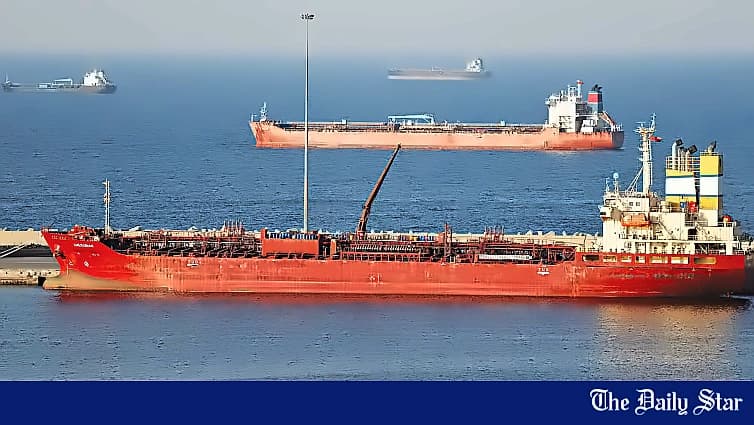
The renewed conflict has made other shipping operators increasingly cautious, with six vessels transiting the Strait of Hormuz on Sunday, the lowest number in five weeks, according to shiptracking data from Kpler as reported by The Times of India. Only two tankers had passed through the strategic waterway during the early hours of Thursday, among them the crude supertanker Berg 1, which loaded its cargo at Iran's Kharg Island and is under US sanctions, according to Kpler's analysis. The latest data shows that tankers that exited the strait included the Very Large Crude Carrier Humanity, laden with 2 million barrels of Iranian oil and another tanker, Capetan Andreas, carrying about 500,000 barrels of Kuwaiti oil products, while three empty tankers entered the Gulf to load oil. Most of the tankers switched off their transponders when crossing the strait, with no liquefied natural gas tankers that entered the strait over the weekend that were visible on ship-tracking data. The Joint Maritime Information Center noted that the southern route coordinated by Oman remains available, though the JMIC had earlier reported almost no traffic through the strait on Sunday. U.S. President Donald Trump said on Sunday that the Strait of Hormuz is open to commercial traffic, although Iran declared earlier that it closed the strait after a vessel traveled on an unapproved route and was struck. Iran has demanded that ships use a northern route through its territorial waters as it asserts control over the strait, with the Islamic Republic launching retaliatory drone and missile attacks on U.S. allies across the Middle East, including Kuwait, Jordan and Qatar. Before the conflict began on February 28 with US and Israeli strikes on Iran, the Strait of Hormuz carried around one-fifth of global oil supplies. Industry experts believe normal shipping activity through the Strait of Hormuz is unlikely to resume anytime soon, requiring coordinated vessel movements, the restart of oil production, repairs to damaged infrastructure and agreements on de-mining efforts.

The daily RSI for Brent crude oil now reads near 55, back above the neutral 50 line, signaling that buyers are in control of momentum after a significant technical breakout. The indicator had previously been capped by a descending resistance line that had defended the RSI near 64, 58, and 46 levels during May and June, before momentum bottomed near 27 in late June, close to oversold territory. A descending resistance line had capped every recovery since the RSI peaked near 90 in early March, but the indicator finally pushed through that trendline in early July and accelerated above the neutral zone. The next barrier sits at $90-$92, with that area serving as a triangle support in April and early June and now acting as the confirmation zone of the earlier breakdown. A rejection there could validate the bearish structure and send the price back to $71-$73, while a daily close above $92 would invalidate the breakdown and restore the bullish outlook from earlier this year. The geopolitical risk premium could stay elevated as long as Iran keeps the Strait contested, with the technical signal remaining bullish until the RSI falls back below 50 and returns under the broken line.