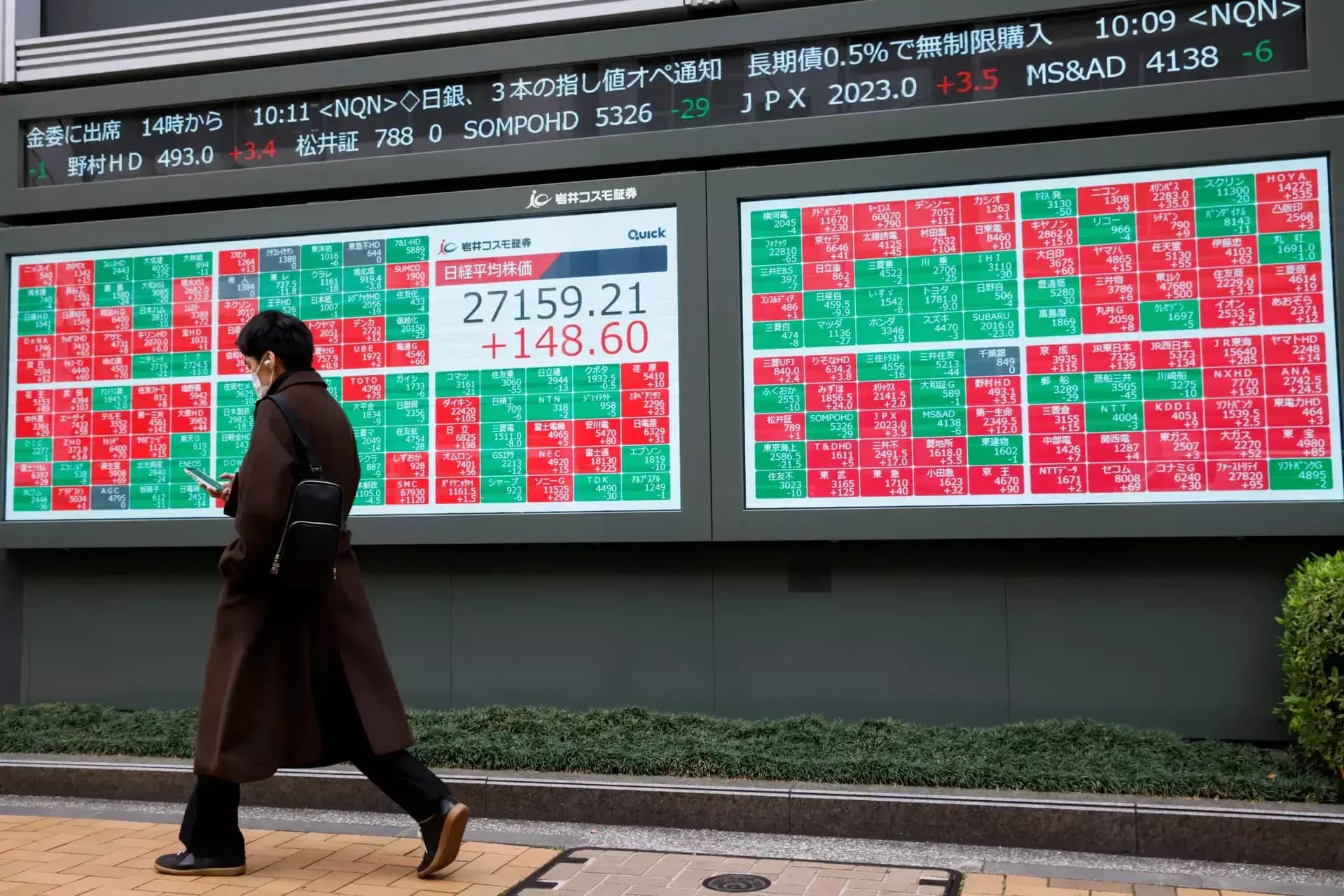
Japanese investors became net sellers of foreign equities in April for the first time in four months, offloading 636.4 billion yen worth of overseas stocks according to Reuters calculations based on data from Japan's Ministry of Finance. This marked the largest monthly net outflow since October 2025, as reported by The Economic Times. The shift in investment behavior reflected growing caution among investors amid heightened geopolitical uncertainty and persistent inflation concerns in major global economies. Recent market developments have intensified this trend, with Japanese stocks falling 0.98% as the Nikkei 225 declined amid concerns over monetary policy shifts.
Among Japanese institutional investors, trust accounts emerged as the largest sellers of foreign equities, pulling out nearly 1.85 trillion yen during the month, the biggest monthly withdrawal since June 2025. As reported by The Economic Times, these accounts simultaneously increased investments in foreign long-term bonds by 897.3 billion yen. In contrast, investment trust management companies and life insurers continued to add exposure to overseas equities, with investment trusts purchasing foreign stocks worth 1.25 trillion yen and life insurers buying a net 333.1 billion yen during April. The latest market movements show Japanese stocks falling as investors focus on monetary policy rather than company headlines.
The selling pressure has been compounded by Bank of Japan board member Kazuyuki Masu's hawkish stance, who stated that interest rates should be raised at the earliest stage possible if economic data doesn't show clear slowdown signs. This reinforces expectations that rate hikes could come as early as June, creating additional uncertainty for Japanese investors. The yen has strengthened as markets price in higher borrowing costs, making Japan more attractive for cash parked in the currency. However, a stronger yen complicates life for big exporters, since overseas sales translate into fewer yen once profits come home. The shift represents the sharpest split under Governor Kazuo Ueda, with reports describing three other board members as leaning toward more tightening, making markets more sensitive to each speech and data point.
Separate figures released by the Bank of Japan indicated that Japanese investors sold substantial amounts of overseas debt in the first quarter of the year. Holdings of U.S. bonds were reduced by 4.95 trillion yen, while European bond holdings declined by 1.02 trillion yen. Within Europe, Japanese investors sold French bonds worth 797.66 billion yen and German bonds amounting to 307.65 billion yen during the quarter, highlighting continued caution toward major global debt markets amid uncertainty over inflation and interest rate trends.