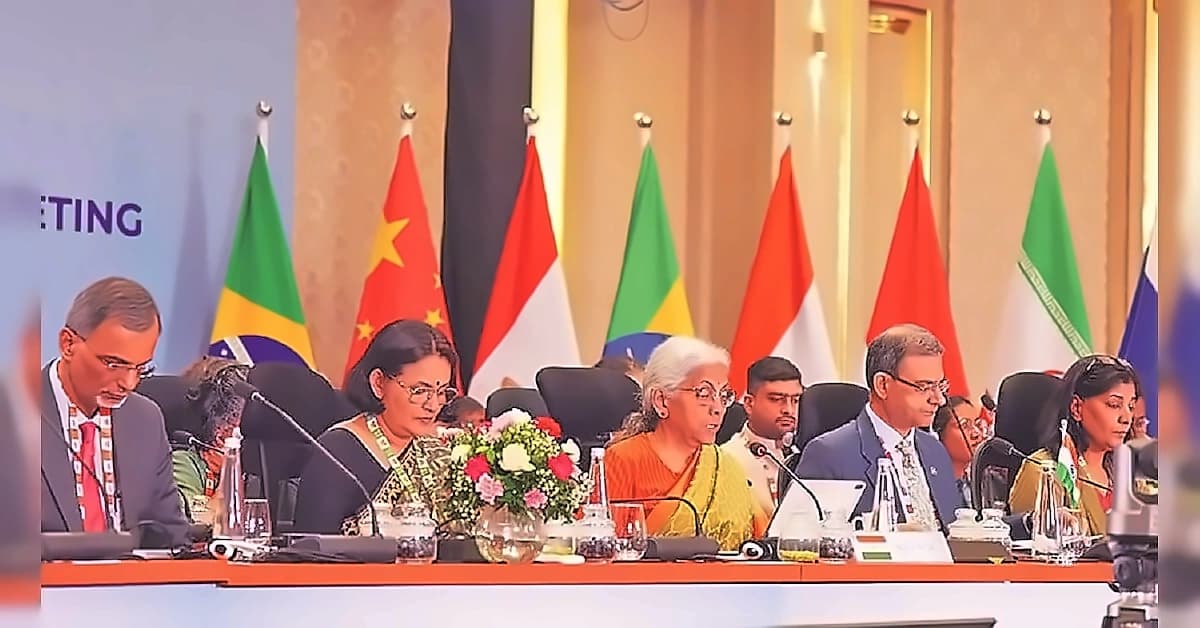
Iran has achieved a historic milestone by becoming a full member of BRICS during the current summit in New Delhi, marking a significant shift in the geopolitical dynamics of the influential bloc. As reported by Nukta, this membership represents a major diplomatic development as these nations counter Western economic and political influence. The Iranian delegation, led by Foreign Minister Seyed Abbas Araghchi, participated in the BRICS Foreign Ministers' Meeting at Bharat Mandapam from May 14-15, with Araghchi arriving in New Delhi on Wednesday on a three-day official visit to attend the summit amid escalating geopolitical tensions in West Asia. In his opening remarks, India's Foreign Minister Subrahmanyam Jaishankar called for 'safe, unimpeded maritime flows' through international waters, as the Strait of Hormuz, through which a fifth of global oil and gas passes, remains under blockade.
Among those present were Russian Foreign Minister Sergey Lavrov, Indonesian Foreign Minister Sugiono and several other top diplomats, all of whom gathered for an official group photograph with Jaishankar. As reported by ANI Digital, China was represented not by Foreign Minister Wang Yi — currently in Beijing as US President Donald Trump visits for high-stakes talks with Xi Jinping — but by Chinese Ambassador to India Xu Feihong. Hosting the leaders, Jaishankar, in his opening remarks, urged BRICS nations to find "practical ways" to better navigate the fallout of global conflicts, economic volatility, and trade disruptions. The theme of this meeting is 'Building for Resilience, Innovation, Cooperation and Sustainability', according to India's External Affairs Ministry, focusing on 'people-centric and holistic healthcare, with an emphasis on collaboration on pressing health challenges'. The meeting is taking place on Thursday, May 14, and Friday, May 15, with sessions expected throughout the day and concluding with a dinner at 7pm on Friday.

India officially assumed the BRICS Chairmanship on January 1, taking over from Brazil. This marks the fourth time India has held the presidency of the influential bloc, having previously hosted summits in 2012, 2016, and 2021. According to the Ministry of External Affairs, foreign ministers and heads of delegations will also call on Prime Minister Narendra Modi during the visit. The meeting is expected to play a significant role in shaping the agenda for the BRICS Leaders' Summit scheduled later this year. On Thursday at 1pm (07:30 GMT), Indian Prime Minister Narendra Modi will join the visiting leaders in a conference call from Seva Teerth, the prime minister's official headquarters. The BRICS foreign ministers' meeting is taking place on Thursday, May 14, and Friday, May 15, with all meetings except one taking place in Bharat Mandapam, an exhibition hall and convention centre close to the Supreme Court of India.
Araghchi's presence in Delhi is particularly significant as since hostilities erupted on February 28, the two ministers had already engaged in at least four high-level discussions. As reported by ANI Digital, Araghchi advocating for BRICS collaboration to safeguard international order while reaffirming Tehran's "legitimate right of self-defence." The visit marks Tehran's first high-level diplomatic engagement with India since the outbreak of the US-Israel war involving Iran more than two months ago. Iranian Foreign Ministry spokesperson Esmaiel Baghaei had earlier underlined that Tehran "looks forward to bilateral meetings with other ministers" at the event and described the BRICS gathering as being "of importance to Iran." Iranian Foreign Minister Araghchi will hold separate meetings with Indian Foreign Minister Subrahmanyam Jaishankar and other officials attending the meeting, according to Iran's Tasnim news agency. Iranian Foreign Minister Araghchi has landed in New Delhi to participate in the main BRICS sessions, with Iran's Tasnim news agency reporting that he will also hold separate meetings with Indian officials.
The Iranian foreign minister is also scheduled to hold extensive bilateral talks with S Jaishankar, with discussions expected to centre on the deteriorating security situation in West Asia amid the ongoing conflict involving Iran, the United States and Israel. The strategically crucial Strait of Hormuz is likely to feature prominently in the talks, as India is expected to convey concerns over the safe passage of merchant vessels through the narrow waterway. According to people familiar with the matter, global oil and gas prices have witnessed sharp volatility after Iran effectively moved to restrict maritime traffic through the Strait of Hormuz, a key shipping corridor linking the Persian Gulf with the Gulf of Oman that accounts for nearly 20 per cent of global oil and liquefied natural gas trade. Since early March, Iran has restricted shipping through the strait, requiring vessels from select countries to negotiate transit with the Islamic Revolutionary Guard Corps (IRGC). The war on Iran entered its 76th day on Thursday, with diplomatic efforts to end the conflict hanging in the balance. Since early March, Iran has restricted shipping through the strait, a narrow waterway linking Gulf oil producers to the open ocean and through which 20 percent of the world's oil and liquefied natural gas supplies were shipped before the war.
Diplomatic observers are closely watching whether the BRICS ministerial meeting will be able to produce a consensus statement on the West Asia conflict, amid visible divisions within the bloc. According to diplomatic sources, no joint position could be finalised during a meeting of the grouping's deputy foreign ministers and special envoys on the Middle East and North America last month, due to disagreements between Iran and the United Arab Emirates (UAE), which have traded accusations in recent weeks over alleged Iranian attacks on energy infrastructure in the UAE. In April this year, India hosted a BRICS Deputy Foreign Ministers and Special Envoys for the Middle East and North Africa meeting in New Delhi, which ended without a joint statement after Iran and the UAE clashed over how to address the US-Israel war on Iran. ECFR's Rafael Loss predicted that it is unlikely the BRICS summit will produce a consensus statement that goes beyond condemning attacks on nations' sovereignty in general terms, as BRICS has opted to do in the past, including on Russia's war against Ukraine. The meeting comes amid an energy crisis triggered by the closure of the Strait of Hormuz, with the US announcing a naval blockade on ships entering or leaving Iranian ports in April, further adding to global oil and gas supply disruptions. "The Iran war is likely to cast a shadow over both the BRICS summit and the Trump-Xi meeting," Rafael Loss told Al Jazeera. "The meeting in India occurs at a difficult time in which the cohesion of the BRICS confronts challenges due to the closer relations of India with the US and Israel, and the conflict in West Asia between Iran and the UAE," Michael Dunford, emeritus professor at the University of Sussex, told Al Jazeera.