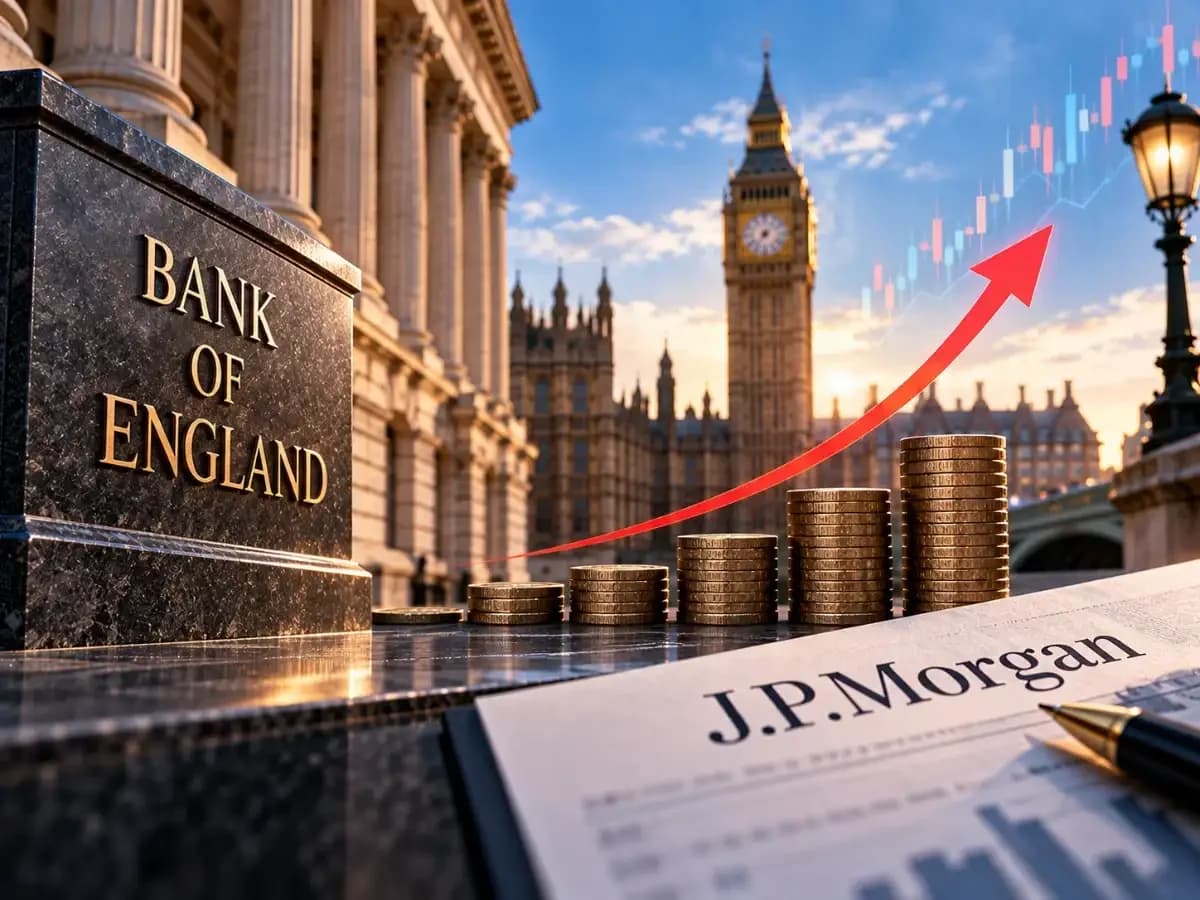
The Bank of England maintained interest rates at 3.75% with a 6-3 vote, keeping borrowing costs unchanged as expected by economists. However, the central bank's tone shifted significantly toward future rate hikes, with Governor Andrew Bailey and his deputies Sarah Breeden, Clare Lombardelli and Dave Ramsden all signalling they could back a rate rise. As per Reuters, the BoE warned that inflation could reach slightly over 4% in early 2027, more than double its 2% target. The central bank had previously kept rates unchanged at 3.75% by a 6-3 vote, while warning that inflation could rise above 4% early next year. Following this, J.P. Morgan expects the BoE to stay put on borrowing costs, unless there is clearer evidence of second-round inflation effects, including wage expectations rising to 4%. Markets are now pricing in at least one rate hike from the BoE this year, with a chance of another, as policymakers project one more rate hike in 2026 and a hold in 2027.
The central bank announced a six-month pause in its sales of government bonds as part of a longer-term overhaul of its approach to reducing its debt holdings. This decision has pushed bond yields lower and comes ahead of the UK government's budget next month, as global fixed-income investors remain concerned about rising debt levels across developed economies. The BoE also announced a new long-term plan to unwind its stock of British government bonds, with the MPC aiming to cut its holdings of gilts for monetary policy purposes to zero by 2034. The central bank will sell its gilts that are due to mature between 2035 and 2049 back to the government, with full plans due before April 2027. Short-dated gilts due before 2035 will be held until maturity, effectively leaving the government's Debt Management Office in full control of gilt issuance to the secondary market.
The BoE hardened its language on price pressures, saying "Given the lags with which second-round effects appeared, it was not appropriate to wait too long for evidence of such effects before responding with policy." The central bank noted that inflation risks had tilted further to the upside since its last set of economic forecasts in July, adding that the move in energy prices since then bore similarities to its "adverse" scenario that risked entrenching inflation. As per Reuters, the BoE warned that persistent US-Iran hostilities mean the risk of a rate hike has shifted from a possibility to a probability. The bank had previously expected the BoE to raise rates once in November 2026 and then cut rates twice in 2027, but has now revised its expectations following the latest policy developments and inflation outlook. Inflation has exceeded the 2% target in all but three months over the past five years. Economists say markets are overpricing future rate increases amid fears the oil shock could worsen after Houthis seized a strategic stretch of Red Sea coastline, a move seen as signalling a more assertive stance by Iran-backed militia.
The BoE's decision to pause government bond sales for six months while finalizing details of its longer-term debt reduction plan has raised concerns about policy coordination. As reported by Reuters, the bank had previously expected the BoE to raise rates once in November 2026 and then cut rates twice in 2027, but has now revised its expectations following the latest policy developments. The firm describes the plan as a clear and assertive effort to reduce uncertainty while market conditions remain volatile, though it notes this move risks blurring the line between monetary and government policy at a critical time for global fixed-income markets. The pound fell by around half a cent against the dollar and British government bond yields dropped sharply after the announcement of no change to rates and the overhaul of the BoE's bond-selling approach. The Federal Reserve's decision to raise rates and flag more hikes has soothed concerns about the central bank's independence in the face of President Donald Trump's demands for lower rates, though traders continue to price in a more aggressive policy response than projected in the Fed's dot plot.