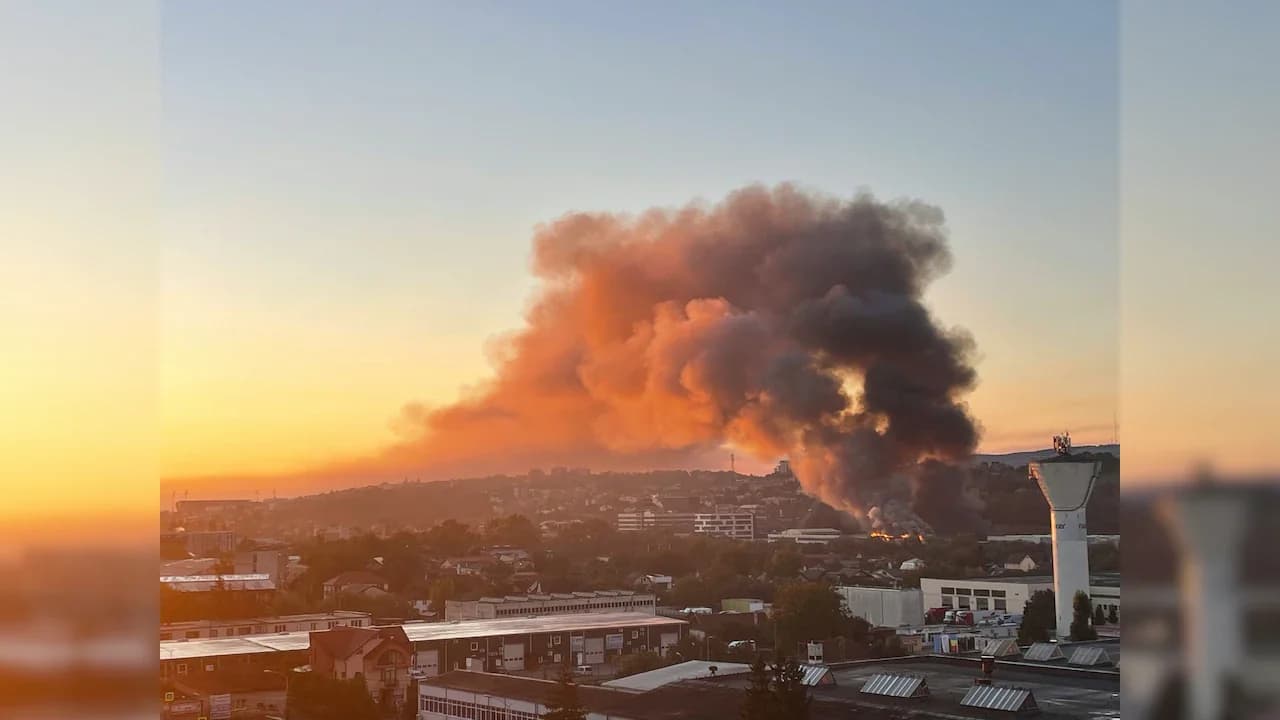
Israel launched strikes on Beirut targeting Hezbollah infrastructure on Sunday, with smoke rising over the Lebanese capital as reported by Associated Press. The Israeli military said the strikes were in response to Hezbollah attacks on northern Israel, with the group launching three projectiles into the region. An Associated Press photographer at the scene reported that the building struck was a five-story apartment building with shops on the bottom floor, with the two lower floors being the most heavily damaged. Residents of the southern suburbs, many of whom had returned to their homes after a period of relative calm in recent weeks, could be seen fleeing the area. The strikes threatened to hamper negotiations over a deal, which in its current form is a deep disappointment to Israel's government. This marks the second strike on Beirut's suburbs in a week, setting off the most serious escalation of fighting between Iran and Israel since the tenuous ceasefire took hold April 7.
President Donald Trump announced 'major combat operations' against Iran on February 28, with massive joint U.S.-Israeli strikes, as reported by Associated Press. Trump said a deal between the U.S. and Iran is scheduled to be signed tomorrow, reopening the Strait of Hormuz. "At the appropriate time, when all is calm, we will go in and get the Nuclear Dust, buried deep under the powerful sunken granite mountains, thanks to our beautiful B-2 Bombers and their brilliant pilots, and downblend and destroy it, whether in Iran, or the United States," Trump said in a post on social media. "We look forward to working with Iran, and the entire Middle East, long into the future. Hopefully, this process will all work out quickly, easily, and smoothly. If it doesn't, we have the ultimate alternative, hopefully never to be used again!"
Despite the military escalation, Qatari mediators traveled to Tehran on Sunday to finalize the US-Iran agreement, as reported by Associated Press citing two regional officials who spoke on condition of anonymity. The officials expressed cautious optimism that the US and Iran were finally approaching an agreement that could halt hostilities that have killed thousands of people and reopen the Strait of Hormuz, whose closure has thrown world markets into disarray. US President Donald Trump and Pakistani Prime Minister Shehbaz Sharif said Saturday that the deal would be signed on Sunday, while Iran's foreign ministry spokesperson Esmail Baghaei said it could happen in the coming days. Trump said that the Strait of Hormuz would open immediately after the signing. However, Trump has pressed Netanyahu to stop hitting Lebanon hard while a deal is near, but the prime minister has defied him, with Israel's military saying "Israel will not tolerate firing into its territory."
The current deal being discussed offers a 60-day framework for technical discussions on nuclear issues and frozen assets, according to Pakistinian and regional officials familiar with the negotiations, as reported by Associated Press. However, the deal does not solve the thorniest issues between the US and Iran, including Iran's nuclear programme or its frozen assets. Under the current framework, US and Israel appear to have fallen short of their original goals of destroying Iran's missile and nuclear programmes and ending its support for proxies. Critics in Trump's own Republican Party, struggling with an unpopular war ahead of the midterm elections, criticized the deal, with some saying it did not improve on the terms of the 2015 Iran nuclear deal that Trump withdrew the US from during his first term.