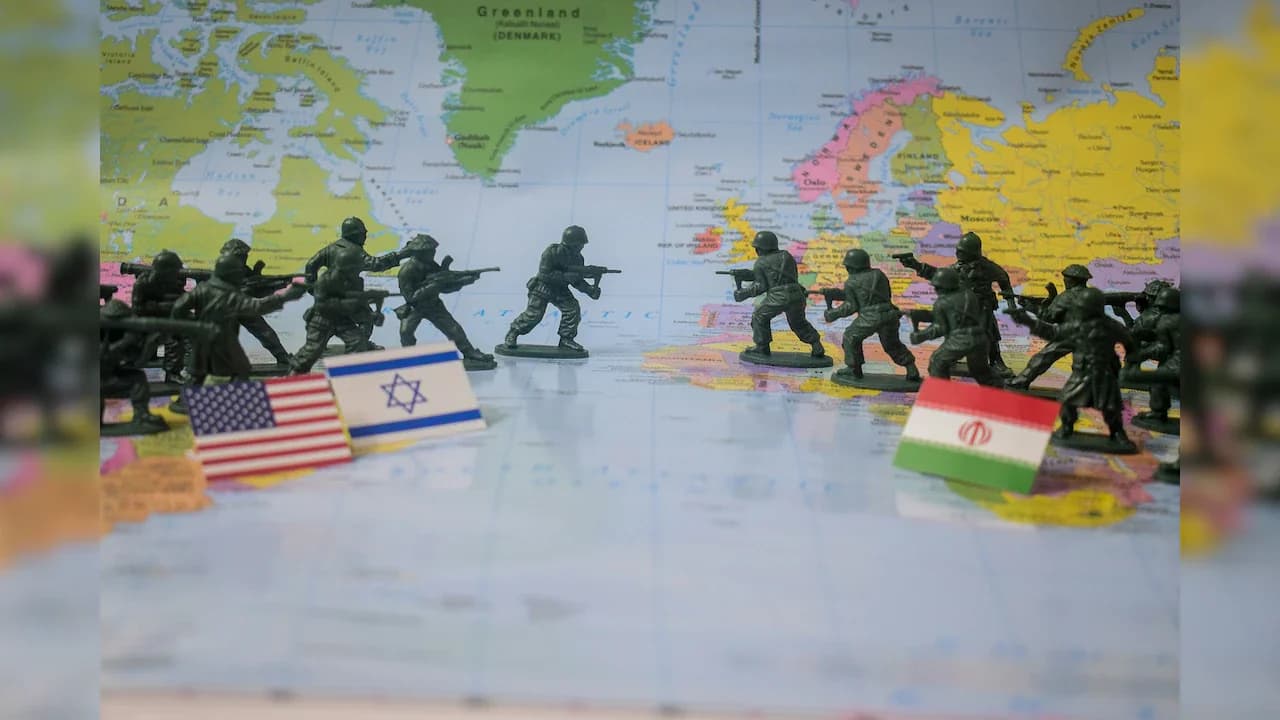
The US and Iran have decided to extend their 60-day ceasefire as the conflict crossed the 170-day mark on Monday, with the traffic in the Strait of Hormuz continuing to be affected. According to Upstox Securities, the supposed extension does not hint towards a potential or imminent deal, highlighting the ongoing challenges in reaching a comprehensive settlement. The June interim ceasefire agreement had given Iran and the United States 60 days to reach a final deal to stop the war, but as per Iran, Tehran sees no deadline to extend the ceasefire, which is supposed to expire on Aug. 17. The Iran-US war has now entered its 170th day, with both sides maintaining their positions despite the extended timeline.
US President Donald Trump has reiterated that preventing Iran from obtaining a nuclear weapon remains his top priority, stating his 'number one goal' is to ensure Tehran does not acquire nuclear weapons. According to his latest post on Truth Social, Trump wrote: 'Simply stated, IRAN CAN NOT HAVE A NUCLEAR WEAPON.' The renewed pledge comes as negotiations show no clear path towards reopening the Strait of Hormuz, with the 60-day deadline for the US-Iran ceasefire agreement having expired on Monday. As per Business Standard, talks have focused on reopening the Strait of Hormuz and lifting a US blockade on Iran, both of which were supposed to have happened under the interim deal, but there has been no sign of any compromise on the strait, or that detailed nuclear talks have even begun. The June interim ceasefire agreement gave Iran and the United States 60 days to reach a final deal to stop the war, but as per Iran, Tehran sees no deadline to extend the ceasefire, which is supposed to expire on Aug. 17.
The ongoing dispute between the United States and Iran over the Strait of Hormuz has escalated with competing claims of control, as both sides make contradictory statements about the waterway's management. Iran's Basij paramilitary unit head Hossein Taeb declared on Thursday that 'Today you see that the Strait of Hormuz is under the management and control of the Islamic Republic', according to the semi-official Fars news. This directly contradicts US President Donald Trump's assertion that the US has 'total control' over the vital waterway. Trump has now escalated his claims, telling Fox News on Friday that 'Pretty soon I'll be declaring the Hormuz Strait a territory of the United States' and describing a US blockade of Iranian ports as a 'wall of steel' that enables Washington to effectively govern Hormuz. Taeb further stated that the US had sought to disrupt what he described as the Islamic Republic's popularity in the region by launching another war in the Strait of Hormuz, but had once more been defeated despite claiming Iran had neither an air force nor a navy. The competing claims highlight the fundamental disagreement between the two nations over who has legitimate authority over the strategic waterway.
Iran has taken a firm stance on reopening the Strait of Hormuz, with senior military officials emphasizing that reopening the waterway is not something the US can achieve unilaterally. Senior military political official Rasoul Sanaei-Rad stated on Thursday that Iran would not reopen the Strait unless the other side fulfilled its commitments under the interim deal, according to Fars news. Sanaei-Rad also warned that Iran would respond more forcefully in any future conflict, saying: 'In a possible future war, we will stand more firmly and more offensively.' This position reflects Iran's strategy to purposefully extend the current conflict with the United States to deplete Washington's resources and create long-term deterrence. Earlier this month, Iran issued a list of demands for reopening the strait, including the lifting of the American blockade, the withdrawal of US forces from around Iran and the payment of reparations for damage inflicted in the war started by the US and Israel on February 28. Even then, Iran has said it would control the strait - and potentially charge fees - through an agreement it is negotiating with Oman, and that the strait will not go back to being an open, toll-free waterway as it was before the war. The confrontation over the reopening of the Strait of Hormuz has emerged as one of the biggest obstacles to a broader settlement, with negotiations aimed at ending hostilities failing to produce a breakthrough.
Oil prices have responded significantly to the ongoing Strait of Hormuz tensions, with Brent crude rising 1.2% to $89.54 a barrel, nearing the $90 threshold amid heightened clashes between Israel and Iran-backed Hezbollah, while West Texas Intermediate held near $82. According to the International Energy Agency, oil prices have been volatile amid mixed messages about a potential US-Iran deal, with prices moving lower after Pakistan's defence minister said the countries were close to an arrangement, only to rebound following more hawkish comments from Iran over the strait's closure. The IEA said benchmark crude prices traded in an 'unusually wide range' of almost $40 a barrel in July, driven by sudden diplomatic pivots on the conflict. Global oil demand is now forecast to decline by 1.6 million barrels a day this year, about 47% more than the IEA projected in July, as supply constraints and higher fuel prices weigh on consumption. Meanwhile, global oil supply is forecast to fall by 4.3 million barrels a day, to 102 million barrels, due to losses from the Middle East and Russia. Trump has told Americans to brace for continued high fuel prices, stating that paying 'a tiny little bit more for your gasoline' is worth the cost of ensuring 'a very evil country' could not have a nuclear weapon. The average US price of a gallon of gasoline was about $4.08 on Friday, up 29% from a year earlier, according to the American Automobile Association, in a trend that has sparked inflation and disappointed voters.