US President Donald Trump has threatened to attack Iran's Pickaxe Mountain after intelligence reports claimed Tehran moved centrifuges to the underground site. According to the Wall Street Journal, Israeli intelligence assessed that Iran transferred centrifuges to Pickaxe Mountain last fall, with the facility located south of the Natanz uranium enrichment plant. The threat comes as tensions between Washington and Tehran continue to escalate amid ongoing military exchanges, with the US military conducting additional strikes on Iranian military targets for the 11th consecutive night as of late Tuesday. US Secretary of State Marco Rubio warned against creating a dangerous precedent by allowing Iran to control the Strait of Hormuz, while Iran said it had retaliated against the latest strikes.
US and Israeli intelligence agencies believe Iran has shifted parts of its nuclear programme to the heavily fortified Pickaxe Mountain after last year's strikes on nuclear facilities. According to a Wall Street Journal report, US and Israeli officials believe Iran moved thousands of uranium enrichment centrifuges to the site after key nuclear facilities were damaged during the June 2025 conflict. The underground complex, located about 1.5 kilometres south of the Natanz nuclear facility, has also drawn the attention of US President Donald Trump, who has repeatedly suggested it could become the target of future military action. The facility's geological composition of igneous rock, primarily granite, makes its tunnels between 100-135 meters underground almost completely resistant to conventional aerial bombardment, with characteristics similar to Iran's Fordow enrichment plant. The name Pickaxe Mountain is itself a translation - its Persian name, Kuh-e Kolang, refers to a pickaxe or hoe, apparently reflecting the difficulty of excavating the mountain even in ancient times, despite modern equipment and reported Chinese expertise.
The renewed focus on Pickaxe Mountain comes after the United States and Israel launched strikes on Iran's nuclear facilities at Natanz, Fordow and Isfahan during the 12-day conflict last year under "Operation Midnight Hammer." The International Atomic Energy Agency (IAEA) later confirmed that Natanz's above-ground enrichment plant was destroyed, while its underground facility suffered significant damage. According to intelligence shared by Israeli officials with Washington, Iran responded by relocating surviving centrifuges and other sensitive equipment to the tunnel network beneath Pickaxe Mountain to protect its uranium enrichment programme from future attacks. The underground facility was not attacked in June 2025 because it was empty or nearly empty and its intended role had not yet been established, with transfers beginning only in fall 2025 after Iran cleared damaged tunnel entrances at other sites. US and Israeli officials noted that the transfer of sensitive equipment inside the mountain increases concerns that Tehran is working to ensure continued uranium enrichment, even in the event of a large-scale military attack on its soil. The facility was not attacked during Israel's Roaring Lion operation or the American Epic Fury campaign, which began in late February 2026 and continued until the ceasefire in early April.
The Washington-based Institute for Science and International Security (ISIS) has estimated that between 400 kilogrammes and 450 kg of uranium enriched to 60% survived the earlier strikes and has not been publicly accounted for. The organisation believes Pickaxe Mountain is one of the most likely storage locations, although there is no independent confirmation. According to ISIS analysis, the site features two pairs of tunnel entrances that are assumed to lead to a single underground facility, with the complex estimated to be at least 100 metres beneath the mountain's surface. The mountain itself stands 1,608 metres above sea level, with the difference in elevation between eastern and western entrances creating a nearly 50-metre difference that has led analysts to suggest the facility may contain multiple underground levels. The facility is located within a heavily secured perimeter that also houses a smaller tunnel complex built in 2007, with the older complex expanded and reinforced in recent years before its entrances were sealed shortly after the June 2025 conflict. The eastern tunnel entrance is located about 145 metres below the mountain ridge, while the western entrance is roughly 100 metres below it. The physical defensive measures include extensive fortification of tunnel entrances, with the western tunnel entrances remaining open as of July 9, 2026, while the eastern tunnel entrances were partially backfilled to obstruct ground vehicle access. According to a Reuters report, reinforcing the tunnel entrances would make it significantly more difficult to strike the facility using deep-penetrating weapons, including bunker-buster bombs designed to destroy underground targets.
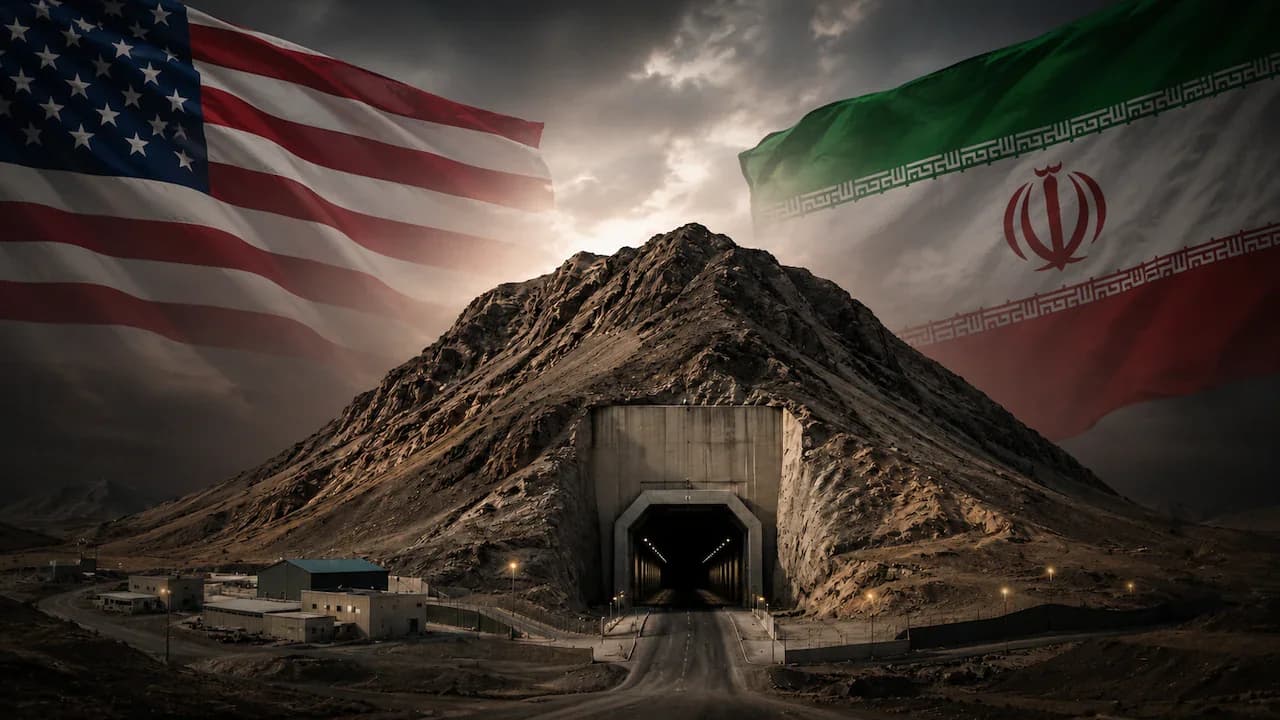
Although Iran informed the IAEA in 2021 that nuclear-related work was planned at the site, inspectors have not been granted access to verify what is taking place underground. The UN nuclear watchdog has said that it has not been allowed to inspect Pickaxe Mountain despite growing intelligence assessments. IAEA Director-General Rafael Grossi demanded that Iran provide answers regarding its activities at the site, but Iran failed to give answers that would allow the Iranian statements to be verified or the presence of nuclear material inside the mountain to be ruled out. The relative immunity afforded by the rock's depth has made the site one of the main targets in the confrontation with the United States, with US President Donald Trump threatening to eliminate the site and his administration closely monitoring activity surrounding the tunnel's entrances. However, there is currently no public evidence that Iran has installed the centrifuges stored in the mountain's tunnels for operation, though satellite images show Iranian work around tunnel entrances to reinforce and harden them. At the same time, those entrances would be difficult for ground forces to reach if the United States decided on an operation to destroy the facility's contents or potentially remove enriched uranium stored there.