Finance Minister Nirmala Sitharaman will chair a crucial meeting of BRICS finance ministers on September 1-2, ahead of the main summit on September 12-13, according to official sources from the Ministry of External Affairs. The meeting will focus on developing practical mechanisms to reduce trade transaction costs among the 11-member BRICS grouping and exploring ways to increase intra-Brics trade using national currencies. India will also flag the need for more balanced trade among BRICS member countries, as reported by the MEA. The summit represents India's fourth BRICS Chairship, having previously held the position in 2012, 2016, and 2021, with the current tenure beginning on January 1, 2026.
Chinese President Xi Jinping is expected to attend the summit in New Delhi over September 12-13, marking his first visit to India since 2019 when PM Modi hosted him for one-on-one meetings in Tamil Nadu. As per Business Standard, if Xi visits India, it would be his first international trip outside China in recent months, with China's Ministry of Foreign Affairs typically announcing outgoing visits only a day or so in advance. Xi has not travelled outside China over the past months, except to neighbouring North Korea recently. China's Ambassador to India Xu Feihong attended the India meeting in Chinese Foreign Minister Wang Yi's place during the BRICS foreign ministers' meeting in May, while National Security Adviser Ajit Doval and Wang met on the sidelines of the BRICS national security advisors' meeting in June, followed by a one-to-one focused on the border in August in Beijing. A rare joint statement issued after their meeting said "The two sides underlined their commitment to advancing negotiations on a framework for the settlement of the boundary question" in accordance with a bilateral agreement signed in 2005.
BRICS comprises Brazil, China, Egypt, Ethiopia, India, Indonesia, Iran, Russia, Saudi Arabia, South Africa, and United Arab Emirates as member countries, with Belarus, Bolivia, Kazakhstan, Cuba, Malaysia, Nigeria, Thailand, Uganda, Uzbekistan, and Vietnam serving as partner countries. The grouping represents almost 49.5% of the global population, around 40% of global gross domestic product and around 26% of global trade, as reported by the MEA. The bloc is not launching a single shared unit to replace the greenback, but the plan involves linking each country's own payment systems together so trade can settle directly in national currencies instead of routing through the dollar every time. Iran has emerged as the most motivated member to build payment systems independent of US-controlled infrastructure, with its central bank governor proposing a dedicated financial corridor for the bloc and requesting full membership in the New Development Bank at a BRICS finance meeting in Jaipur in August 2026. However, India and Brazil face "potential currency manipulation" if they go along with a Brics currency, which will likely be the renminbi, because it's the strongest in the developing world, according to Indian experts cited by Business Standard.
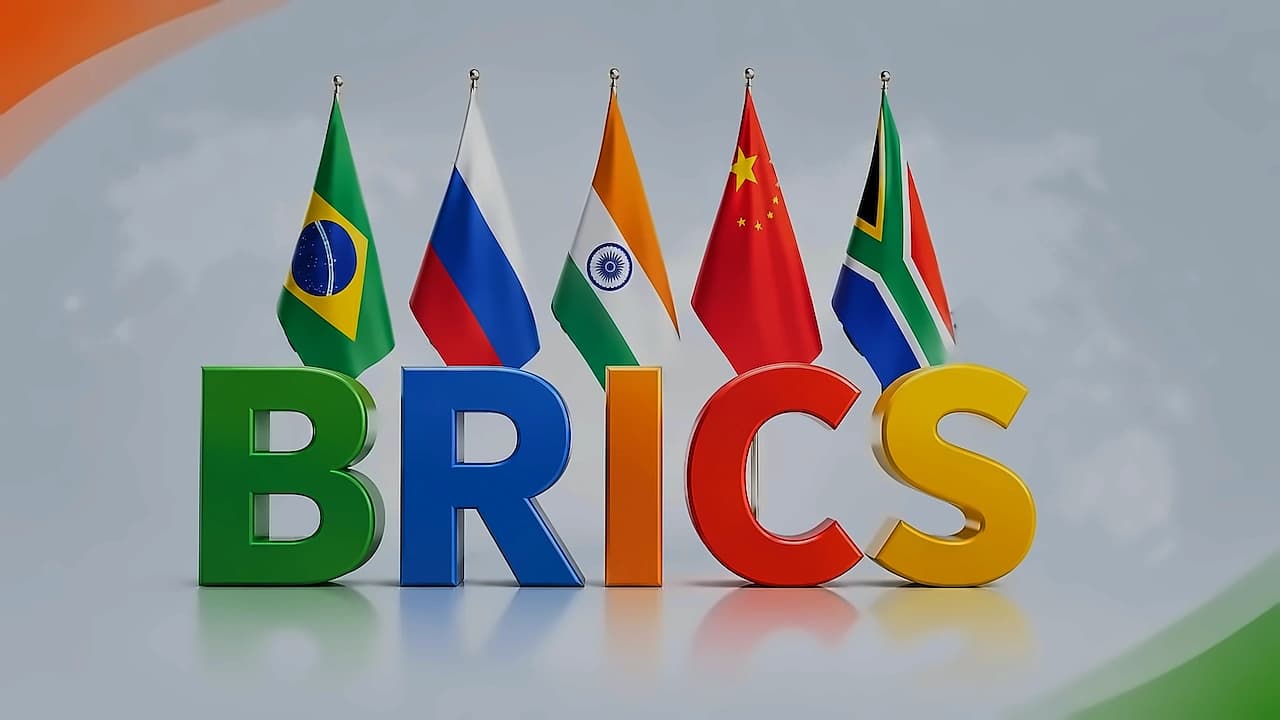
Despite bilateral challenges, Brics remains an alternative for the developing world in the Trump era, with the grouping's combined GDP between $29 trillion and $30 trillion in nominal terms. As per Business Standard, experts note that India and China are in what experts call "a cooperation-versus-competition situation" in the Trump era. India is wary of China's interest in bringing in its Belt and Road Initiative allies to the grouping, with China lobbying for Pakistan's entry and Russia Türkiye's inclusion. India's approach is "delimitation" — defining the line and its demarcation over the next 10-15 years or so — pending a final settlement, according to JNU professor Srikanth Kondapalli, rejecting China's "early harvest" approach of settling the least difficult middle sector first. The bloc faces multilateral challenges beyond India-China relations, with issues such as relations with the US, Russia's invasion of Ukraine and the Iran war potentially making joint statements difficult. At the 2024 Brics foreign ministers' meeting in New York, the group failed to agree on new additions to the UN Security Council, with India, Brazil and South Africa wanting permanent seats while China has long raised objections to India's bid.
The currency shift involves digital finance and blockchain-style settlement tools, including central bank digital assets designed to link across borders. Some payment systems under discussion lean on cryptocurrency-adjacent technology, even though the summit itself isn't a crypto event. The goal is direct settlement, for example, India paying Russia in rupees or rubles instead of dollars. Analysts describe this as a slow and uneven shift, not one dramatic event, with the bigger open question being where trade activity concentrates next. The summit lands amid sanctions, tariff threats, and regional conflicts, all pushing countries toward greater financial independence, with the signal to watch being whether payment-linking systems move from pilot programs into daily use. China is taking advantage of its massive dollar reserves and Trump's apparent interest in the great-power equation, pushing its cross-border interbank payment system as a Brics-aligned alternative to Western systems, though India doesn't find that appealing according to JNU professor Kondapalli.
Officials are hopeful of reaching a consensus declaration, including on the contentious West Asia conflict, since both Iran and the United Arab Emirates are BRICS members, according to the MEA. The declaration is likely to focus on resolution of the conflict in West Asia through dialogue and diplomacy and ensuring the free flow of maritime commerce. The declaration is also likely to include paragraphs on ensuring territorial integrity, increasing intra-Brics trade, free flow of maritime commerce and protection of civilians and civilian infrastructure. This represents a significant diplomatic challenge, as a meeting of the foreign ministers of the grouping's member states in May ended without a joint statement after Iranian Foreign Minister Abbas Araghchi and the UAE representative argued over the West Asia conflict, with India issuing a chair's statement and outcome document featuring two specific paragraphs where unanimity could not be reached. At this year's summit, issuing a joint statement on the ongoing war might be a tough challenge as China and Russia will side with Iran while US allies in West Asia such as the UAE and Saudi Arabia will oppose it, potentially putting the host in a tight spot.