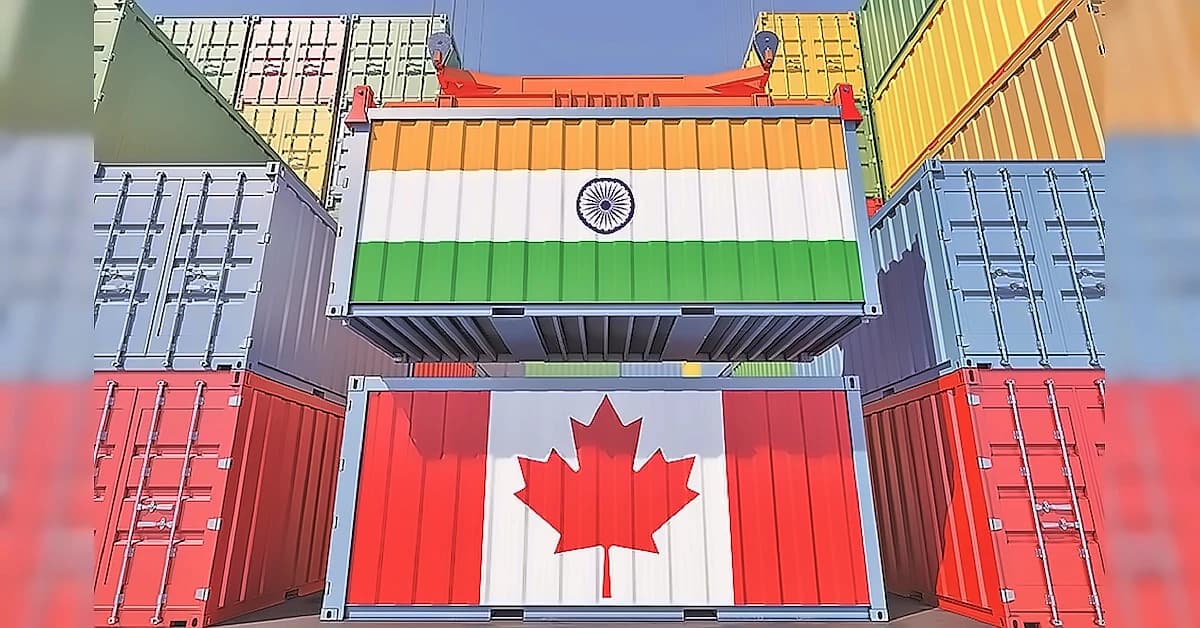
Canadian and Indian officials have expressed renewed optimism about ongoing negotiations on a proposed free trade agreement during a business summit in Regina. Canadian High Commissioner Chris Cooter told CBC News that negotiations on the agreement were continuing and expressed confidence that a deal could be reached later this year, stating 'The free trade agreement will happen. I have no doubt.' India's High Commissioner Dinesh Patnaik also confirmed that negotiations were ongoing, according to CBC News. The comments came days after Commerce and Industry Minister Piyush Goyal announced that India and Canada are targeting to conclude free trade agreement negotiations by December-end, with Prime Minister Mark Carney having 'shaved off one more month' from the timeline. The summit discussion also touched on trade in agricultural commodities, with Saskatchewan Premier Scott Moe expressing hope that pulse crops would be included in any future trade agreement, though he indicated their exclusion would not be a deal-breaker.
Commerce and Industry Minister Piyush Goyal has secured a Canada-India trade mission scheduled for November during his recent visit to Toronto. According to the Ministry of Commerce & Industry, the proposed mission will focus on sectors such as AI, semiconductors, clean energy, critical minerals, nuclear energy, renewable energy, semiconductors, clean technology, digital infrastructure and advanced manufacturing. The announcement was made during a fireside chat between Goyal and Sidhu at the Canada-India Building Bridges event hosted by Global Affairs Canada, Confederation of Indian Industry (CII), and ASSOCHAM at the World Trade Centre Toronto. As per ANI, the mission aims to bring Canadian companies to India to explore collaboration opportunities in these high-growth sectors. Canadian minister for international trade Maninder Sidhu confirmed that a 'Team Canada' business delegation will arrive in India later this year to further boost economic ties, as both sides look to triple bilateral trade to $50 billion by 2030 from the current $17 billion. Goyal emphasized that 'today there are very few countries in the world that can give the kind of returns that investments in India can,' citing India's technology innovations like UPI as examples of how Indian solutions could benefit Canadian businesses.
During the Western Canada-India Leaders Summit in Regina, officials conducted series of bilateral meetings with prominent business leaders and government officials. Saskatchewan Premier Scott Moe described the relationship between Saskatchewan and India as important for the province and pointed to ongoing trade discussions as a reason for optimism. The summit discussion also touched on trade in agricultural commodities, with Moe crediting Canadian Prime Minister Mark Carney with helping restart engagement with India, including through a visit to Mumbai and New Delhi earlier this year, which Moe also attended. According to CBC News, Moe said he hoped pulse crops would be included in any future trade agreement but indicated their exclusion would not be a deal-breaker. Last year, India imposed a 30 per cent levy on imported yellow peas and a 10 per cent duty on lentils, affecting Canadian exports of the crops. However, Global News reported that Moe said Saskatchewan could work around existing Indian duties on pulse imports even if those tariffs were not removed under a future agreement.
The investment discussions centered on India's rapidly growing financial services ecosystem and the country's commitment to clean energy transition. According to Business Standard reports, Goyal emphasized India's focus on infrastructure development, financial sector reforms, and ease of doing business as key drivers for attracting global investors. The meetings with Canada's leading institutional investors and pension funds represent a significant step in strengthening bilateral economic cooperation between the two nations in emerging technology sectors and traditional financial services. The summit was organized by the Canada-India Business Council and brought together political leaders, diplomats and business representatives from both countries. As per ANI, discussions also explored cooperation in financial markets to support 'sustainable growth and shared prosperity for both countries' and highlighted the 'growing complementarities between India and Canada.' Goyal urged people not to let the past two years slow the political reset, stating 'They may have a few misunderstandings and disagreements, but marriages are forever. Marriages are to be nurtured, so are relationships, friendships, partnerships, and political and economic possibilities.'
India-Canada bilateral trade currently stands at $8.66 billion in FY25, with key exports from India including pharmaceuticals, iron and steel, seafood, cotton garments, electronic goods and chemicals. Imports from Canada include pulses, pearls and semi-precious stones, coal, fertilizer, paper, and petroleum crude. According to ANI, Goyal stated that 'it is eminently doable' to achieve the Prime Ministers' ambitious target to grow bilateral trade from $17 billion to about $50 billion by 2030. The minister is leading a delegation of more than 100 industry leaders spanning sectors such as energy, mining, automotive goods, pharmaceuticals, telecom, AI, leather, and textiles to Canada. Goyal called on Canadian Prime Minister Mark Carney, who stated that the FTA will be 'a game changer for Canadian workers and businesses - unlocking a massive new market' and emphasized opportunities in energy, agri-food, technology, and education. The recent months have seen renewed trade engagement between the two countries after trade talks stalled in 2023 following relations deteriorating after Canadian allegations linking Indian agents to the killing of Sikh separatist Hardeep Singh Nijjar in British Columbia.