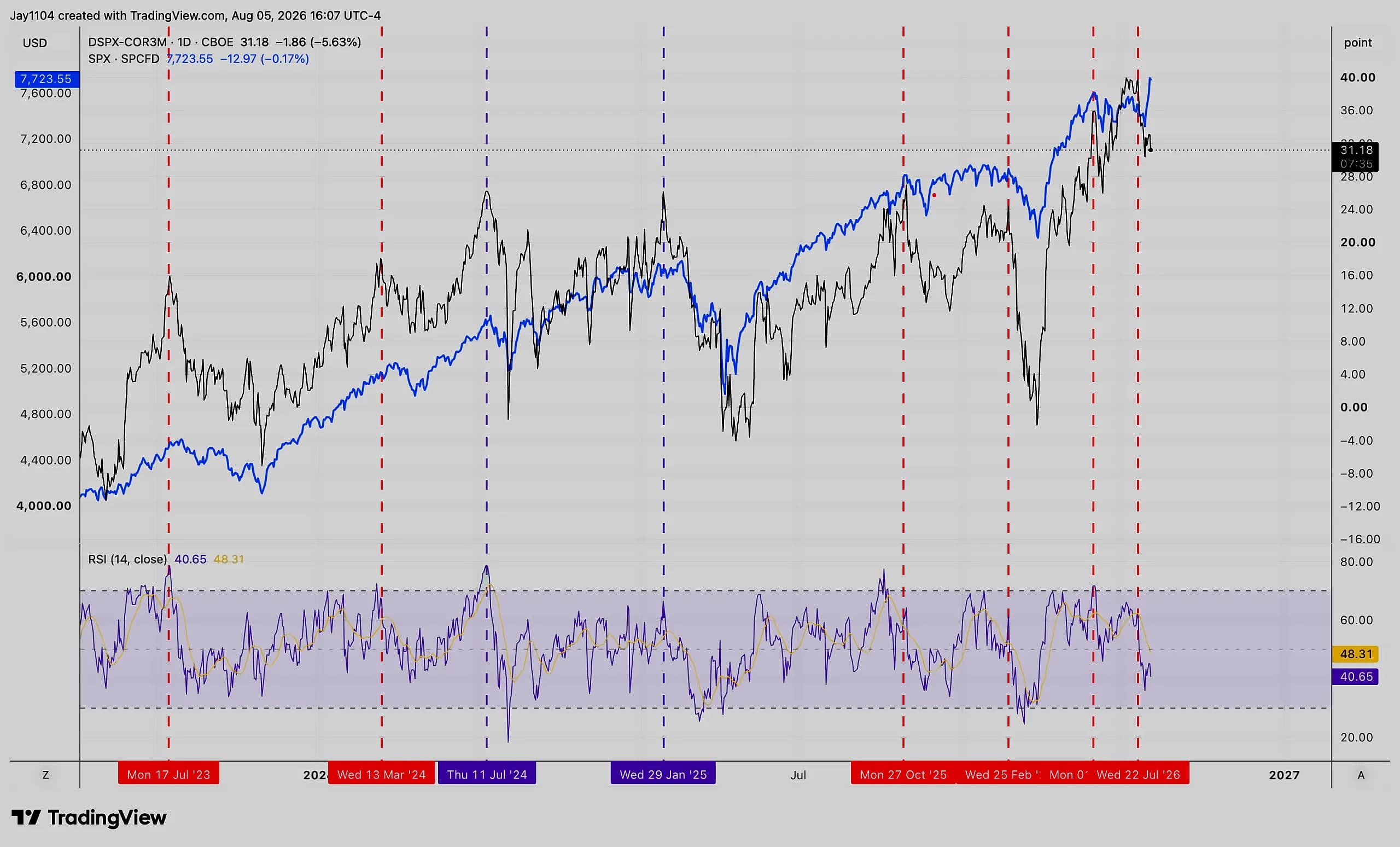
According to Goldman Sachs' volatility desk, index skew — the premium typically paid for downside protection — has collapsed to unusually low levels, prompting the desk to declare that "skew is broken." The market has become so comfortable riding the AI-fueled rally that fewer passengers feel the need to locate emergency exits. S&P volatility skew has fallen to an 18-month low, driven by unusually cheap downside puts and increasingly expensive upside calls. The Goldman Panic Index closed Friday with a reading beginning with a "1" for the first time in two years, measuring the two-year percentile rank of several key fear gauges including the VIX, VVIX, skew, and at-the-money volatility. This suggests that option markets are pricing an extraordinary lack of concern about downside risk, with investors spending less money protecting against a selloff and more money betting the rally still has further to run.
Goldman Sachs COO John Waldron has identified inflation as the single biggest risk element to the economy during a talk at the Bernstein Strategic Decisions Conference in New York. As the No. 2 executive at Goldman Sachs after CEO David Solomon, Waldron stated that "Inflation, I would say it's probably the single biggest risk element. It's the one that worries me the most personally." He warned that if longer-end interest rates move higher across the globe, that can have an impact on cost of capital across the economy, consumer behavior. The warning comes as the Bureau of Economic Analysis released April data for the Personal Consumption Expenditures (PCE) index, showing its highest reading in three years. Earlier this month, the bond market began signaling that interest rates may not be high enough, with the majority of traders now pricing in a slightly higher chance that the Federal Reserve will raise interest rates this year (50.5%) rather than keeping them at the current level (49%) according to CME FedWatch.
Goldman Sachs Group Inc has emerged as a strong buy candidate with multiple technical indicators supporting an upward trajectory. The stock holds buy signals from both short and long-term Moving Averages, with the short-term average positioned above the long-term average. A buy signal was issued from a pivot bottom point on Friday, March 13, 2026, and the stock has since risen 28.91%. The stock also shows a buy signal from the 3-month Moving Average Convergence Divergence (MACD). However, volume fell during the last trading day despite gaining prices, causing a divergence between volume and price that may serve as an early warning signal.
The stock gained 1.19% on Thursday, May 28, 2026, rising from $996.47 to $1,008.37. During the trading session, the stock fluctuated 2.80% from a day low at $982.45 to a day high of $1,009.94. The stock has risen in 6 of the last 10 days and is up by 5.54% over the past 2 weeks. Volume fell by 158,000 shares on the last day, with total trading volume of approximately $2.05 billion as 2 million shares were bought and sold.
The stock lies in the middle of a wide and strong rising trend in the short term, with further rise within the trend signaled. Given the current short-term trend, the stock is expected to rise 21.60% during the next 3 months. With a 90% probability, the stock is projected to hold a price between $1,144.18 and $1,274.24 at the end of this 3-month period. However, Goldman Sachs' prime brokerage desk reports that hedge funds were net buyers for a second consecutive week at the fastest pace of the year, driven by fresh long positions and short covering from macro funds. The top ten companies now account for roughly 40% of the S&P 500, turning what was once a broad market into something increasingly resembling a concentrated AI portfolio. The most concerning development is that the last four record highs in the S&P 500 were achieved on negative market breadth, meaning more stocks were falling than rising on the very days the index was celebrating new peaks.

According to data tracked by S3 Partners, the total bearish positions across US and Canadian equities have surged by over $100 billion from late-April to reach $2.13 trillion, which represents an all-time high. This data tracks back to 2010, making the current levels historically significant. As reported by CNBC TV18, Goldman Sachs' trading desk views this setup as a pivot point for the next phase of market movement, with the next leg higher for US equities more likely to be fueled by short-squeezes that force buying in pockets of the market outside of megacap tech names.