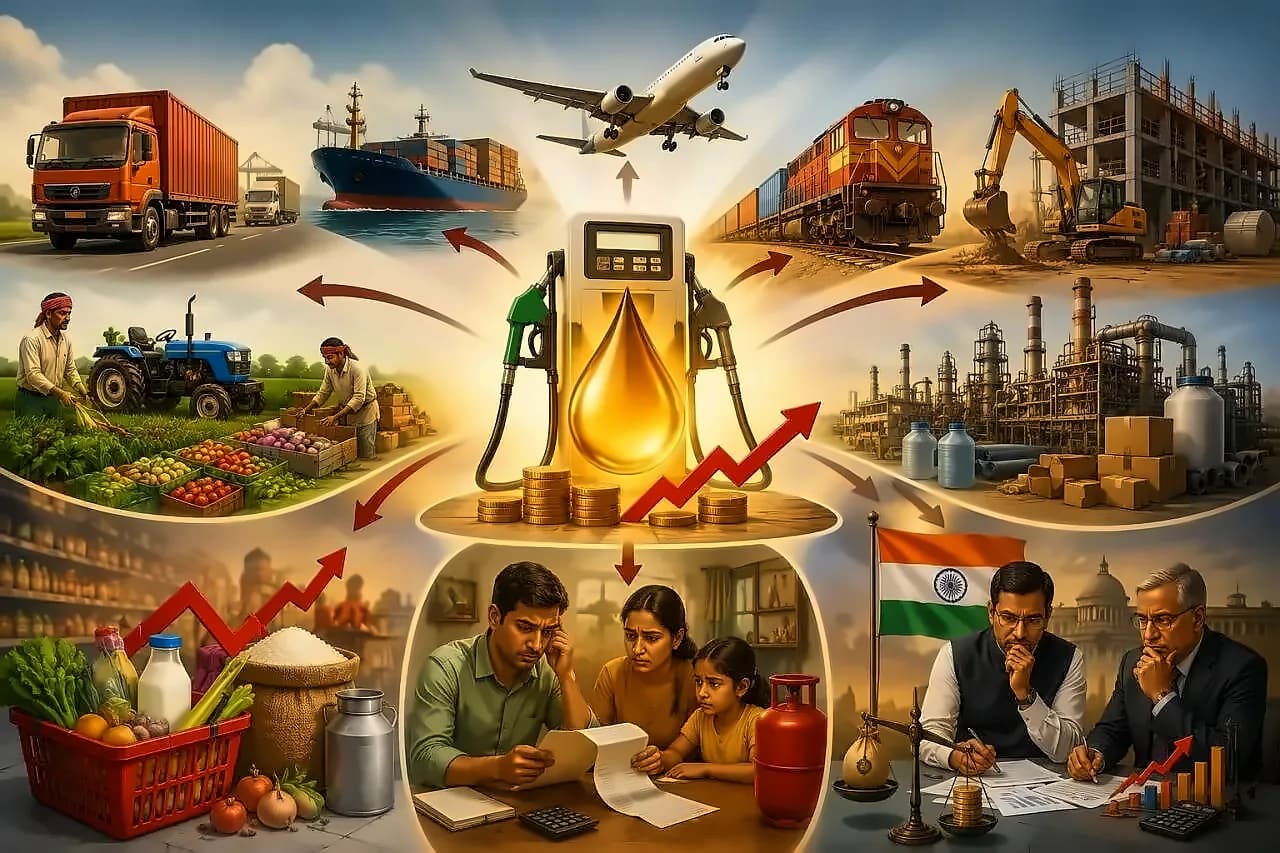
India's decision to raise petrol and diesel prices by ₹3 per litre represents the first fuel price adjustment in 49 months, ending a long period of stable retail fuel prices. According to reports from Business Standard, the move offers partial relief to state-run fuel retailers but raises fresh concerns around inflation, monetary policy, and foreign investor sentiment at a delicate stage for the Indian economy. The fuel price revision comes after an extended freeze in retail prices despite Brent crude rising sharply from nearly $69 per barrel before the recent geopolitical conflict to over $107/barrel currently. Market experts warn that further fuel price hikes may intensify FPI selling in Indian markets, as reported by Business Standard citing Apurva Sheth, CMT of Samco Securities Limited.
India has already witnessed sustained foreign outflows amid concerns over elevated valuations, global uncertainty, and weakening macro indicators. As reported by Business Standard, according to NSDL data, FPIs have pulled out nearly ₹2.2 trillion from Indian equities so far in 2026, reflecting the cautious stance of overseas investors toward domestic markets. The latest data shows that cumulative FPI withdrawals have already exceeded ₹2 lakh crore by early May 2026, surpassing all of 2025's outflows, driven by high global valuations, geopolitical uncertainties from the West Asia conflict, and a stronger US dollar. Foreign ownership in Indian stocks has fallen to its lowest in 14 years, with the Indian Rupee (INR) weakening nearly 3% in the past month and over 11% in the last year.

India's headline CPI inflation rose to 3.48 per cent in April, the highest level in nearly a year, while food inflation climbed to 4.2 per cent. According to Business Standard, the fuel price adjustment is expected to push May CPI forecasts to around 4.1%, likely boosting core inflation due to higher transportation costs. The Petroleum Ministry indicates that state-run OMCs are collectively incurring losses of nearly ₹1,000 crore per day, with cumulative losses reaching nearly ₹1.98 lakh crore. Higher fuel prices are expected to increase transportation and logistics costs, creating spillover effects across sectors including FMCG, cement, automobiles and consumer services, placing upward pressure on core inflation in the coming quarters.
The development complicates the Reserve Bank of India's policy outlook, as the RBI recently revised its FY27 inflation forecast upward to 4.6 per cent while lowering GDP growth projections to 6.9 per cent. As reported by Business Standard, expectations of aggressive rate cuts had supported equity valuations earlier, but persistent inflation could force the central bank to maintain a tighter policy stance for longer. The RBI faces a difficult choice: support growth with a loose policy or fight inflation with tighter measures, a decision that may become harder to make. Economic forecasts for FY27 are cautious, with GDP growth projected between 6.5% and 6.7%, and analysts believe the RBI will likely maintain its current policy, balancing growth concerns with the need to control inflation, possibly for an extended period.