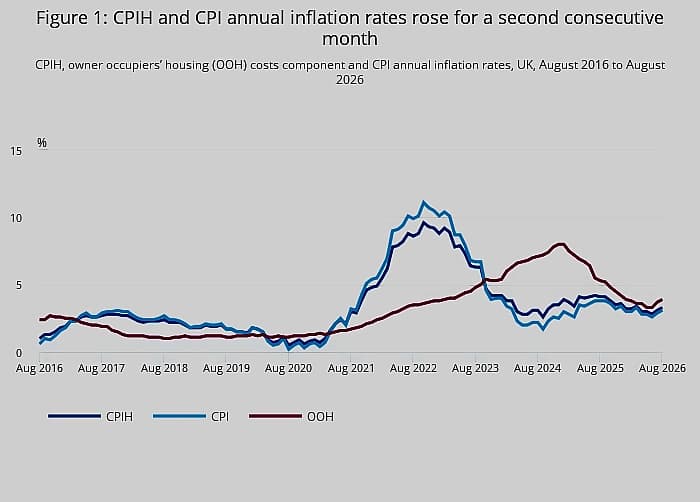
The FTSE 100 fell 0.13% to as of 03:25 ET (07:25 GMT) as investors processed softer-than-expected UK inflation data ahead of Thursday's Bank of England rate decision. According to reports from Investing.com, UK inflation unexpectedly remained unchanged at 2.8% year-on-year in May, below expectations for a rise to 3.0%, suggesting price pressures were easing even before the recent collapse in oil prices following the U.S.-Iran peace agreement. The DAX slipped 0.39% and CAC 40 fell 0.03% as markets reacted to the inflation data. Rob Wood at Pantheon Macroeconomics notes that "a stronger signal about underlying inflation pressure from services inflation jumping to 3.7% in May, from 3.2% in April," which was above consensus although still below the BoE's 3.9% forecast from April. He says the inflation figures will support the MPC's highly likely decision to keep Bank Rate on hold this week and make a July hike less likely. Financial markets are pricing in just a 2.6% chance of an interest rate hike from the Bank of England tomorrow, with economists and traders widely expecting policymakers to sit on their hands while they digest the latest inflation figures and assess the impact of the Iran war. Economists polled by Reuters expect the BoE's Monetary Policy Committee to vote 7-2 to keep rates on hold at 3.75%, with the BoE having time to wait to assess the conflict's impact on the economy.
On a monthly basis, CPI rose 0.2%, remaining steady from April and below forecasts of 0.4%. As reported by Investing.com, transport made the largest upward contribution, with air fares jumping 10.3% between April and May. However, food and non-alcoholic beverages provided the biggest drag, with annual food inflation easing to 2.2%, its lowest since December 2024. ONS Chief Economist Grant Fitzner noted that "the main upward movement came from transport with airfares, vehicle taxes and petrol prices all pushing up inflation," while "these were offset by lower food prices, with decreases in inflation seen across a range of meat, dairy and vegetable items compared to last month, as well as the cost of domestic heating oil, which fell back after climbing in recent months." Transport costs rose at an annual rate of 6.8%, up from 4.5% in April and the highest since December 2022, with the main effects coming from air fares, motor fuels, and sea fares. The average price of petrol rose 0.6p a litre between April and May, to an average price of 157.4p a litre - the highest since November 2022, when fuel prices were pushed sharply higher following the Russian invasion of Ukraine. Core CPI, which excludes more volatile components such as food and fuel, rose to 2.6% from 2.5%, but remained below expectations of 2.7%. Services price inflation, which the BoE views as a guide to underlying price pressures, rose to 3.7% in May from 3.2% in April, in line with economists' forecasts.

Britain has been more affected than most Western countries by the conflict due to its reliance on imported natural gas, and manufacturers reported an 8.7% annual rise in their raw material costs for May, the biggest since February 2023. As reported by Reuters, "A chunk of inflation is locked in the system now," Rob Wood, chief economist at Pantheon Macroeconomics, said. He now predicts inflation will peak at 3.4% in November, down from his previous forecast of 3.6% before the Iran deal, and he no longer expects the BoE to raise rates this year. A quarterly BoE survey released last week showed the public's expectations for inflation in five years' time were the highest since the series began in 2009 at 3.9%. In April, the BoE said it was likely to rise above 3.5% by the end of the year and potentially exceed 6% early next year under the most adverse of three scenarios. However, financial markets this week have drawn comfort from an interim agreement between the U.S. and Iran which promises to reopen the Strait of Hormuz, a major corridor for oil exports, and is due to be signed in Switzerland on Friday.
According to Investing.com, the broader picture supports the Bank of England's wait-and-see approach, with softer inflation, a weakening labour market and recent GDP contraction reducing the need for further policy tightening. Sterling weakened a little against the U.S. dollar after the data, British government bond yields fell to a new two-month low and investors slightly trimmed their expectations for a rate increase later this year. Yael Selfin, chief economist at KPMG, said "Today's data strengthens the case for a continued cautious approach from the Bank of England." Patrick Munnelly at Tickmill notes that "the collapse in the oil price has changed the tone of global markets, supporting bonds and reducing near-term inflation pressure," though he adds that AI valuations remain under scrutiny and central banks are not ready to fully reverse their caution. In bond markets, the yield on the 10-year UK government bond dropped almost four basis points to 4.75%, the lowest in a month, reflecting the cautious market sentiment ahead of the BoE decision. The FTSE continues to trade within a descending triangle pattern, having recently rebounded from support around 10,170 and recovered above the 50-day SMA. A break above the trendline would weaken the bearish pattern, with a move above 10,570 creating a higher high and opening the door towards 10,725.
Looking ahead, attention turns to the FOMC decision later today, with a more hawkish-than-expected Federal Reserve potentially supporting the U.S. dollar and weighing on GBP/USD, which may benefit the multinational-heavy FTSE 100 through overseas earnings translation. According to Investing.com, higher global bond yields could also limit gains in broader equity markets, highlighting the delicate balancing act facing the new Fed Chair in his first meeting. The retreat in oil prices is already shaping central bank thinking on both sides of the Channel, with falling crude seen easing some of the inflationary pressure built up since the Middle East conflict began. Patrick Munnelly at Tickmill adds that today's Federal Reserve meeting is less about the rate decision (no move is expected) and more about new chief Kevin Warsh's framework, while the collapse in oil prices has materially reduced near-term pressure on headline inflation. Japan's Nikkei, which soared through the 70,000-point mark for the first time ever on Tuesday and also traded at that level today, has ended the day at a new closing high of 69,925, up 0.7%, while other Asian markets were mostly higher despite central bank rate hikes. The Confederation of British Industry regarded the latest inflation print as a "welcome surprise," saying markets widely anticipated a rise in inflation for the month, though they warn this represents "the calm before the storm" with price pressures set to rise over coming months as energy costs increase.