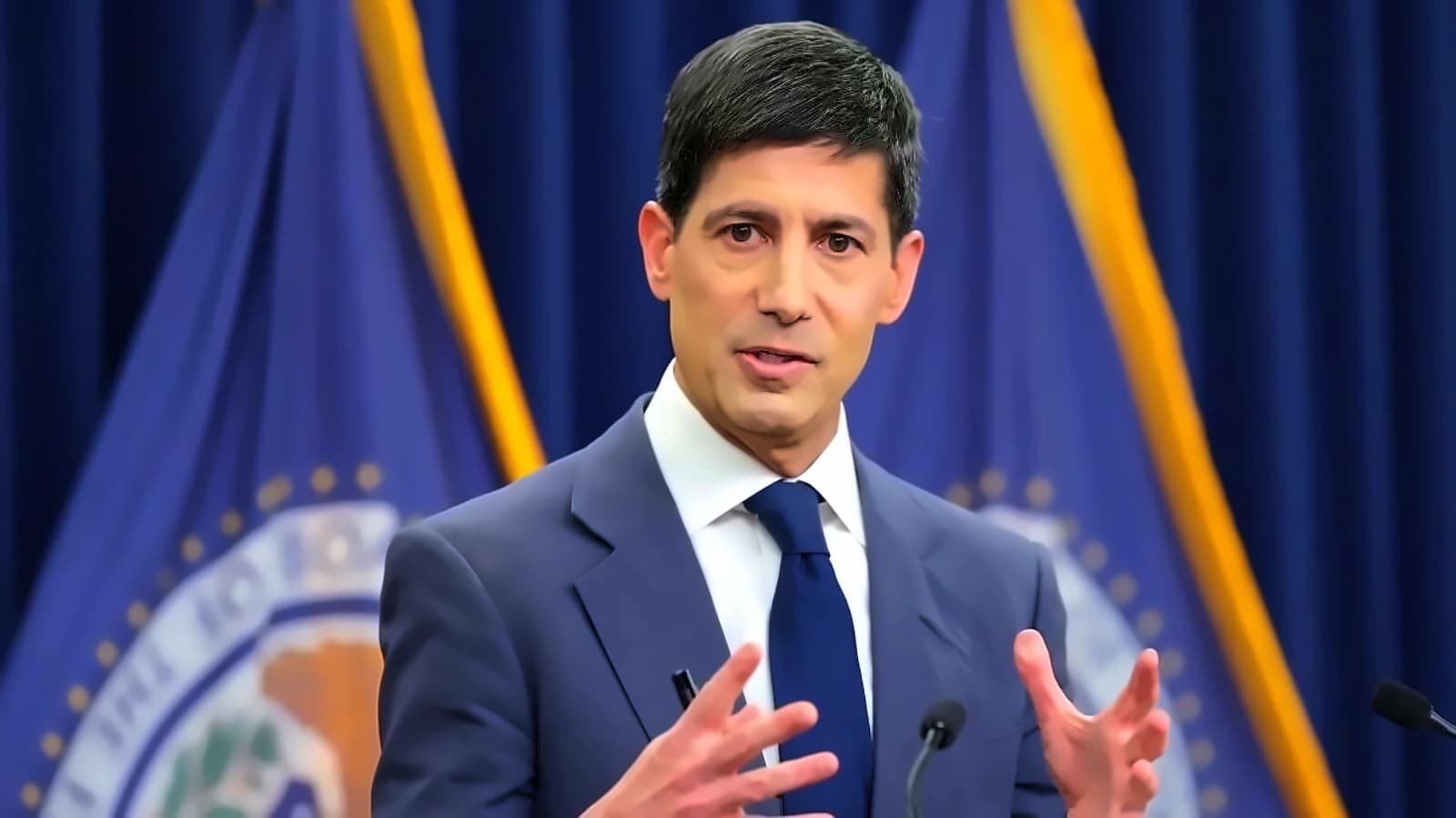
The U.S. Federal Reserve maintained interest rates unchanged for the fifth consecutive meeting, as widely expected by markets. However, the decision drew three dissenting votes from Federal Open Market Committee members who 'preferred' a quarter-percentage-point hike at this meeting. According to reports from The Hindu BusinessLine, the Federal Open Market Committee voted 9-3 to hold the benchmark federal funds rate in a range of 3.5% to 3.75%. Dallas Fed President Lorie Logan, Cleveland's Beth Hammack and Minneapolis Fed chief Neel Kashkari dissented in favor of raising rates by a quarter percentage point. This marked the fifth straight time officials have opted to leave rates unchanged, but the dissents suggest it could become more challenging for Warsh to continue holding if inflation fears grow. The committee's post-meeting statement was otherwise identical to the one issued following their June meeting, with officials repeating their pledge to 'deliver price stability.' As reported by Mint, this was the first time in almost 10 years (since September 2016) that three policymakers dissented with a unified view about the direction of interest rates.
Federal Reserve Bank of New York President John Williams has provided additional clarity on the Fed's future policy stance, signaling the central bank's preparedness to act if inflation persists above target levels. As reported by The Hindu BusinessLine, Williams stated that 'I think that some of the big drivers that pushed up inflation' over the last year and half or so 'will not be at play as much, and then some of the disinflationary forces that we've been seeing' should reassert themselves. He expressed optimism that inflation pressures are on track to ease gradually, but warned that 'if the economy is not on a trajectory that will bring inflation back down to 2 per cent ... it would absolutely be appropriate to act to get us on a trajectory that does bring inflation back to 2 per cent.' Williams noted that 'my forecast personally is for inflation to come down in the second half of this year and come down further next year,' adding that 'my focus is quite a bit on, what are we seeing in the core inflation data over the next several months, and is that consistent with a kind of a run rate of inflation moving towards 2 per cent and really on a disinflationary path consistent with us achieving our 2 per cent inflation goal on a sustained basis by 2028.' He emphasized that 'there is no soft inflation target. There is no soft implicit target, not on this committee's watch. There's only a target, and it's 2%.'
Market reactions to the Fed's decision showed mixed signals across asset classes, with precious metals rallying significantly after the announcement. As reported by The Hindu BusinessLine, two-year Treasury yields fell following the Fed's decision, while U.S. stocks pared losses after the release of the statement. The number of officials voting in favor of tighter policy suggests a change in Fed thinking, with Nationwide Chief Economist Kathy Bostjancic noting that 'the high number of dissents underscore that policymakers are increasingly more hawkish.' However, she thinks 'the Fed can and should remain on hold this year since higher interest rates will not solve the energy supply shock from the Middle East nor slow AI capex that is driving up prices.' Precious metals rallied after the Fed announced its policy decision as investors reduced expectations of another interest-rate hike in September. Spot gold climbed 1.16% to $4,075.53 per ounce, while spot silver gained 2.19% to $58.38 per ounce in late trading. The gains came as traders interpreted the Fed's decision as less aggressive than some had feared, even though Warsh kept the possibility of future rate hikes on the table. As reported by Mint, the US stock market came under pressure after the Fed's policy, with Nasdaq closing 1.74% lower and S&P 500 settling 1.40% lower, while the dollar index declined by over 0.50% and 10-year Treasury yields rose five basis points to 4.66%. Long-term bond yields have been rising, with investors worried inflation pressures will stay high, and futures traders have priced in a decent chance the Fed will raise rates by year end.
The Federal Reserve noted that economic activity continues to expand at a solid pace, supported by a resilient labour market, despite uncertainty linked to global geopolitical developments. As reported by The Hindu BusinessLine, employment conditions remain healthy, with steady job gains and a low unemployment rate. However, policymakers acknowledged that inflation continues to run above target, requiring policymakers to remain cautious. The inflation measure the Fed uses for its 2 per cent target rose 3.7 per cent in June on a year-over-year basis, still facing upward pressure from supply shocks triggered by things like the Iran war and President Trump's tariffs, as well as demand pressures from things like hefty business investments in artificial intelligence. Cleveland Fed President Beth Hammack noted that 'inflation has remained stubbornly above 2 per cent for more than five years, and I am not confident it will return to our objective on its own.' Williams acknowledged there is ample uncertainty around the outlook right now and that the renewal of conflict in the Middle East makes it unclear when energy prices might fade, but said once there is a resolution and shipping traffic resumes, improvement could be swift. The Fed's preferred inflation gauge has accelerated in recent months, hitting 3.4% in the year through May, though a weaker-than-expected June reading of inflation took some pressure off policymakers to raise rates this week.
The Fed's decision may provide some relief to Indian markets through multiple channels, according to market analysts. Harshal Dasani, Business Head at INVAsset PMS, highlighted that a status quo from the Fed may transmit to the Indian stock market through four key channels - foreign flows, currency stability, discount rates, and RBI policy. 'The first is the foreign flows. A Fed that is not tightening removes the dollar magnet that pulls capital out of emerging markets. It has arrived exactly as FPI selling has moderated for five straight months and turned positive in recent sessions,' Dasani explained. 'The second is the currency. With the dollar index capped near 101, the rupee stabilises around 96 rather than breaking lower, easing imported inflation and giving corporate India a predictable planning rate,' he added. 'The third is the discount rate, because US yields anchored near 4.6% keep the global valuation math steady, and Indian multiples hold their premium without fresh justification. The fourth is the RBI, since a Fed on hold preserves the MPC's optionality to ease later in FY27 once food inflation cooperates,' Dasani noted. However, analysts remain cautious about the sustainability of this relief. VK Vijayakumar, Chief Investment Strategist at Geojit Investments, said the Fed's status quo is unlikely to impact the Indian stock market since it is already discounted, with 'For markets, the Middle East conflict and the rise in crude oil prices is a bigger worry. Brent crude prices jumped over 7% to trade above $90 per barrel on Thursday morning,' he noted. 'It was a hold and not a cut. With markets pricing nearly 80% odds of a hike by September, the July policy decision removes a headwind rather than adding a tailwind. For a market with a structural domestic bid, that is enough,' Dasani concluded.