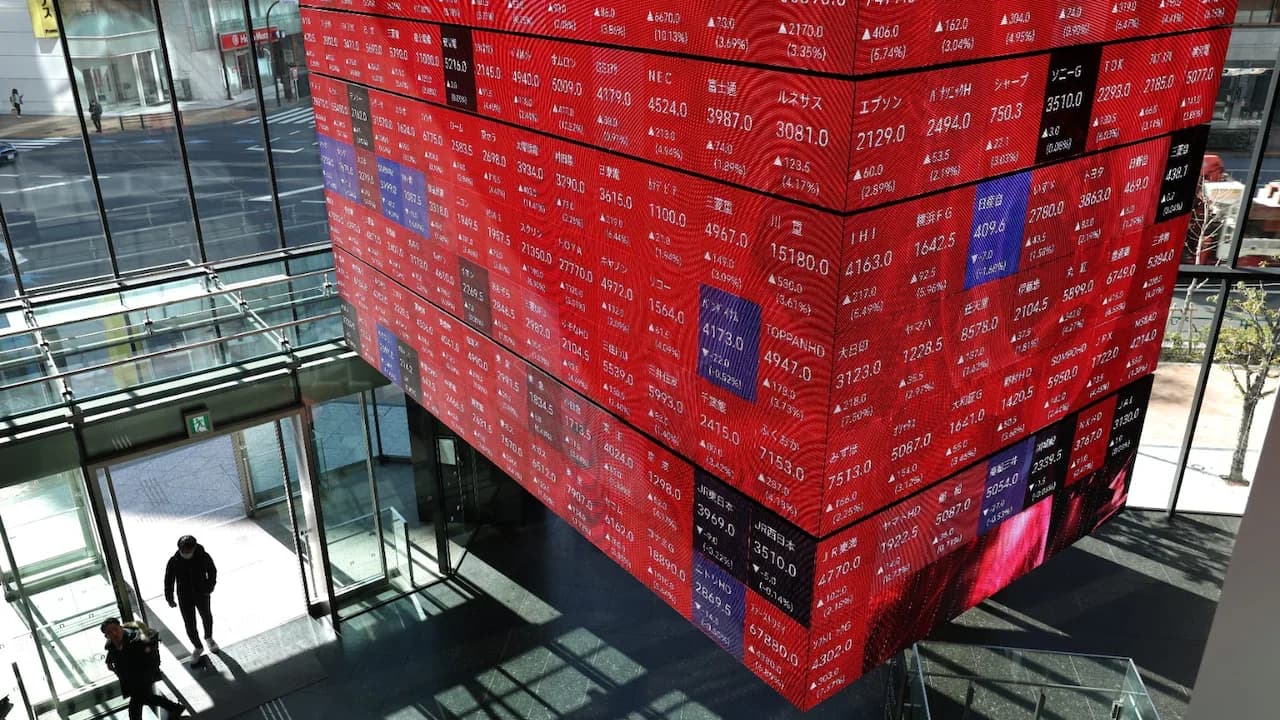
Asian equities opened cautiously on Monday October 26 as investors weighed a fresh bout of AI-linked selling against a heavy slate of earnings and central bank meetings. MSCI's Asia Pacific index eased 0.1% in early trading, following its fourth consecutive decline last week, the longest losing streak since April. Japan's Nikkei 225 dipped 0.8% after losing 4.0% last week, while South Korea fell 0.4%, having shed almost 19% so far this month. In India, the GIFT Nifty which indicates how the country's stock market would commence trading for the day, predicted a muted start in the red. The subdued start follows a rough Friday on Wall Street, where AI-related stocks buckled and a closely watched US chip index extended its losing run to the longest since November. US equity futures gave up their early gains and hovered around flat, with the slide dragging the regional benchmark down more than 6% this month. According to Investing.com, the S&P 500 only slipped 0.5% last week, but the headline badly understated the churn underneath, with communication services falling more than 6% as Meta was punished after earnings. What changed was not the AI story itself so much as the price investors were willing to pay for it, with valuations already stretched and the forward earnings yield on the S&P 500 recently slipping below the 10-year Treasury yield for the first time since the dot-com bust.
The upcoming week will feature critical policy announcements from major central banks, with the Federal Reserve, European Central Bank, and Bank of Japan all set to announce policy decisions. According to reports from Bloomberg Economics, the Fed and its peers in the euro zone and Japan are likely to keep interest rates steady in the coming week, opting to bide their time before potential further hikes. Three days of decisions starting on Wednesday in Washington are likely to affirm a hawkish stance balanced by a measured pace as policymakers confront inflation risks ranging from surging energy prices to the artificial intelligence boom. The Fed raised rates in September for the first time since 2023 and signaled another increase was likely this year, though Fed funds futures trading suggests a 90% likelihood that US Fed will hold interest rates at the current target range of 3.75% to 4% on Wednesday. Markets assume the US Federal Reserve will stand pat, but imply an 80% chance it will hold the trigger in December, with much the same pricing in for the Bank of Japan and the European Central Bank. New Zealand's central bank is widely expected to raise rates on Wednesday, while Canada should start its tightening cycle and first moves are expected from the UK and Sweden next month, according to JPMorgan. The Fed can pause but cannot afford to sound asleep, with the meeting coming only a week before the November 3 midterms.
Three of the so-called hyperscalers - Alphabet, Microsoft, and Amazon - will post results at a time investors are becoming wary of the risks of spending on data centres. As reported by Reuters, the week will be critical to determining if the third quarter lived up to high expectations for US profit growth, with about one-third of S&P 500 companies reporting. Consensus on Microsoft is for $90.6 billion of revenue and an adjusted EPS of $4.73, with Amazon at $202 billion of revenue and EPS around $1.97, while Alphabet revenue is seen at $128 billion and EPS of $3.00. Other high-profile firms set to report include drugmaker Eli Lilly, oil majors Exxon and Chevron, and industrial equipment giant Caterpillar. The results will be particularly important for gauging whether the AI capital investment theme that has driven up equities can fuel the next leg of the rally. In the United States, Alphabet and Microsoft report on Wednesday, followed by Amazon on Thursday, with their capital-expenditure plans and returns from AI investment being central to global technology sentiment. Asia enters its busiest reporting period, with about 550 of the 1,200 or so companies in the MSCI Asia Pacific Index set to publish results, according to Bloomberg data. Results from Intel and Sandisk also could influence the AI trade, offering insights into whether AI loses further momentum and whether investors would need to look towards consumer demand and other areas of the economy for growth.
AI spending under investor scrutiny as investors increasingly question whether returns from AI investments will justify enormous capital commitments made by technology giants. Capital expenditure by major cloud computing companies is expected to reach around $800 billion this year, supporting businesses across the AI supply chain, including semiconductor manufacturers, data centre operators and equipment suppliers. However, higher financing costs and uncertainty over the pace of returns have raised questions about the sustainability of this spending. According to Reuters, Nick Giorgi, chief equity strategist at Alpine Macro, said investors face several competing market catalysts, with technology earnings likely to determine whether companies can justify their substantial AI-related spending. Kevin Mahn, president and chief investment officer at Hennion & Walsh Asset Management, highlighted the importance of earnings in determining investor confidence in the AI trade and the duration of the current investment cycle. King Lip, chief strategist at BakerAvenue Wealth Management, said the latest earnings round would help determine whether the technology sector's pullback represents a buying opportunity or signals the beginning of a deeper market correction. What changed was not the AI story itself so much as the price investors were willing to pay for it, with the market looking straight through the growth story and focusing instead on the size and persistence of the spending bill. Last week was the first meaningful sign that the market may be done writing blank cheques simply because the spending comes stamped with the letters A and I, as Meta was the warning shot and Lam Research delivered another reminder that exposure to the AI buildout and ownership of the AI trade are no longer quite the same thing.
Crude oil prices eased, giving some respite to market sentiment. Brent futures slipped 1.0% to $115.48 amid reports Qatari mediators were in Tehran on Sunday as part of an effort to de-escalate regional tensions in coordination with the United States. Brent futures jumped 6.2% last week to their highest weekly close since mid-2022 as Houthi attacks in Saudi Arabia stoked concerns over energy supplies, while US crude futures fell 1.1% to $102.08 a barrel. However, West Asia continues to keep traders on edge as US President Donald Trump said it was "getting to be decision time" on whether to strike a deal with Tehran or resume attacks. Trump has suggested strikes on Iran could resume after the November 3 midterm elections, with officials warning that the gap between the vote and the new Congress taking office could prove especially dangerous. Washington is cutting diplomatic and military staffing in parts of the Middle East, and the Houthis have repeatedly targeted Riyadh airport, which reopened to commercial flights on Sunday. The longer crude stays at these levels, the less comfortable the soft-landing story becomes, with oil above $100 eventually bleeding into transport costs, margins, inflation expectations and policy. The inflationary pulse from oil is likely to alarm all the central banks meeting this week, with hikes seen as just a matter of time even if some hold for now, according to JPMorgan. The most important risk is that oil futures are above forecasts, largely reflecting concerns about potential further conflict with Iran.
In currencies, the Japanese yen retained its safe-haven appeal at 157.00 per dollar, having gained around 0.8% last week. The euro held steady at $1.1204 as political unrest in France kept investors wary, though the country did escape a credit downgrade last week. Sterling held at $1.3346 with Britain's new finance minister, John Healey, set to deliver his first budget on Wednesday against a backdrop of rising global borrowing costs and high energy prices due to the Iran war. In commodity markets, non-interest-bearing gold was a fraction firmer at $4,001 an ounce, having fallen more than 4% last week. Equity valuations have been tested by higher bond yields, though Treasuries did manage a rally last week before running into renewed selling on Friday. Investors will weigh the Fed's guidance, corporate earnings and economic data against persistent inflation, oil supply concerns and global trade tensions to assess the outlook for US markets. Among individual stocks, SoftBank Group shares rose 0.35%, while Tokyo Electron stock price declined 3.24% and Advantest share price fell 1.67%. South Korea's Samsung Electronic shares fell 0.70%, while SK Hynix shares gained 1.41%, reflecting mixed sentiment across the technology sector as earnings season progresses. The S&P 500 is still up around 11% on the year, the bull market has just passed its fourth anniversary and corporate earnings remain exceptionally strong, but the market has clearly become more selective.