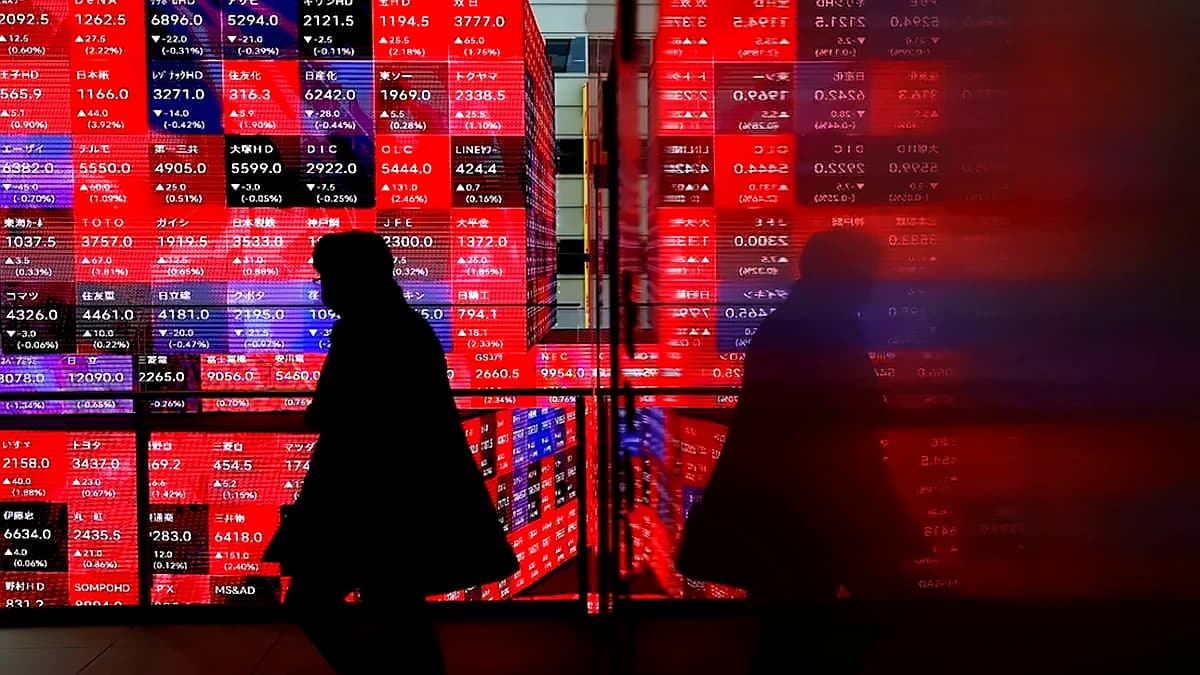
JPMorgan Chase & Co. strategists have issued a warning about potential accelerated yen gains, estimating that ¥16 trillion ($102.6 billion) to ¥17 trillion of bearish yen positions remain outstanding. According to Bloomberg, strategists including Junya Tanase wrote that "recent price action appears to corroborate our view that a relatively large JPY short position may still be outstanding." If dollar-yen breaks below 155, "the risk cannot be ruled out that selling could beget further selling and drive a larger-than-expected yen appreciation." JPMorgan estimates a complete unwind could theoretically push dollar-yen into a 142-146 range, significantly below current levels. The warning comes after one of the currency's sharpest rallies since Japan and the US jointly intervened to support it in late July, with dollar-yen climbing to 160.39 earlier this week, its highest since that operation, before reversing sharply to as low as 155.30.
The yen strengthened 2% Thursday, reversing a month of gradual decline, as traders lifted bets on Japanese interest-rate hikes and were on high alert to the risk of authorities wading back into the market to boost the currency. The yen advanced to 155.52 per dollar in early New York trading, on track for its best day since Tokyo and Washington entered the market to prop up the currency just over a month ago. The rebound from a fall to 160 earlier this week underscores market jitters ahead of the Bank of Japan's Sept 18 policy decision, when the central bank is widely expected to raise rates. Hideaki Minami, director of the foreign-exchange spot trading team at Mizuho Bank, noted that "yen buying may have emerged, particularly among overseas players, on speculation about an outsized rate hike," though he cautioned it's premature to conclude the yen's weakening trend has reversed. Thursday's gains were likely amplified by an unwind of speculative short positions in the yen, alongside hedging demand from domestic investors, according to Chidu Narayanan, chief APAC strategist at Wells Fargo in Singapore.
Asian markets mirrored Wall Street's upward trend, with MSCI's Asia Pacific equities gauge advancing 0.5%, while Japan and South Korea gained benchmarks. The Kospi added 0.56%, while the Topix climbed 0.67%, according to CNBC TV18. This reversal came after the S&P 500 snapped a three-day decline and the tech-heavy Nasdaq 100 rose 0.2%. Technology shares remained in focus after Broadcom Inc. predicted a boom in artificial intelligence chip sales over the next two years, with the advance following a stronger session in the US where technology stocks remained in the spotlight. The Nikkei bucked the broader regional trend, slipping 0.25%, while Hang Seng futures pointed 0.5% higher. The GIFT Nifty is trading over 90 points higher, indicating a gap-up start.
Oil prices retreated after President Donald Trump downplayed fears of an extended confrontation with Iran, but later rose about 1% amid worries about further disruption to energy supplies. Brent crude futures gained 98 cents, or 1% to settle at $95.63 a barrel, while US West Texas Intermediate crude futures rose 79 cents, or 0.9% to settle at $91.01, as reported by Business Standard. This represents a continuation of earlier volatility that pushed oil prices to a five-week high as the threat of further disruptions to the Strait of Hormuz brought about renewed anxiety over inflation. The pullback in oil also supported bonds during the US trading session, dragging US Treasury yields down from the multi-year highs they had touched earlier in the week. Westpac analysts noted that the threat of further disruptions to the Strait of Hormuz has brought about renewed anxiety over inflation, driving a selloff in stocks across most major markets and a rout in global bond markets.
The swaps market has nearly fully priced a 25-basis-point rate increase this month and is factoring in a 75% possibility that the BOJ will deliver an additional hike in December, according to Bloomberg. BOJ board member Hajime Takata on Wednesday reinforced speculation among investors that the central bank could take a more aggressive approach than expected, saying a 25-basis-point hike "is not necessarily set in stone" and that generally speaking, back-to-back rate hikes would be a possibility. Japan's top currency official Atsushi Mimura told reporters he was unsatisfied with the yen's current situation and pledged "to continue the battle on FX," ratcheting up the Finance Ministry's rhetoric. Yusuke Miyairi, FX strategist at Nomura International, noted that Mimura's comments were much stronger than his recent previous comments, adding that his choice of words was significant given that the market has become more nervous about intervention risk. There is still an unusually acute risk of financial-market turbulence from the BOJ's meeting after US Treasury Secretary Scott Bessent stepped up his increasingly public pressure on Japan to raise interest rates. Any failure to follow Bessent's barely camouflaged calls to raise rates would now not only surprise traders, but also send the yen tumbling.
Wall Street stocks ended higher in a partial rebound from their recent fall, which was tied to the escalation in the Middle East and the global bond selloff. The Dow Jones Industrial Average rose 295.07 points, or 0.56% to 53,061.95, the S&P 500 climbed 35.13 points, or 0.46% to 7,666.60 and the Nasdaq Composite was up 118.05 points, or 0.45% to 26,217.83, according to Business Standard. "We're seeing a little bit of a relief rally in stocks after the underperformance that came" with higher yields, said Rick Meckler, partner at Cherry Lane Investments. MSCI's gauge of stocks across the globe was 0.14 points higher at 1,142.87 after ending lower for the previous three sessions, while the pan-European STOXX 600 index fell 0.24%. The Bloomberg Dollar Spot Index was down 0.5% after Federal Reserve Governor Christopher Waller said his next decision on interest rates will be "heavily influenced" by August inflation data, pushing traders to pare back expectations for rate hikes in the US.
US Treasury yields eased from multi-year highs as investors tracked the latest developments in the US-Iran conflict. The yield on benchmark US 10-year Treasury notes shed 0.2 basis point to 4.794%, and was on track to snap its longest streak of daily gains since March, after hitting an earlier high of 4.818%, according to Business Standard. The rise in borrowing costs across major economies had deepened concerns about tighter monetary policy and deteriorating fiscal conditions. The yield on 10-year Japanese government bonds held above 3% for a second straight session after hitting a three-decade high earlier this week. Japan's 5-year government bond yield climbed to 2.295%, a record high, while Japan's 10-year yield hit 3% for the first time since 1996, while yields hit their highest in Germany and their highest since 2008 in the UK. Japanese government bond yields climbed to multi-decade highs, with the 10-year JGB yield rising as high as 3.01%, its highest level since September 1996, while the two-year yield reached 1.83%, the highest since April 1995.