Asian markets declined in early Monday trading after a volatile week, with MSCI's Asia-Pacific index falling 0.2% ahead of this season's busiest earnings week in Asia. According to The Economic Times, the decline came as US equity-index futures erased earlier gains and traded little changed, following the previous session's 2.9% tumble and Philadelphia Semiconductor Index's 6.7% decline - their biggest falls since late June. Tech megacaps that powered a four-year bull run in US equities bore the brunt of the selling as investors rotated into defensive dividend-paying staples and utilities. The weak start followed declines on Wall Street on Friday as the AI trade came under intense pressure and a key US chip gauge posted its longest losing streak since November. Chinese stocks declined on Monday, dragged lower by technology shares and tracking weakness across regional markets, as investors turned cautious ahead of major central bank meetings and corporate earnings.
Chinese technology stocks experienced significant declines, with the ChiNext Composite Index dropping 1.7% and Shanghai's technology-focused STAR50 Index tumbling 1.9%, according to Reuters. The CSI 5G Communications Index plunged 3.7% in morning trading, reflecting continued pressure on technology-related stocks. At the midday break, the benchmark Shanghai Composite Index was down 0.2%, while the blue-chip CSI300 Index fell 0.5%. In Hong Kong, the benchmark Hang Seng Index edged up 0.4%, while the city's technology shares fell 0.4%, reflecting continued divergence between the broader market and the technology sector. Chinese equities experienced volatile trading last week, with blue-chip shares recording their longest-ever weekly losing streak despite increased trading activity in exchange-traded funds favoured by state-backed investors.
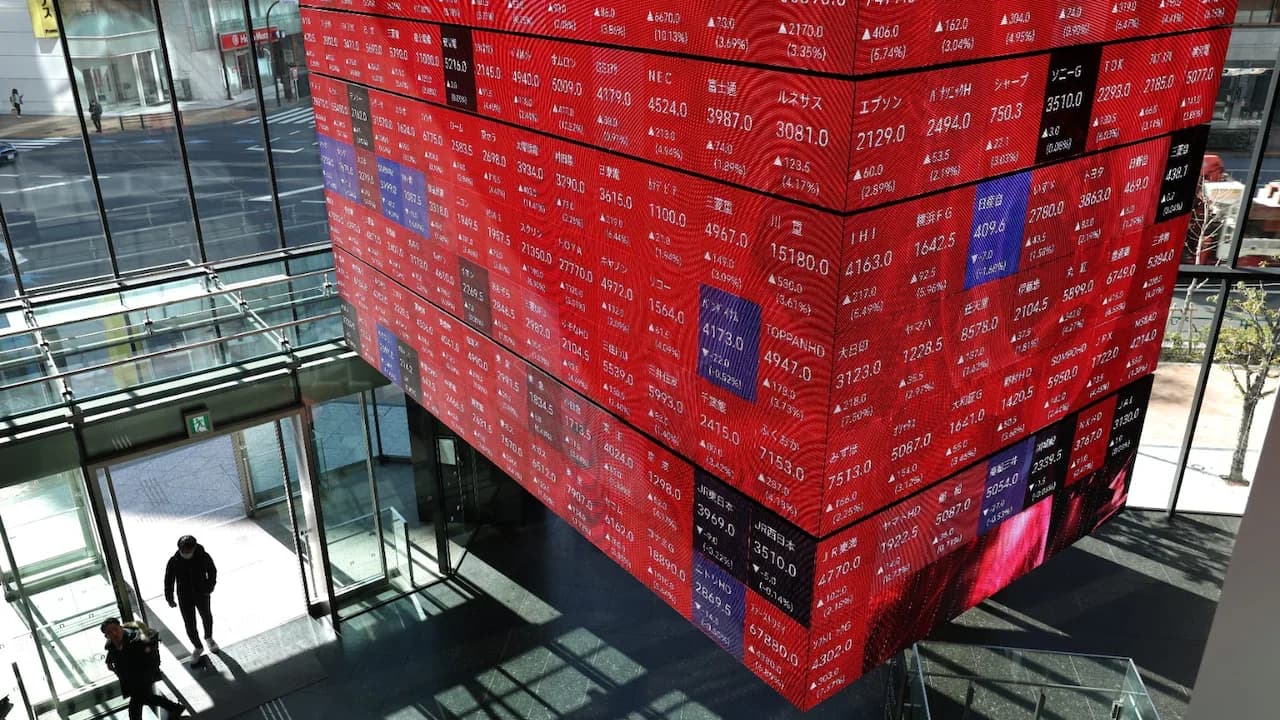
Japan's Nikkei 225 declined 0.43% to 62,425.47 in morning trade, putting it on track for its lowest close since July 30, as reported by Reuters. The broader Topix index rose 0.48% to 3,984.74, contrasting with the Nikkei's weakness. Despite a surge in energy stocks driven by rising oil prices, concerns over global market fluctuations left investors wary. Sumco was the biggest percentage loser on the Nikkei, falling 4.03% and heading for its lowest close since April 2026, while Kokusai Electric dropped 3.86% and Screen Holdings declined 3.78%. Energy and trading-related stocks led the gainers, with Inpex rising 4.92%, JGC Holdings advancing 4.56%, and Mitsubishi Corp gaining 4.28%. According to Reuters, the Nikkei declined despite broadly positive market breadth, with 166 stocks advancing and 59 declining.
South Korean shares fell 1.50% to 5,467.16 points as AI-related concerns weighed on investor sentiment ahead of quarterly earnings from major US technology companies. As reported by The Economic Times, the benchmark KOSPI fell 83.14 points with chipmakers leading losses, as Samsung Electronics fell 1.39% and SK Hynix declined 0.47%. Battery maker LG Energy Solution slipped 1.70%, while Hyundai Motor and Kia Corp dropped 2.71% and 1.78%, respectively. However, despite Monday's decline, the index has gained about 30% so far this year. According to Reuters, SK Hynix said it would announce shareholder return measures on Wednesday alongside its quarterly results, following a report that the South Korean chipmaker is considering a special dividend of around 16 trillion won ($12 billion). Market breadth remained weak, with 792 stocks declining against 98 advancing among the 914 issues traded, while foreign investors were net sellers of South Korean shares worth 517.9 billion won.
Investors face another pivotal week after a volatile stretch for the AI trade, with earnings from Microsoft Corp., Alphabet Inc. and Amazon.com Inc. set to test confidence in the sector. As reported by The Economic Times, about a third of S&P 500 companies are scheduled to report quarterly results this week, including Alphabet, Microsoft and Amazon. Investors are expected to watch their capital expenditure forecasts closely as markets assess the outlook for AI-related investments and spending. Microsoft and Alphabet report on Wednesday, hours after the Federal Reserve announces its rate decision at 2 p.m. Eastern Time, while Amazon follows on Thursday. US stock futures showed continued weakness with S&P 500 e-minis down 0.4% at 7,765.8 as investors assessed third-quarter results from major technology companies. Investor sentiment remained cautious ahead of policy meetings scheduled later this week by the US Federal Reserve, the Bank of Japan and the European Central Bank.
In currency markets, the won strengthened 0.32% to 1,322.0 per dollar on the onshore settlement platform, compared with its previous close of 1,326.2, as reported by The Economic Times. The currency has appreciated about 9% against the dollar so far this year. South Korean government bonds also gained, with December futures on three-year treasury bonds rising 0.09 point to 103.24. The yield on the most liquid three-year Korean treasury bond fell 2.4 basis points to 3.792%, while the benchmark 10-year yield declined 1.9 basis points to 4.080%. Treasuries surged across the curve Thursday as the deepening rout in AI-related shares drove investors toward safety, with the benchmark 10-year yield declining 17 basis points to 4.95%.