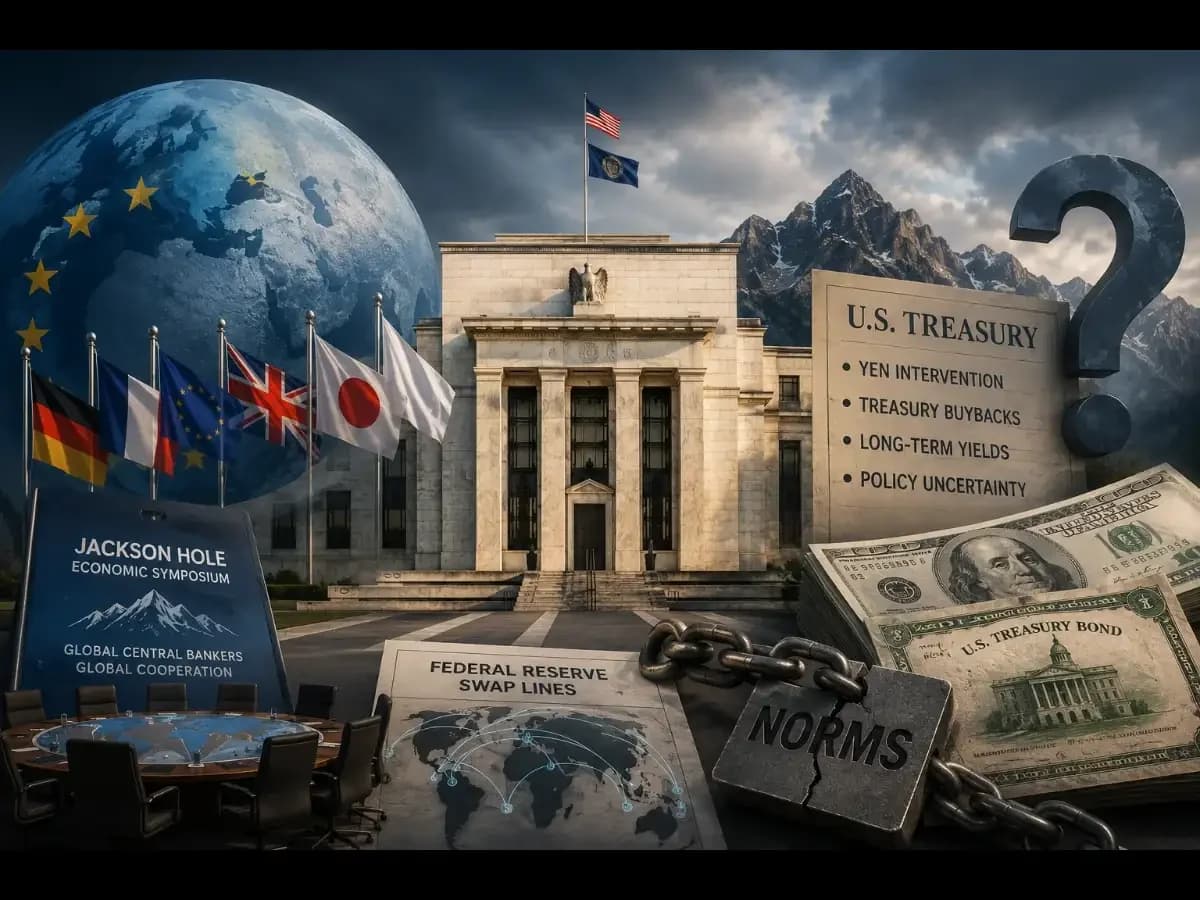
European central bankers left the annual Jackson Hole gathering of global policymakers with concerns that established norms of international financial cooperation could face increasing strain, as uncertainty grows over the relationship between the United States and its allies. According to reports from Reuters, more than half a dozen officials familiar with discussions on the sidelines of the Kansas City Federal Reserve's annual economic symposium said recent US Treasury interventions had heightened concerns among European policymakers. Federal Reserve policymakers sought to reassure their European counterparts during the gathering, promising to honor all commitments and emphasising their commitment to existing international arrangements. However, Fed officials could not provide assurances that U.S. President Donald Trump would not introduce abrupt policy changes, given the separation between the central bank and the administration. The sources emphasised that Trump has shown he is willing to go to extraordinary lengths to get his will across, raising concerns about potential market upheaval that would extend far beyond the United States.
The August 1 yen intervention was a particular source of irritation among European officials because the United States did not provide the customary advance notice that euros would be sold as part of the transaction. As reported by Reuters, Treasury Secretary Scott Bessent later confirmed that the Treasury had sold euros to purchase yen, with the foreign exchange assets coming from the Treasury's Exchange Stabilisation Fund. One European official described the lack of notification as "infuriating" - "You always pick up the phone and give heads-up." Another official said the unusual nature of the transaction could have resulted from an oversight, while others considered it a serious breach of established communication practices. A U.S. official said the intervention was undertaken to counter disorderly movements in the yen and support stability in global financial markets, emphasising it was "not directed at anyone else." However, European officials were especially annoyed by the lack of customary heads-up, with one source noting "The message to me is that the U.S. does whatever it wants."
European central bankers were also concerned about Bessent's plans to increase buybacks of longer-dated U.S. government bonds. According to Reuters reports, such operations could potentially be financed through greater issuance of shorter-term debt. The officials viewed the move as another indication that the administration is prepared to take unconventional steps to influence borrowing costs. As one source noted, "These interventions normally offer just temporary relief. But they are clearly worried. So, what is next? Will they put pressure on the Fed to start buying bonds on the market?" A U.S. Treasury official said the expanded buybacks were designed to improve liquidity in longer-dated Treasury markets and were not intended as monetary policy or as an effort to impose a ceiling on interest rates. However, a U.S. Treasury official had told reporters on Thursday that the Treasury was "really focused on bringing those long-end yields lower" because they had risen above what the department viewed as "fair value."
European officials also raised concerns about the future of the Federal Reserve's dollar swap lines with major overseas central banks. As reported by Reuters, the facilities are viewed as an important pillar of global financial stability because they provide foreign central banks with access to U.S. dollars during periods of market stress. Officials said there was currently no indication that the swap arrangements were at risk and expected them to continue unchanged. The swap lines are authorised by the Federal Open Market Committee and operated by the Federal Reserve rather than the administration, with Treasury officials also stressing that recent actions involving the yen and Treasury buybacks had no implications for the Fed's authority over such facilities. However, some European sources expressed concerns about potential political meddling, with one noting "Rationality doesn't always prevail with this administration. When they run retaliatory trade policies with their closest allies, Trump could just say, 'Hey, they're ripping us off' and the swap lines could be gone overnight."
Fed Chair Kevin Warsh, who travelled to Europe shortly after taking office, has sought to strengthen relations with European policymakers and has generally made a positive impression, according to officials cited by Reuters. His first appearance as Fed chair at Jackson Hole also included the customary photograph with Bank of Canada Governor Tiff Macklem, the gesture carrying added significance amid the Trump administration's increasingly contentious trade relationship with Canada. The European concerns underscore a broader challenge for global policymakers: maintaining established channels of cooperation as U.S. economic and financial policy is increasingly shaped by the Trump administration's willingness to pursue unconventional measures.