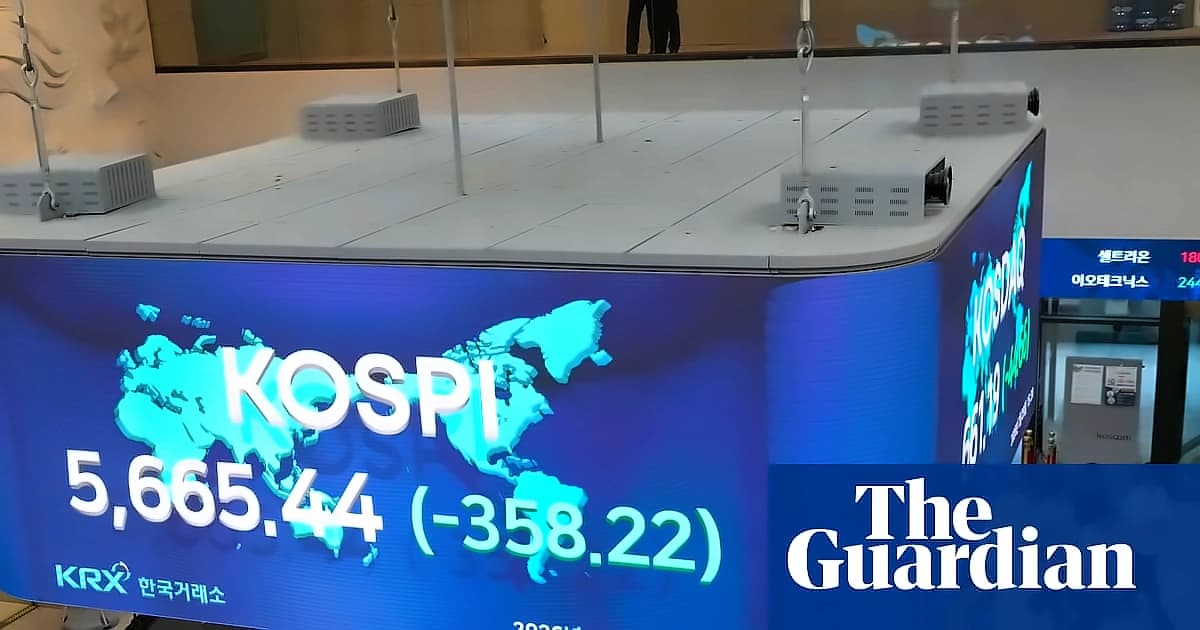
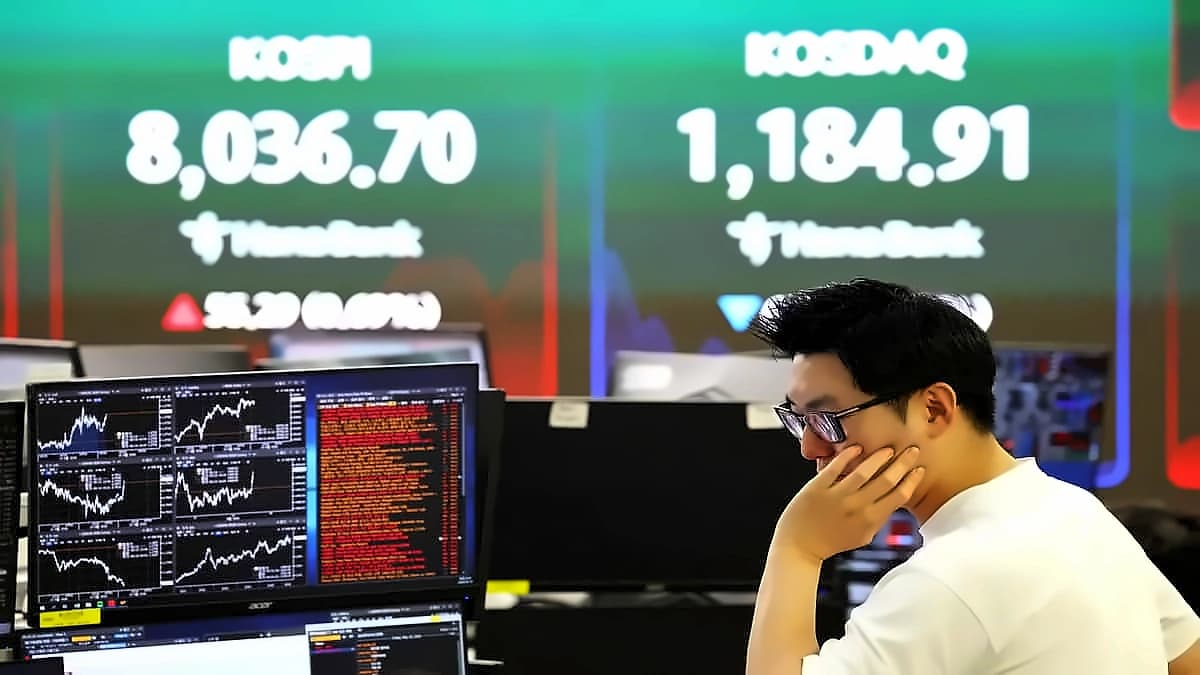
South Korea's Kospi index plunged 8% to 7,478.61, triggering a 20-minute trading halt after the index fell sharply. According to ET Now, the trading suspension was implemented to prevent further volatility and stabilize the market. The decline represents a sharp reversal for a stock that had inched record highs this year, jumping beyond the 9,000 milestone just days earlier, riding the same AI wave that has now dragged it down. Foreign investors were the biggest sellers, offloading a net 1.74 trillion won worth of shares, while institutional investors also sold a net 97.3 billion won and individual investors emerged as net buyers with purchases worth 1.81 trillion won. The broader market saw 357 stocks advancing while 511 declined out of 910 traded stocks.
Samsung Electronics fell 7.4% despite projecting a record operating profit of 89.4 trillion won ($58.4 billion) for the April-June period, beating the average market forecast by 6.2% according to Yonhap Infomax. The estimate includes provisions for employee bonuses, with excluding those provisions, Samsung's quarterly operating profit is estimated to have reached around 100 trillion won. As reported by The Economic Times, the strong performance was driven by the AI-led boom that has pushed memory chip prices to record highs. The stock's decline indicates investors might have already priced in solid results and are increasingly focused on the longer-term trajectory of the memory cycle. The company's quarterly profit soared past elevated expectations due to rocketing demand for memory chips needed in AI data centers, yet the market reaction suggests investors are questioning whether the AI boom can sustain its extraordinary momentum.
The semiconductor selloff has intensified with SanDisk shares sinking 14.13%, Seagate dropping 10.38%, and Micron falling 5.49% over the last 24 hours, as reported by Bloomberg. These companies have now lost 19.59%, 17.54%, and 14.36% respectively over the past five sessions, erasing a chunk of 2026's extraordinary rally. Morningstar's director of research, Lorraine Tan, told Bloomberg TV that AI-linked stocks could fall 20% to 30% before becoming buyable again, citing new supply coming from Samsung and SK Hynix and a potential plateau in AI capital spending. The concerns have been sharpened by Meta Platforms' announcement of building a cloud service to sell its own excess AI computing power, which investors took as evidence that hyperscaler capex may be nearing a ceiling. A separate antitrust suit accusing Samsung, SK Hynix, and Micron of inflating DRAM prices has added to the scrutiny.
Hyundai Motor declined 5.9% while Hanwha Aerospace lost 4%, according to The Times of India. Hanwha Ocean plunged 23% after a South Korean consortium that includes the shipbuilder failed to secure Canada's multibillion-dollar submarine procurement project. POSCO Holdings declined 3.27%, and Samsung BioLogics slipped 0.57%. Among the gainers, cosmetics maker Amorepacific rose 2.9% and leading refiner SK Innovation gained 3.9%. According to The Economic Times, pressure on the sector has intensified after reports that Apple is in discussions to source chips from two Chinese semiconductor manufacturers, raising fears that Samsung Electronics and SK Hynix could face stronger competition. Louis Navellier of Navellier & Associates noted concerns that high memory prices will bring AI solutions that need less memory, and that token pricing of AI software will push users to lower-cost versions, especially Chinese offerings.
The latest sell-off has renewed focus on the growing concentration of South Korea's equity market, with Samsung Electronics and SK Hynix now accounting for around 60% of the KOSPI, up from about 40% two years ago. As reported by The Times of India, over the previous month, regulators had twice intervened by pausing trading to calm markets after sharp declines. According to Julius Baer, daily moves exceeding 5% in the MSCI Korea index have occurred on one-fifth of trading days this year, compared with just 0.8% of trading days in 2025. Mathieu Racheter, head of equity research at Julius Baer, noted that "The latest market action provides an important reminder about concentration risk. Periods of elevated volatility should be expected when investor positioning becomes crowded." The surge has helped the benchmark nearly double this year and made South Korea the world's best-performing equity market, while exposing structural vulnerabilities as market performance has become increasingly dependent on just two companies.