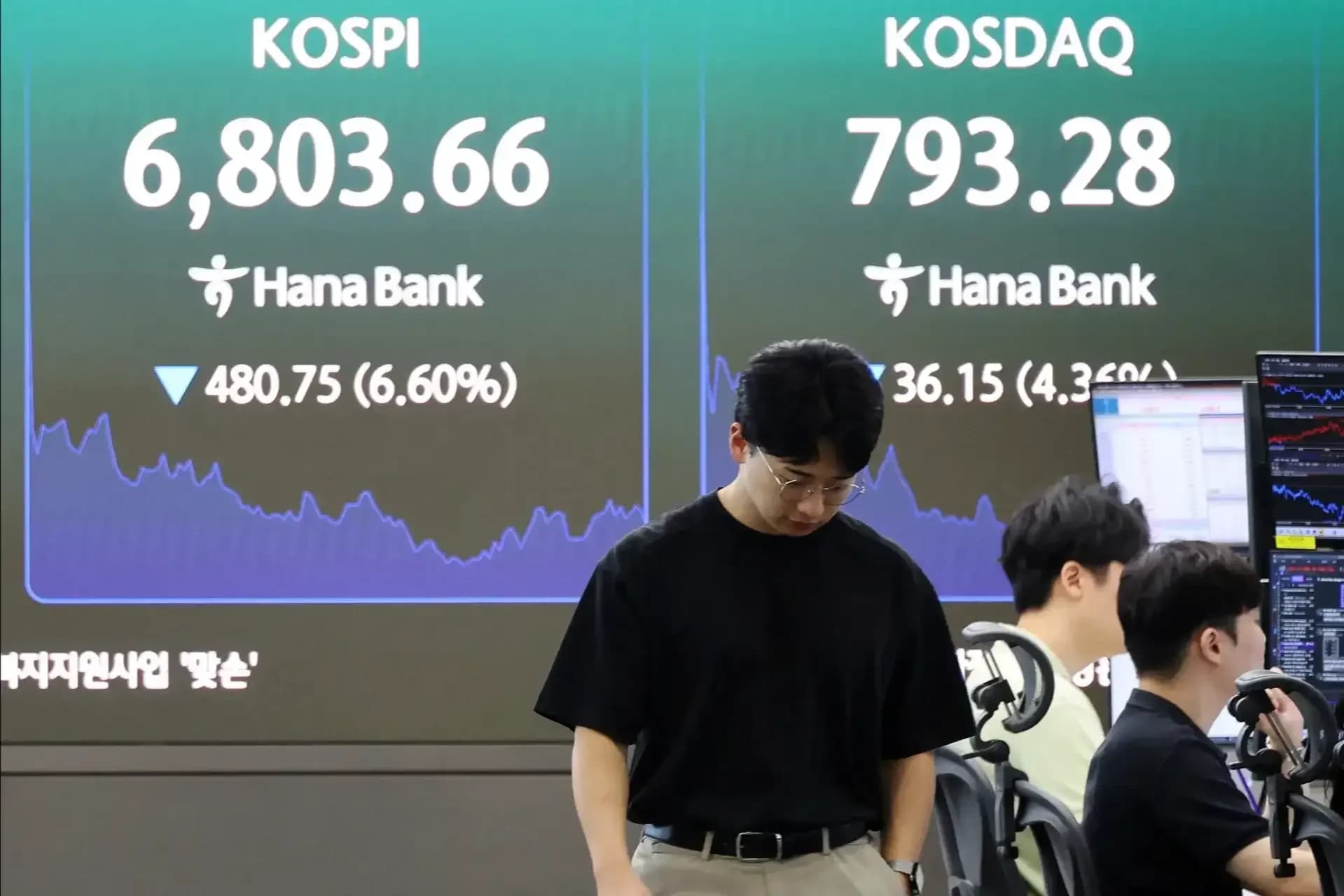
Asian and European equity markets surged Monday as bargain hunting in battered technology shares combined with easing Middle East tensions and a weaker-than-expected U.S. jobs report that reinforced expectations the Federal Reserve could still lower interest rates later this year. MSCI's Asia Pacific Index climbed 0.5%, with more than two shares rising for every one that declined in the gauge. South Korea's Kospi Index advanced 2.2%, ahead of this week's $29 billion US listing for SK Hynix Inc. US equity-index futures held onto Friday's gains, with S&P 500 futures rising 0.5% and Nasdaq 100 futures climbing 1.4% as equity-index futures held gains from Friday. According to The Hindu BusinessLine, European indices rose benefiting from the changed U.S. interest rate outlook, with Euro Stoxx 50 futures up 0.9%. Wall Street did what it has repeatedly done throughout this cycle: it found the dip buyers, with the S&P 500 rising 0.7% and Nasdaq 100 gaining 1.3% after a long weekend and an ugly week for the AI complex.
Technology heavyweights attracted renewed buying as investors selectively rebuilt positions following this week's sharp correction. Samsung Electronics Co Ltd jumped 4% after a report said the company's considering increasing some chip prices, while SK Hynix Inc shares rose 1.4% ahead of this week's listing of $29 billion American depositary receipts. The recovery spread across Asia's semiconductor supply chain, with Japan's Topix climbing 0.6% as exporters and technology suppliers rebounded. Memory chipmaker Kioxia Holdings Corp and Rohm Ltd led gains on the benchmark after this week's sharp AI-driven selloff. Sentiment toward chipmakers remained robust with Nvidia Inc.'s server assembly partner Hon Hai Precision Industry Co. reporting stronger-than-expected sales. In China, technology stocks emerged as the primary drivers with Eoptolink Technology rising 3.34%, Victory Giant Technology adding 0.65%, and Shennan Circuit jumping 7.42%, as reported by Business Standard. However, after its surge in recent months, powered by the rise of AI, the US technology sector nonetheless looks to be searching for fresh momentum, as more investors begin to question the stretched valuation levels that now define the sector.
Investors welcomed key data Thursday showing the U.S. economy added fewer than half the jobs forecast in June, while figures for the previous two months were revised down. The probability of a rate increase as early as late July has fallen from nearly 30% last week to about 18% today, as hiring is slowing and easing the risk of an immediate tightening in Federal Reserve monetary policy despite current inflation pressures. According to The Hindu BusinessLine, traders trimmed expectations that a hike was imminent following softer-than-expected jobs data and Chair Kevin Warsh's comment that inflation pressures had eased. Speculation had grown since the central bank's June policy meeting that it would announce a rate increase this year because of elevated inflation. The US labour market today is not strong enough to instigate rate hikes but importantly is no longer a handbrake or impediment to hikes, said Rodrigo Catril, analyst at National Australia Bank. Against such a backdrop, the likelihood of a US rate hike before the end of the year remains, according to some analysts. Futures now imply a 78% chance of a steady outcome at the July 29 meeting, with the cooling in energy costs combined with softer payrolls leading markets to scale back near-term hike expectations.
Oil prices slipped as energy flows through the Strait of Hormuz persisted and OPEC+ signaled higher supplies. Brent crude fell 0.3% to $71.88 a barrel as shipping through the US-protected corridor in the waterway showed signs of recovering, with 160 vessels reported passing through the Strait of Hormuz from Monday to Saturday last week. OPEC+ members also backed another modest rise in collective quotas for next month, with OPEC+ agreeing a further increase in output targets by 188,000 barrels per day from August. West Texas Intermediate crude fell 0.2% to $68.56 a barrel, reaching near four-month lows. The Japanese yen traded at 161.55 per dollar after touching a 40-year low versus the greenback last week, while the dollar was steady in early Asian trading. The won was also in focus as the Korean currency was steady after rebounding late Friday from its weakest level against the dollar since 2009 after officials prepared for currency flows related to SK Hynix's ADR offering. Goldman Sachs Group Inc. revised its yen forecast to 165 per dollar in a year's time from 155 previously, with strategists noting that the broader macro backdrop of higher-for-longer US yields, low recession risk, lingering fiscal concerns, and only gradual BOJ hikes strongly argues for continued depreciation pressure on the currency.
The diminished risk of a Federal Reserve rate hike this month should allow investors to focus on the looming earnings season, where the AI boom is set to deliver bumper tech profits. Samsung Electronics is set to make a splash on Tuesday as analysts expect an 18-fold increase in profits, with the world's largest memory chipmaker by sales likely to flag an operating profit of 86 trillion won ($56.35 billion) for the April to June quarter. This week has just Delta Air Lines and PepsiCo as tasters, though the earnings calendar includes major tech companies. Tech stocks and tech-heavy indices in the US and Asia have entered a period of consolidation ahead of the Q2 earnings season, said Tony Sycamore, an analyst at IG Markets in Sydney. South Korea's red hot market cooled a little last week but is still up 92% for the year so far as AI demand and tight supplies boost chip prices, with the index adding another 2.25% on Monday. MSCI's broadest index of Asia-Pacific shares outside Japan gained 0.4%, while S&P 500 futures firmed 0.5% and Nasdaq futures climbed 1.4% on top of a 2.1% gain last week. The data calendar kicks off with the U.S. ISM Services survey later on Monday where forecasts favour a slight pullback to a still-healthy 54.0 in June, with a clutch of central bankers speaking at an ECB conference including Fed Board Governor Christopher Waller. Treasuries were steady as cash trading resumed following Friday's holiday, with the US sovereign debt market facing a test of investor demand for longer maturities this week, including auctions of 10- and 30-year Treasuries. Gold gave up its initial gains to trade around $4,175 an ounce while silver rose 0.4% to about $62.66 an ounce.