The Tokyo Financial Exchange will launch a futures contract linked to the Bank of Japan's overnight call rate this month, seeking to give traders a tool to hedge growing interest-rate volatility as the central bank moves into a more active phase of policy tightening. According to Reuters, the new contract lets market participants position for interest-rate changes between BOJ policy meetings, as expectations for the timing and pace of further rate hikes become increasingly important for Japan's financial markets. The exchange's existing three-month Tokyo Overnight Average Rate (TONA) futures have not fully met demand from traders looking to hedge shifts in rate expectations around individual BOJ meetings, with trading activity in the contract falling nearly 50% in September from a year earlier, as reported by the Tokyo Financial Exchange.
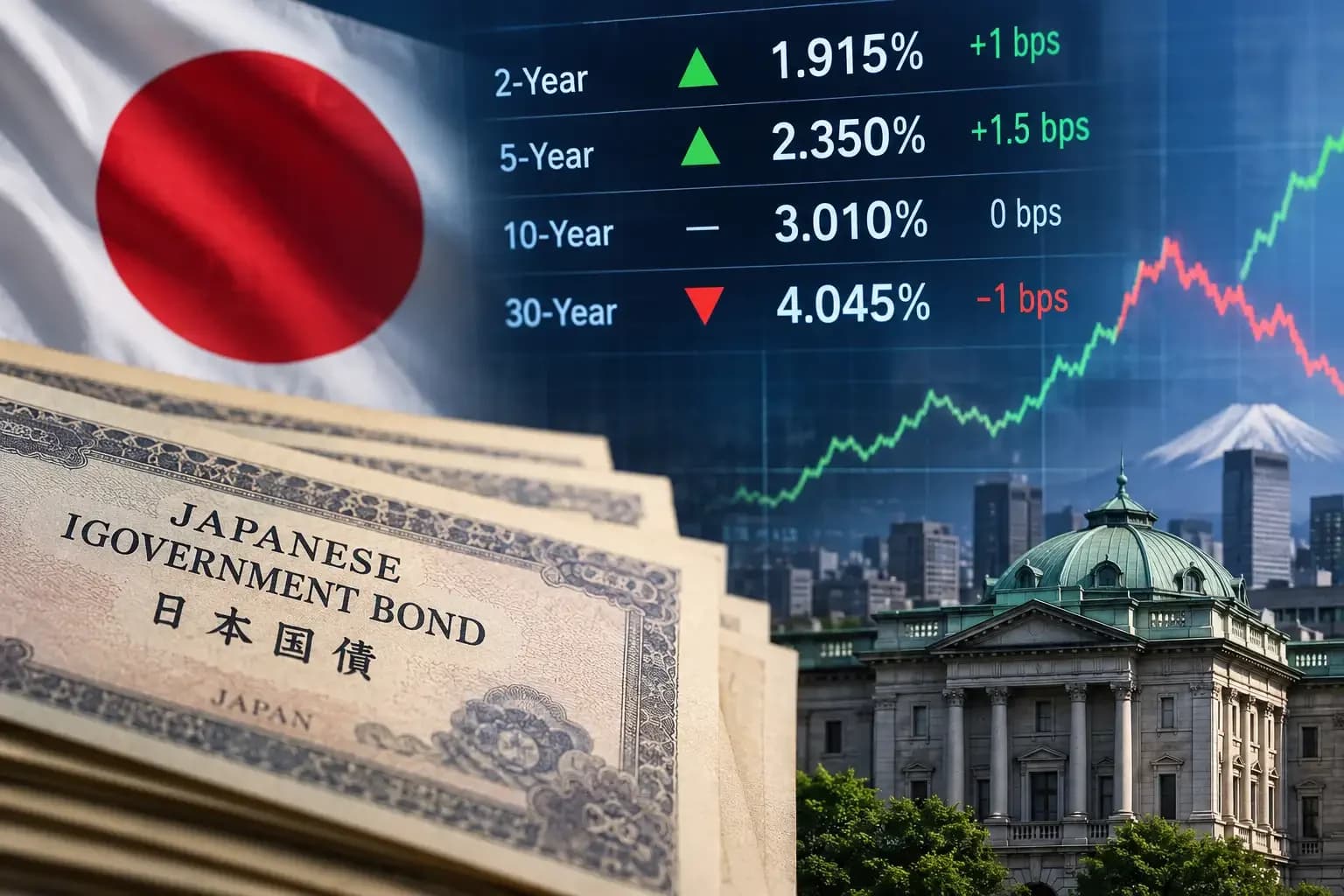
Japanese government bond yields declined on Thursday, with the 30-year yield retreating from a record high as investors remained cautious about the Bank of Japan's policy tightening path ahead of a closely watched 30-year debt auction. The 10-year JGB yield fell 2.5 basis points to 3.080%, while the 30-year yield declined 4 basis points to 4.170%. As per Reuters, the Japanese finance ministry is due to auction about 600 billion yen ($3.80 billion) of 30-year bonds later on Thursday, with the 30-year yield having touched a record 4.25% on Monday amid concerns over Japan's deteriorating public finances and spillover from a selloff in French government debt. The retreat in JGB yields also tracked a decline in global bond yields, with U.S. Treasury yields easing from multi-decade highs after strong demand at a 10-year Treasury auction and lower oil prices helped temper inflation concerns.
The Bank of Japan may signal later this month that underlying inflation has roughly reached its 2% target, strengthening expectations of another interest rate increase in December, according to three sources familiar with the central bank's thinking. Such a signal would be largely symbolic but would reinforce dominant market expectations for a December hike and demonstrate the BOJ's willingness to raise interest rates at relatively short intervals if price pressures continue to develop in line with its projections. The central bank has begun stressing the need to anchor underlying inflation around its target in judging the pace and timing of further interest rate increases. As per Reuters, this shift represents a meaningful change in policy backdrop for a central bank that has spent years trying to generate sustainable inflation.
Market participants are now pricing in an 86% chance of no October rate move and around 64% odds of another hike by December, according to latest trader sentiment. The shift reflects the BOJ's cautious approach after raising rates in September, with many policymakers preferring to gather more evidence on how previous rate hikes have affected domestic financial conditions. The BOJ last month raised its key policy rate for the second time this year to 1.25%, its highest level in 31 years, with markets widely expecting another increase by December, marking a considerably faster pace of tightening than the roughly six-month intervals between rate increases seen previously. The sources note that many in the central bank would prefer to take a more cautious step in October, wanting to gauge more data on how previous rate hikes are filtering through to the economy.
Recent economic data, including Tokyo consumer inflation and the BOJ's quarterly Tankan business survey, are likely strengthening the central bank's confidence that underlying inflation has broadly reached its 2% target, the sources stated. At the same time, the Tankan survey showed that corporate inflation pressures were moving sideways rather than accelerating sharply, reducing immediate pressure on policymakers to deliver a second consecutive rate increase this month. Inflation expectations remain elevated but are not flaring up, suggesting that while inflation risks remain, they are not heightening sharply. As one source noted, "All in all, prices are moving in line with the BOJ's projections," indicating that underlying inflation was now roughly around its target. The sources point to steady wage gains alongside firmer consumer and wholesale inflation as reasons for the change in tone, with recent Tokyo inflation data and the BOJ's Tankan survey adding to confidence that underlying inflation is now close to 2%.

Continued increases in wholesale and consumer prices, steady wage growth and a renewed rise in crude oil prices have further strengthened expectations that underlying inflation could remain sustainably around the BOJ's target, the sources told Reuters. At its September meeting, Governor Kazuo Ueda indicated that underlying inflation, which reflects the broad demand-driven trend in prices after stripping out temporary factors, was quite close to the BOJ's 2% objective. The shift in tone underscores the readiness to raise interest rates again in the coming months, though there is little urgency to move straight away after having raised interest rates in September. Demand for overnight index swaps (OIS) has been increasing as investors seek to manage exposure to Japan's evolving rate outlook, with the notional value of yen-denominated OIS contracts covering maturities of up to and beyond 30 years reaching a record high last month, according to the Japan Securities Clearing Corp.
The BOJ remains focused on limiting inflation risks and could still signal its readiness for another rate increase in the near term. In its previous quarterly report released in July, the BOJ projected that underlying inflation would reach levels consistent with its 2% target sometime between October 2026 and March 2028. The BOJ will likely point to such factors in signalling that underlying inflation has roughly hit its target in a quarterly report due after its next policy meeting on October 29-30. The central bank has raised its key rate to a 31-year high last month, with Governor Ueda signalling the central bank has entered a phase focused on preventing underlying inflation from overshooting its target, raising the prospect of tighter policy in the coming months. The October meeting is positioned as another building block towards further tightening, with market debate gradually shifting from "whether further normalisation is justified" to "how quickly rates should rise."