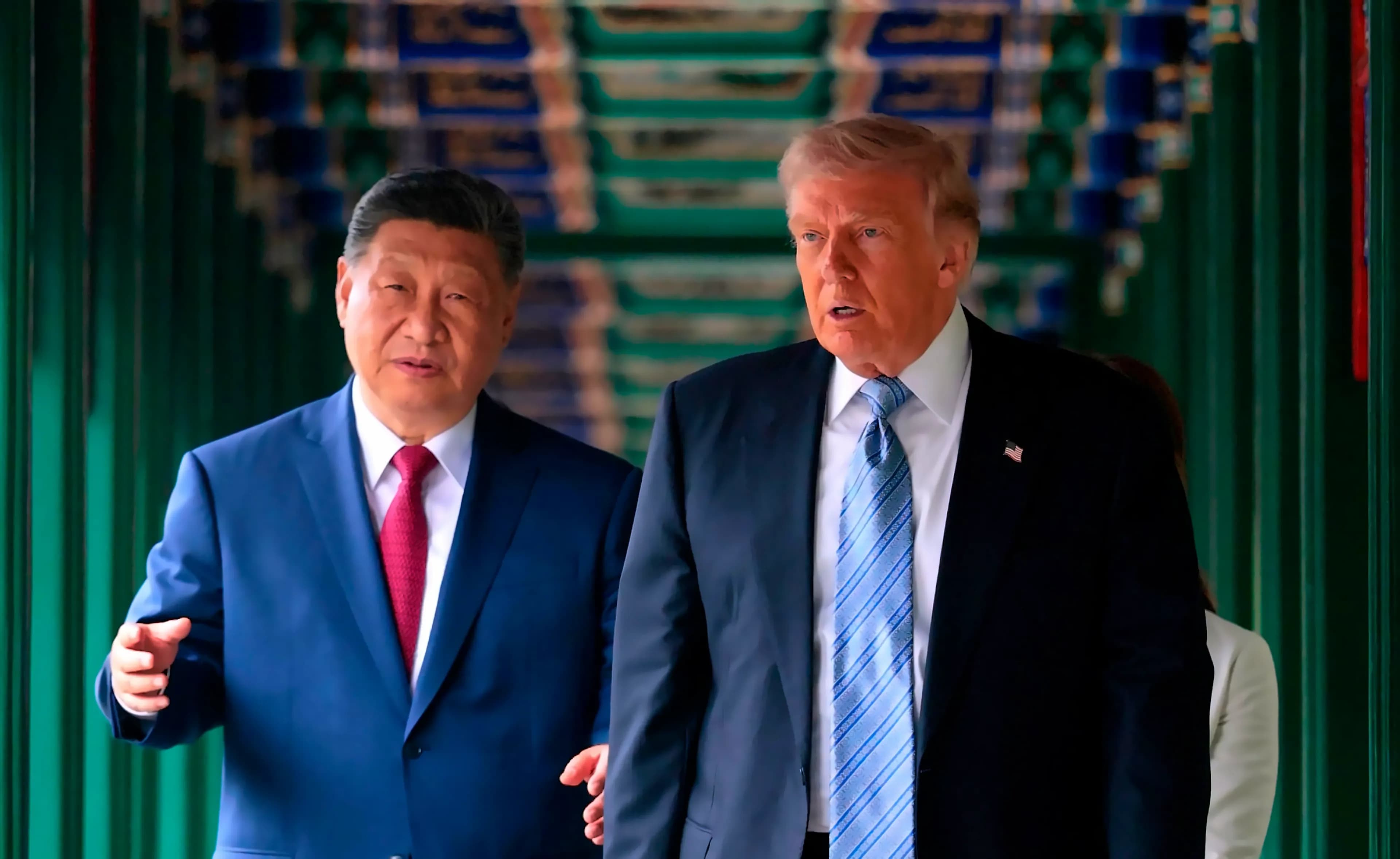
US President Donald Trump will arrive in Beijing on Wednesday (May 13) for a state visit that runs through May 15, marking the first visit by a sitting US president to China in almost nine years. Originally scheduled for late March, the trip was delayed by the US-led war against Iran, which has upended global energy markets and reshaped the diplomatic terrain on which the two leaders will meet. According to TheWire.in, Trump and Chinese President Xi Jinping will hold formal talks at the Great Hall of the People on May 14, followed by a tour of the Temple of Heaven UNESCO heritage site, a state banquet and a working lunch on May 15. A business delegation including Tesla's Elon Musk and Apple's Tim Cook will accompany Trump, though it is smaller than the one that travelled with him when he last visited Beijing in 2017.
The Middle East war that erupted on 28 February sent Brent above USD 100 in March, prompting the IEA to call it the most severe oil supply shock on record. As reported by Investing.com India, US and Israeli strikes on Tehran followed Washington's earlier moves against Caracas, with Iran and Venezuela together representing two of Beijing's most significant overseas resource investments. The Strait of Hormuz matters profoundly here, as both Washington and Beijing understand the global economy cannot function smoothly with one of the world's critical energy arteries operating like a partially blocked heart valve. Markets have rallied partly because traders believe neither side benefits from allowing the energy system to spiral into full-scale supply stress, with the real fear being duration rather than sudden oil spikes. However, analysts note that even if a diplomatic breakthrough occurs, it takes weeks for rerouted shipping to normalize — prices won't fall overnight. Recent developments show that Brent could approach the $130-$150 per barrel range in a worst-case military escalation scenario, with the Eurasia Group projecting prices will remain above $80 per barrel through the end of 2026 even with partial diplomatic progress.
The centre of gravity in US-China economic statecraft has migrated away from tariffs toward Chinese control over critical minerals, rare earths, and magnet supply chains. According to Investing.com India, when China tested this leverage in April and October 2025, Washington blinked, with the Busan truce cutting US tariffs on Chinese imports from 57% to 47% after they had earlier been pushed past 140%. The Global Times has been circulating the phrase 'Giant With a Limp' to describe the United States this week, while Qiushi argues the Iran conflict has 'overdrawn US strategic resources'. China controls the overwhelming majority of global rare earth supply, giving Beijing leverage that increasingly resembles control over financial plumbing during a banking crisis. However, analysts note that China has no formal security relationship with Iran and cannot compel Tehran's compliance through military or diplomatic command, with its leverage being economic and reputational only.

The realistic base case includes extending the October 2025 détente with concrete commitments on Chinese purchases of US soybeans, beef, and potentially a large Boeing aircraft order of 500 airframes. As reported by Investing.com India, a bilateral Board of Trade is expected to be announced, with Beijing pushing for a matching Board of Investment. The analysis suggests that Chinese regulators have quietly instructed major state banks to stop lending to five Chinese refiners sanctioned by Washington for handling Iranian crude, indicating caution in the current environment. Even a constructive joint statement from the Trump-Xi summit calling for Strait reopening would carry significant market weight, potentially triggering a 3-5% downward correction in crude prices as geopolitical risk premiums partially unwound. Markets understand that symbolism matters almost as much as the actual trade volumes themselves, with agriculture remaining the most politically symbolic pressure valve available to both sides.
The oil prices Iran ceasefire Strait of Hormuz crisis is accelerating a structural reassessment of global energy security architecture. US consumer prices rose sharply for a second consecutive month in April 2026, producing the largest annual inflation increase in nearly three years, according to ETEnergyWorld. This transmission mechanism through transportation costs, manufacturing inputs, agricultural production, and retail energy pricing is well understood by economists but often underestimated by consumers experiencing it in real time. The Eurasia Group's projection that prices will remain above $80 per barrel through the end of 2026 establishes the lower boundary of realistic expectations, with the upper boundary defined by conflict escalation pace. If the summit passes with no resolution, the market is going to have to price in a longer war, which could drive oil prices higher and inflation hotter than anticipated. For anyone in or near retirement, the right move isn't to panic — it's to pressure-test your plan against a world where oil stays at $90-$100 and inflation runs hotter than anyone hoped.