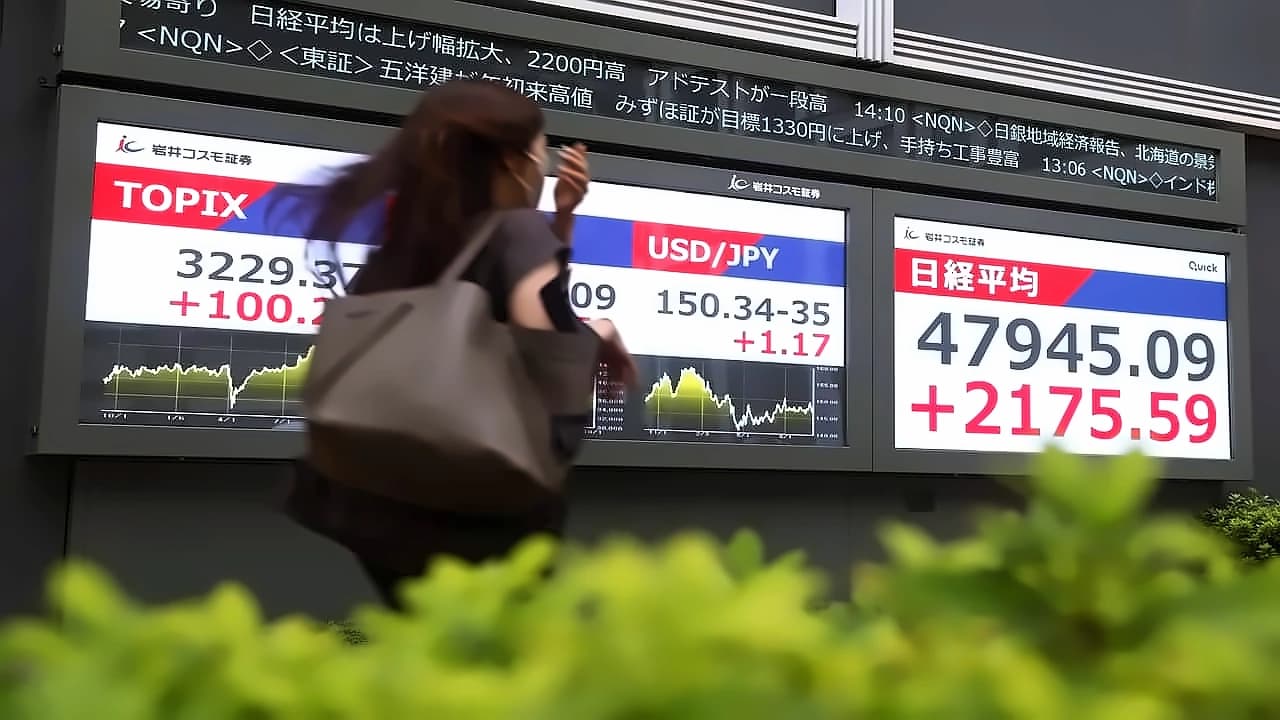
Asian equity markets opened broadly higher on Monday, with South Korea's KOSPI rallying 3.1% and Japan's Nikkei 225 rebounding 2.2% after losing similar amounts last week, according to Business Standard. MSCI's broadest index of Asia-Pacific shares outside Japan climbed 1.1%, while Chinese blue chips added 0.2% with some relief that China's finance ministry will lead a combined $54 billion capital injection into state-owned insurers and banks. The gains came after robust US jobs data was seen as positive for global growth, though it narrowed odds on a Federal Reserve rate hike. Equity-index futures for Japan and South Korea pointed to gains at the open, while Australia's S&P/ASX 200 futures were steady, as reported by Straits Times. US technology shares had advanced on Friday, helping lift sentiment across Asian markets, with some traders pointing to an uber-bullish outlook from Goldman Sachs predicting a further 75% rise in the Kospi to 12,000, though this has been a long-standing call.
Oil prices moved higher as the latest US-Iran confrontation heightened concerns about energy supplies and shipping through the Strait of Hormuz. Brent crude climbed 0.7% to reach $96.97 a barrel, having climbed almost 8% last week, while West Texas Intermediate crude rose 0.8% to $92.24 a barrel, according to Business Standard. Tehran said it will announce a restricted zone outside the Strait of Hormuz in coming days, after US forces hit three Iranian tankers and Iran's Islamic Revolutionary Guard Corps launched ballistic missiles at two US Navy ships. European natural gas prices also rose as much as 4.2% in thin trading, with the latest attacks suggesting little immediate prospect of an end to the war the US and Israel launched against Iran more than six months ago, adding to inflation concerns. The price movements reflect investor concerns about potential disruptions to global oil flows through the strategic waterway, with diesel prices hitting record highs last week - the fuel that matters most for transport, shipping, farming and manufacturing.
The US said it had struck three Iranian oil tankers over the weekend, destroying one, after accusing Iran of launching ballistic missile attacks against US Navy warships. Iran subsequently said it would establish a new restricted zone outside the Strait of Hormuz, with the proposed area beginning at the US Navy blockade line and extending into parts of the Persian Gulf. Iran also said it had targeted three tankers in response to the US strikes, although the claim had not been independently corroborated. The Islamic Revolutionary Guard Corps Navy gave no further details on the strikes, and its Telegram post late on Sept 5 did not specify whether the vessels were hit. Iran's top security official Mohsen Rezaee said a new restricted zone would be declared outside the strait in the coming days, according to Press TV. US Secretary of Energy Chris Wright cautioned that a nuclear agreement with Iran may not be reached soon, suggesting there might not be an agreement and that a deal could instead be left for a future administration in Iran.
Market focus is shifting to upcoming US inflation data that could impact Federal Reserve rate decisions, with a September Fed funds rate hike hinging on Friday's US August CPI print, according to Business Standard. Median forecasts are for a rise of 0.2% in the core CPI, with a risk of 0.3%, which could significantly impact monetary policy. A hot CPI print would all but seal a September hike and underpin a firmer US dollar, while a cooler reading would strengthen the case for a hold and leave USD vulnerable to a dovish Fed repricing. Futures imply a 75% chance of another hike to 3.0% by December, with markets pricing a 58% chance of a hike when the Fed meets on September 16 and 70% for a move in October. Bruce Kasman, global head of economics at JPMorgan, is looking for core CPI to rise 0.21%, which he thinks would be low enough to keep the Fed on hold, if only for now. The People's Bank of China kept its key interest rate unchanged at 3.7% on Wednesday, as reported by NDTV Profit. Markets are pricing a 75% chance the Bank of Japan will raise rates a quarter point at its meeting on September 18, with a 60% probability of another move by December.

In currency markets, the dollar index got only a mild lift from the jobs report as worries about ever-growing US debt and policy uncertainties erode the purchasing power of the currency, according to Business Standard. The dollar index stood at 99.135, not far from recent lows at 98.558, while the euro held at $1.1610, within sight of the August top at $1.1711. The dollar was a tick easier at 156.11 yen, and still threatening major support at 155.00 after losing 2.4% last week as the yen rallied on speculation about a more aggressive BoJ tightening. President Donald Trump caused a stir on Friday when he posted a warning that he would cease international trade with countries running a trade surplus with the United States if the Fed did not slash interest rates as he wanted. Rising bond yields remain a drag for equity valuations, with Treasury 10-year yields near their highest since late 2023 at 4.7840%, and a high CPI reading would likely see yields edge closer to the psychological 5.0% barrier. Gold slipped 0.5% to $4,406 an ounce, after finding support at $4,282 last week, with the precious metal benefiting from safe-haven demand amid geopolitical tensions.