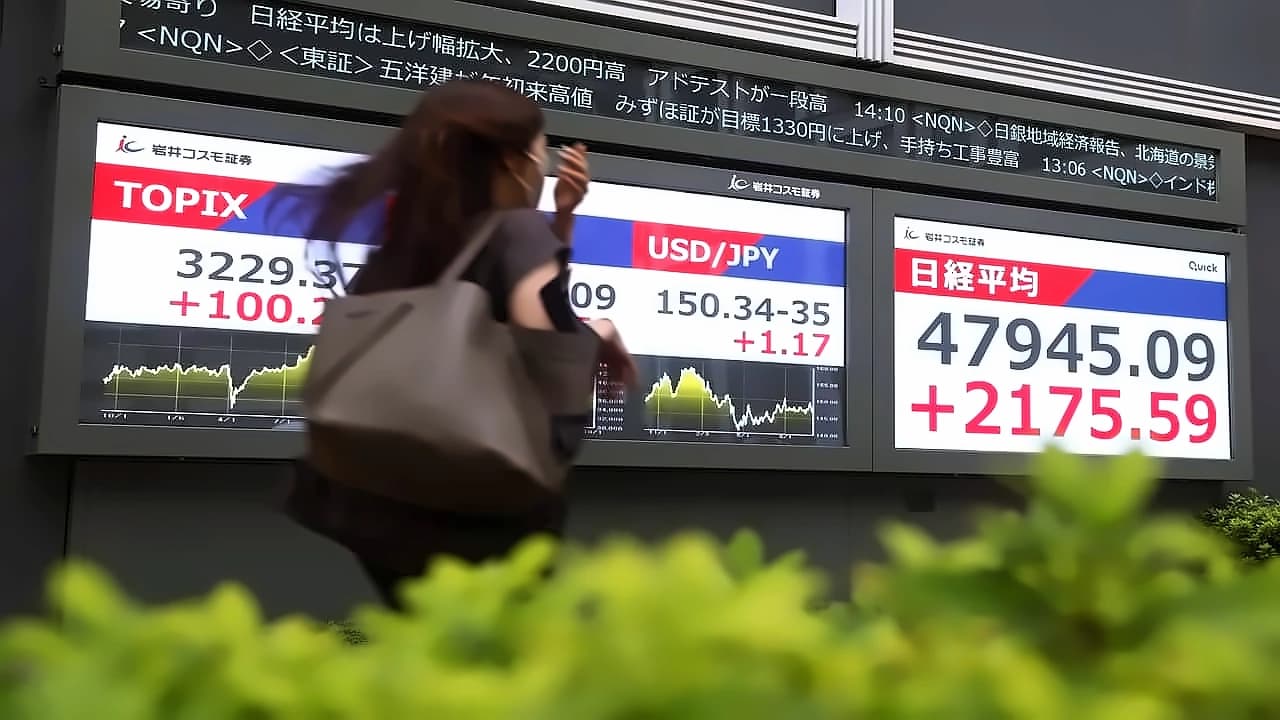
Asian markets delivered strong gains on Wednesday, with MSCI's broadest index of Asia-Pacific shares outside Japan rising 1.5% as investors followed a global rally. According to Reuters, Japan's Nikkei surged more than 3% to 65,979.02, while the broader Topix index gained 1.52% to 4,022.18. The surge was driven by strong earnings from technology companies and a resurgence in tech demand, while hopes for progress on opening the Strait of Hormuz dragged on oil prices and provided additional market support. Japan's Nikkei 225 climbed 3.34% Wednesday to 66,090 points, marking its sharpest one-day gain in weeks, as reported by CNBC. The rally followed an overnight surge on Wall Street, with the S&P 500 and Dow Jones Industrial Average both closing at record highs, while the Nasdaq Composite led gains, climbing 2.59%. Market breadth remained firmly positive, with 67% of more than 1,500 stocks listed on the Tokyo Stock Exchange's Prime Market advancing, 29% declining and 3% unchanged, according to Reuters.
The tech sector showed mixed performance as investors took profits on some winners while remaining optimistic about the overall trend. As reported by Reuters, Japanese semiconductor-related stocks led the gains, mirroring a sharp overnight rally in the Philadelphia Semiconductor Index, which climbed 6.6%. Chip-testing equipment maker Advantest jumped 8%, while chip equipment manufacturer Tokyo Electron gained 4%. Murata Manufacturing, a major supplier of multi-layer ceramic capacitors used in AI servers, rose 8.33% after raising its full-year net profit forecast, reflecting growing optimism over AI-driven demand. Investor sentiment also received support from Fanuc, which gained 3.67% after the industrial robot maker raised its annual net profit forecast. However, Fast Retailing, the owner of the Uniqlo brand, declined 1.82%, making it the biggest drag on the Nikkei, while air-conditioning manufacturer Daikin Industries dropped 8%, marking the sharpest percentage loss among Nikkei constituents. This has been a recurring concern for all AI stocks given the vast cost of compute power, with borrowing costs for the sector continuing to rise.
Oil prices continued their decline as geopolitical developments provided additional relief to global markets. According to Reuters, softer crude oil prices and lower U.S. Treasury yields, amid hopes for a deal related to the Iran conflict, also supported market sentiment. The pullback came as Treasury Secretary Scott Bessent told CNBC Tuesday he expects a deal "today or tomorrow" to reopen the strait, calling it a critical corridor for global oil shipments. Bessent's comments followed Trump's Monday Hormuz talks announcement, with Qatar saying mediators were making progress in efforts to end the US-Iran war. The oil price slide provided significant relief from inflation fears and boosted bonds globally, with the 10-year Treasury yield now at 4.6187%, down from last week's high of 4.747%. Markets also sharply pared the probability of a September rate hike from the Federal Reserve to 57% from 67%.
The Japanese yen retained most of its gains after last week's joint intervention by Tokyo and Washington, with traders remaining wary of further actions. According to Business Standard, the dollar was a shade lower on the yen at 157.53, with the threat of intervention lingering over traders. The currency had surged as much as 5% over the last three trading sessions, with Japan confirming coordinated yen-buying intervention on Friday with the United States in a rare move. US Treasury Secretary Scott Bessent said he was sure Bank of Japan Governor Kazuo Ueda will "do what is best" for the country's economy, which markets took as encouragement to raise interest rates further. "I expect concerns about the possibility of further intervention by Japanese and U.S. authorities (to) constrain downside pressure on the yen in the near term," said Tomo Kinoshita, global market strategist for Japan at Invesco.
The U.S. dollar strengthened against the yen while other currencies remained relatively stable. As reported by Business Standard, the euro was flat at $1.1532, just short of its recent six-week high at $1.1559. The New Zealand dollar slipped 0.2% after data showed unemployment hit a decade peak of 5.6% in the June quarter. The U.S. 10-year Treasury bond yield rose 0.2 basis point to 4.684%, while market pricing continues to indicate a 65% probability of a 25-basis-point Fed rate hike at the September 16 meeting. Fed Bank of Kansas City President Jeff Schmid used a speech on Tuesday to call for tighter policy to help bring inflation back to the central bank's 2% target. The cheaper oil eases cost pressure on energy-dependent economies like Japan and South Korea, providing additional support for regional markets.