Oil prices provided the biggest jolt to markets as Brent crude climbed more than 2.9% to $107.65 a barrel after Saudi Arabia closed its East-West pipeline, a key alternative route to the Strait of Hormuz for its oil exports, following multiple attacks. WTI futures rose $2.27, or 2.27%, to $102.32 per barrel with prices initially rising more than 3% at market open. As reported by CNBC TV18, fresh attacks involving Saudi energy infrastructure and shipping in the Gulf have heightened concerns over disruptions to global oil supplies, while a planned Oman meeting on reopening the Strait of Hormuz was postponed. Saudi Arabian state media on Sunday released video footage of damage to homes and a mosque from what it said was a Houthi attack on the country's southern Jazan province, with the Houthis also striking a Saudi military base in a neighbouring province. A vessel in the Strait of Hormuz was struck by a projectile, causing a fire and forcing the crew to be evacuated, according to the British maritime security agency UKMTO. Iran said one person was killed and four crew wounded aboard an Iranian commercial vessel struck off its coast. The loss of Saudi Arabia's East-West oil pipeline, which helps the country re-route exports avoiding the Strait of Hormuz, threatens up to 4% of global oil supply. With shipping through the strait and the Bab el-Mandeb under threat, analysts fear oil prices could stay elevated for a lengthy period, stoking inflation globally. Nick Twidale, chief market strategist at ATFX Global, noted that "I think that Brent pushing through the $100 level will be seen by many in the market as a significant event in the current scheme of things," emphasizing that "this move now may convince some market participants that may have been holding fire on certain positions, with hopes of a peace deal in the Middle East, to now hit the trigger as the realities of a longer conflict kick in." Oil prices were underpinned after Iran vowed it was prepared for a more intense war after hostilities flared across the Middle East, with Kenny Polcari at SlateStone Wealth noting that "the temperature just got turned up again" and emphasizing that "the risk premium is alive and well, and the risk to energy supplies coming out of the Gulf is real."
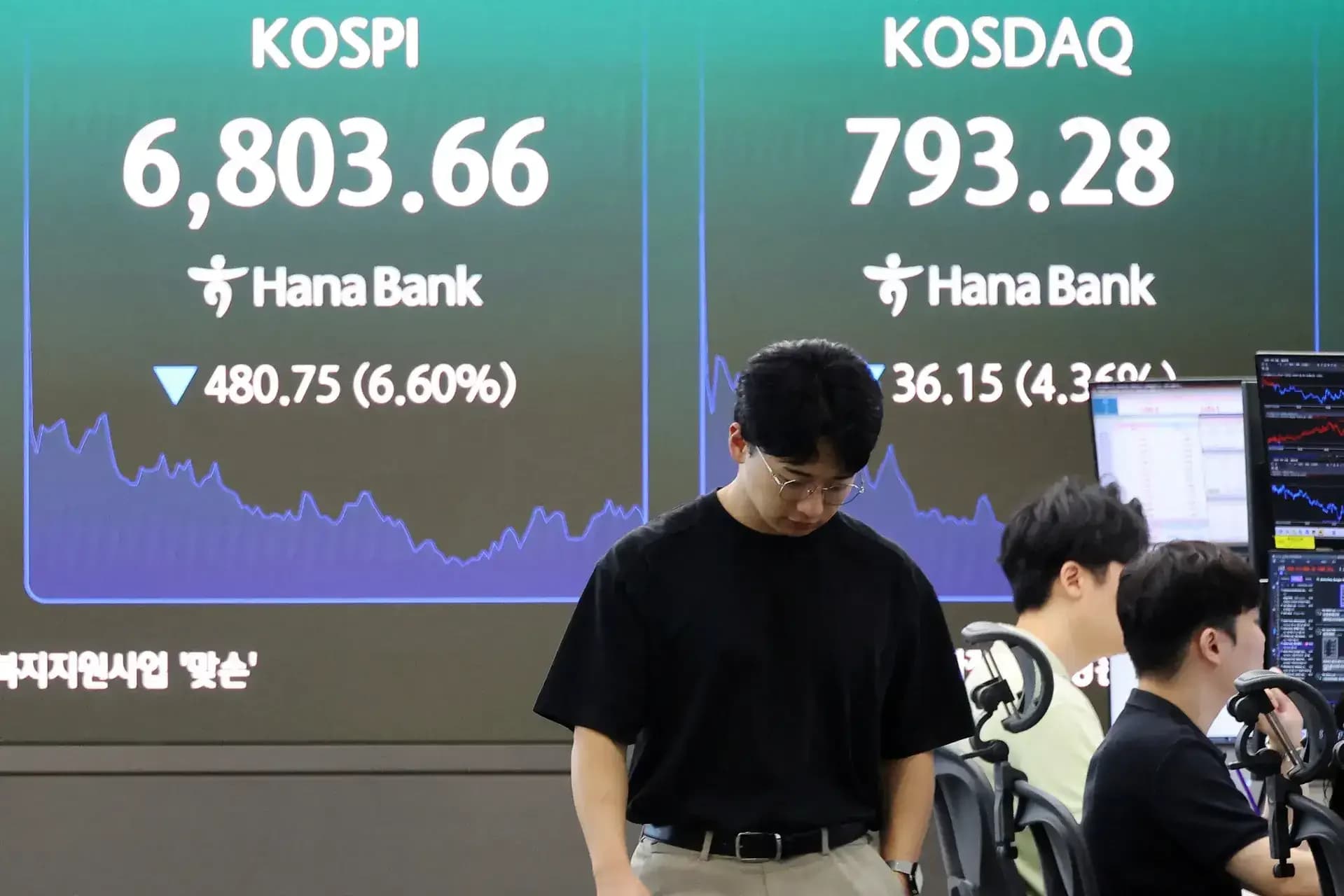
Emerging-market assets fell as rising tensions in West Asia drove investors toward safer assets, while uncertainty over the global rate outlook added to the pressure. An MSCI Inc. index of developing-nation currencies was down 0.2% as of 12:15 p.m. in New York Monday, with the Chilean peso and Hungarian forint among the worst performers in a basket of 22 exchange rates tracked by Bloomberg, with the former slumping more than 1% against the dollar. The MSCI gauge of developing-nation equities dropped for a third straight session, poised for the longest run of declines in almost two months. South Korea's Kospi slid more than 3% after major AI firms called for a slowdown in the technology's development, raising concerns about a sector that has been a key driver of this year's rally. An index of emerging-market currencies was little changed after dropping in the previous two sessions, with the Thai baht and Philippine peso leading losses in emerging Asia as higher oil prices weighed on energy-importing economies. The South Korean won and Taiwanese dollar also declined, according to The Hindu BusinessLine. The Kospi's decline followed calls from major AI executives for a more measured pace of model development amid growing concerns over the risks associated with increasingly powerful systems. Anthropic CEO Dario Amodei urged AI companies to take a more deliberate approach to development, while OpenAI Chief Executive Sam Altman said his company will not go public in 2026, citing safety concerns over quickly advancing AI and its potential risks to humanity. Semiconductor makers and other AI-linked stocks may face the most pressure initially as investors assess whether a more cautious approach to developing advanced models will crimp earnings across the supply chain.
The banking sector experienced particularly severe losses as the Nifty Bank Index fell nearly 1.36% amid negative market sentiment, with the benchmark Nifty 50 down 1.04% as of 09:54 AM. According to Business Standard, the India VIX, the fear gauge index, spiked more than 6% to 12.5 on Friday after oil prices spiked to near $110 a barrel. AU Small Finance Bank and IndusInd Bank were the biggest losers in the Bank Nifty, with their shares falling over 2% each, while HDFC Bank also declined around 2%, with Union Bank and Canara Bank falling over 2% each. Among large banks, State Bank of India (SBI) declined over 1%, ICICI Bank fell nearly 1%, Kotak Mahindra Bank dropped around 1%, and Axis Bank declined nearly 1%. Vipin Kumar, AVP research at Globe Capital Market, noted that the Bank Nifty index has breached the trendline support of its three-month-long consolidation zone with a downside gap, triggered by Brent crude surging toward the $108 level. "Going forward, 55,500 serves as the immediate crucial support. A decisive close below this level will further dampen market sentiment, potentially dragging the index toward the 54,500–54,000 range in the near term," he said. Kumar added that the Nifty Bank index has fallen 2.47% over the past week and is now down nearly 10% from its all-time high.
Rate markets are pricing hikes from three major central banks this month, with Fed futures putting the odds of a rate hike at 86% and markets now expecting the Fed to hike twice this year, in September and December, according to Business Standard. Michael Feroli, chief US economist at JPMorgan, stated "We now expect the Fed to hike twice this year, in September and December. At this stage, failing to back up words with action could put the credibility of the institution at risk." The European Central Bank decides Thursday in Berlin, with all but one analyst in a Bloomberg poll forecasting a quarter-point hike to 2.5% from 2.25%. Markets also imply around a 76% chance the Bank of Japan will lift its cash rate by a quarter point, to 1.25%, when it meets on Friday, with the BOJ also expected to sound hawkish on further tightening as it struggles to prevent a relapse in the yen after market intervention helped to pull it from a 40-year low. Investors are also assigning a high probability to a quarter-point rate increase by the Bank of Japan later this week. Traders are awaiting a string of central-bank decisions this week, starting with the Federal Reserve on Wednesday, followed by the Bank of England and Bank of Japan, for clues on the path for global interest rates as policymakers grapple with renewed inflation risks from higher oil prices. Yields on 10-year Treasury notes were stuck at 4.974%, having been sold heavily in recent weeks, with 2-year yields rising a steep 26 basis points last week and 10-year yields adding 19 basis points as the curve flattened. Ben Snider, chief US equity strategist at Goldman Sachs, noted that "Equities typically struggle when the Fed starts to hike rates, but we expect the bull market to continue. The S&P 500 has generated an average three-month return of -2% at the start of seven hiking cycles during the last few decades, but has generated an average return of +9% during the 12 months following the first hike."
US inflation data released Friday added fuel to rate hike expectations, with the US consumer price index, excluding food and energy, rising 0.3% in August from a month earlier, according to Bureau of Labor Statistics data. On an annual basis, it advanced 2.4%, while overall consumer prices rose 0.4% from the prior month on higher energy prices, and 3.4% from a year earlier. An uncomfortably hot US consumer price report on Friday led markets to price in an 86% chance the Federal Reserve will lift rates by 25 basis points on Wednesday, and move again by December, with this would be the first hike since mid-2023. Bets for a rate hike sent Treasury yields higher on Friday, with two-year yields climbing four basis points in New York and 10-year yields edging closer to the key 5% level. Stephanie Roth, chief economist at Wolfe Research, noted that "Yields and oil probably need to come down in order for stocks to work," adding that "that could happen, for example, if Friday's inflation data were to "come in quite soft."** The surge in oil prices has introduced further challenges for central banks, as the ongoing conflict in the Strait of Hormuz poses a risk of sustaining elevated energy prices, with an increase in attacks on shipping through the critical waterway pushing up prices for oil, natural gas and diesel, raising worries that these energy expenses will contribute to inflation. With oil emphatically above $100 a barrel again and the Middle East war apparently reigniting, any hope among policymakers for a respite in global price pressures seems faint for now. After core inflation came in hotter than expected in the US last week, markets are almost fully pricing in a 25-basis-point increase in borrowing costs by policymakers led by Chair Kevin Warsh on Wednesday. Monday's selloff eased as Brent crude pared some of its gains and 10-year US Treasury yields retreated after touching 5% for the first time since 2023.