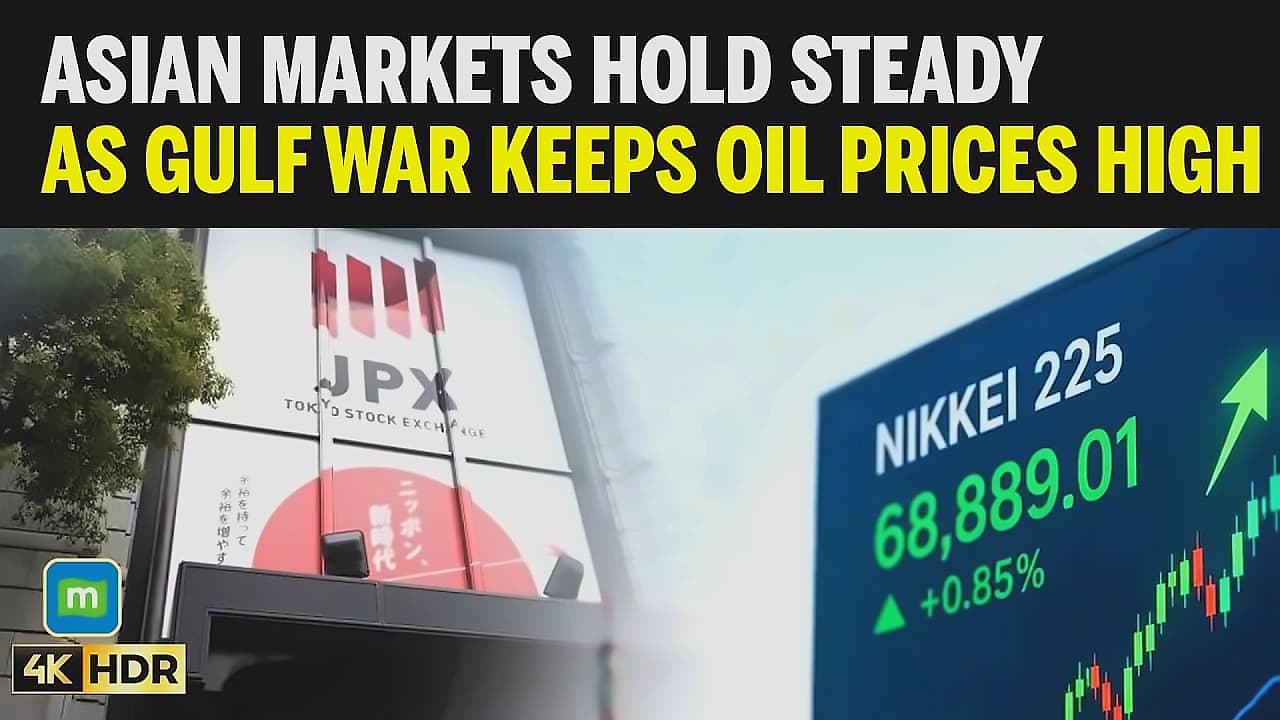
Asian shares climbed to record highs on Wednesday as markets looked for signals that a shaky truce between the United States and Iran will be extended. MSCI's broadest index of Asia-Pacific shares outside Japan advanced 1.6% to an all-time high, marking the fifth straight session of gains. South Korea's KOSPI soared 2.4% to hit an all-time high of 8,692.32, while Japan's Nikkei 225 index was also up 0.9% at 6.33 am IST. According to CNBC TV18, markets are just waiting for something tangible when it comes to a deal between the US and Iran, with investors monitoring lingering uncertainty around the agreement after US President Donald Trump said he wasn't in a hurry to strike a deal. 'a lot of good news is priced in, leaving room for disappointment if something comprehensive isn't announced,' noted Kyle Rodda from Capital.com.
Oil prices remained elevated but showed mixed signals as markets weighed conflicting signals over prospects for a deal to end the war in Iran and restore energy flows through the crucial Strait of Hormuz. Brent crude climbed early Monday to trade around $93 a barrel after closing at its lowest since mid-April on Friday. The Strait of Hormuz carries about a fifth of global oil supply, making any disruption a significant concern for energy markets. However, Iran's foreign ministry said US strikes in the southern Hormozgan province represented a 'gross violation' of a ceasefire, while the US said its attacks were defensive in nature. US forces sustained minor injuries in an Iranian attack on a Kuwaiti airbase over the weekend, while Israel stepped up its offensive against the Tehran-backed Hezbollah in Lebanon, making its broadest incursion into Lebanon in a quarter-century after Hezbollah stepped up attacks in the country's north. Dennis Kissler, senior vice president for trading at BOK Financial Securities Inc., noted that 'the panic buyers are gone, and the realization we're actually not going to run out of oil is setting in.'
China's manufacturing sector showed concerning signs of slowdown, with the official manufacturing purchasing managers' index falling to 50 from 50.3 in April, according to the National Bureau of Statistics. A reading below 50 indicates contraction, adding to signs that the world's second biggest economy is faltering from pressures on global demand and input costs from the Iran war. However, the non-manufacturing measure of activity in construction and services rose more than forecast to 50.1 from 49.4 last month, providing some offset to the manufacturing weakness. The SSE Composite's decline contrasted with the resilience shown by US and selected European markets, with the CSI 300, which tracks the top 300 stocks across both Shanghai and Shenzhen, declining in line with the broader market trend. Chinese retail investors, who constitute a disproportionately large share of trading activity on the SSE relative to most other major global exchanges, tend to exhibit amplified responses to headline risks.
Yields on 10-year notes fell 1.8 basis points to 4.473%, down for a third day to the lowest level since May 14. The focus now shifts to Thursday's release of the personal consumption expenditures (PCE) index, the measure favoured by the Federal Reserve for setting its 2% annual inflation target. The pulse from fuel is expected to lift the headline PCE to a three-year high of 3.8%, while the core is forecast to rise 0.3% to an annual 3.3% and far above the Fed's 2% target. This pick-up has led more Fed members to call for dropping its easing bias, or even preparing for a rate hike. Spot gold fluctuated to trade around $4,540 an ounce, while Bitcoin led cryptocurrencies higher, reflecting continued inflation concerns. Treasuries edged lower as the dollar was slightly stronger against all its Group-of-10 peers.
US President Donald Trump posted on social media he was ready to make a 'final determination' on a preliminary agreement to extend the ceasefire, but hours later left the Situation Room meeting without any decision being made, according to the New York Times. Washington and Tehran exchanged messages seeking amendments to a draft agreement that would extend the ceasefire and reopen the Strait of Hormuz, though it remained unclear whether negotiations were making meaningful progress. The renewed tensions risk interrupting a global stock rally driven by unbounded enthusiasm for sectors touched by the AI trade. Amendments to the deal continue to be proposed by both sides, though both the US and Iran might ultimately reject the changes and the deal would collapse, the semi-official Tasnim news agency reported Sunday. Alexander Guiliano at Resonate Wealth Partners noted that 'the stock market has enough confidence that a resolution with Iran will eventually come to light, even if it's not immediate.' The mixed signals from Washington and Tehran have kept investors on edge, with hopes for a diplomatic breakthrough briefly easing concerns over energy prices and inflation, though the current uncertainty continues to weigh on regional markets.