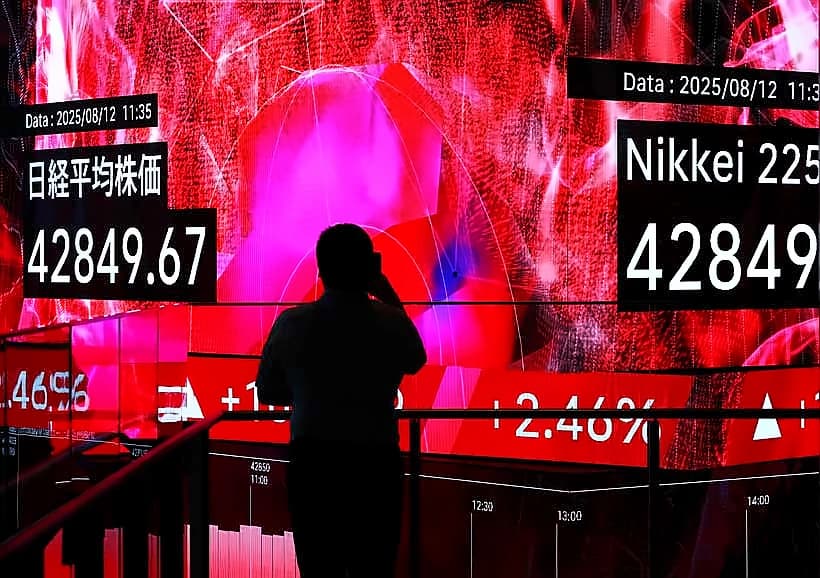
Asian markets traded lower on Monday, May 18, as fresh drone attacks in the Gulf region shoved oil prices and bond yields higher, while geopolitical tensions with Iran continued to weigh on investor sentiment. According to Reuters, the MSCI's broadest index of Asia-Pacific shares outside Japan lost 0.9%, with Japan's Nikkei easing 1.1% after falling 2% last week from record highs. South Korean stocks fell 0.1%, as the red-hot market cooled just a little after demand for semiconductors drove it to all-time peaks. The decline reflects growing concerns about potential supply disruptions from the Middle East region and their broader economic implications.
In a post on Truth Social, Trump on Sunday said 'the Clock is Ticking' for Iran and warned there 'won't be anything left' if action was not taken soon, adding that 'TIME IS OF THE ESSENCE!' As reported by NDTV Profit, he did not elaborate on the steps he wanted Iran to take or the consequences that could follow. Tensions between US and Iran have remained elevated despite a fragile ceasefire reached in early April, with the US continuing its blockade of Iranian ports while Iran has kept the Strait of Hormuz shut since the conflict began. The latest developments include reports of drone strikes causing a fire at a nuclear power plant in the United Arab Emirates and Saudi Arabia reporting interception of three drones. According to Bloomberg, Washington offered 'no tangible concessions,' while seeking 'to obtain concessions that it failed to obtain during the war, which will lead to an impasse in the negotiations,' said Iran's semi-official Mehr news agency.
Oil prices extended gains as efforts to end the U.S.-Israeli war on Iran appeared to have stalled, with Brent crude trading up 2% to over $111 a barrel, after adding almost 8% last week. According to Bloomberg, West Texas Intermediate crude rose 2.3% to $107.89 a barrel. The surge reflects investor concerns about potential supply disruptions from the Middle East region, with the Strait of Hormuz remaining closed to all but a trickle of shipping as Tehran tries to formalise its control of the waterway that during normal times carries 20% of the world's oil trade. Despite a 13 million bpd supply disruption, prices have not climbed as high as anticipated due to temporary factors including sharp decline in Chinese oil imports and consistently record-high US oil export levels in April. As per Bloomberg, the core issue centered around the lack of progress in the Middle East, with the US and Iran not able to make a progress on their fragile ceasefire deal.
US stock futures slipped in the overnight trading session on Sunday after President Donald Trump said that time is running out for Iran, reigniting fears of renewed tension in the Middle East and continued disruptions to global oil supplies. According to NDTV Profit, Dow Jones futures were 0.79% lower, the S&P 500 futures were down 0.70% and Nasdaq 100 futures declined 0.93% as of 9.30 p.m ET. Among ETFs tracking benchmark indexes, the SPDR S&P 500 ETF (SPY), Invesco QQQ Trust (QQQ), and the SPDR Dow Jones Industrial Average ETF Trust (DIA) were all edging lower. On Friday, benchmark indexes closed lower amid surging bond yields and rising inflation concerns, with the Dow Jones index down more than 1% at close, while the S&P 500 and Nasdaq Composite slipped 1.24% and 1.54% respectively. Global bond markets were hammered on Friday on concerns that energy costs would stay high and thus continue to drive inflation, with yields on U.S. 10-year notes hitting a 15-month top of 4.631%, having already surged 23 basis points last week. As per Bloomberg, treasuries declined across the curve with the 30-year yield rising to the highest in almost three years, while Japan's 10-year yields jumped 10 basis points to levels last seen in 1996, while the nation's 30-year yield surged 20 basis points to the highest since its 1999 debut.
A key test for investors this week will be Nvidia Corp.'s earnings, after months of equities brushing aside mounting macro risks on bets that billions of dollars spent on the AI rollout would drive corporate earnings growth. According to Bloomberg, any weakness in Nvidia's earnings 'could weigh on tech names and broader market.' Finance ministers of the Group-of-Seven are set to discuss the debt selloff when they meet this week, though how they can ease pressure remains to be seen. The main issue remains the transit of oil through the Strait of Hormuz, a vital artery for the flow of oil and gas from the Middle East. As per Yardeni Research, 'If the Fed fails to remove it, investors will conclude that the central bank is falling behind the inflation curve and will demand a higher inflation risk premium.' The Fed needs to catch up with bond markets or risk losing control of borrowing costs as investors grow increasingly worried about inflation.