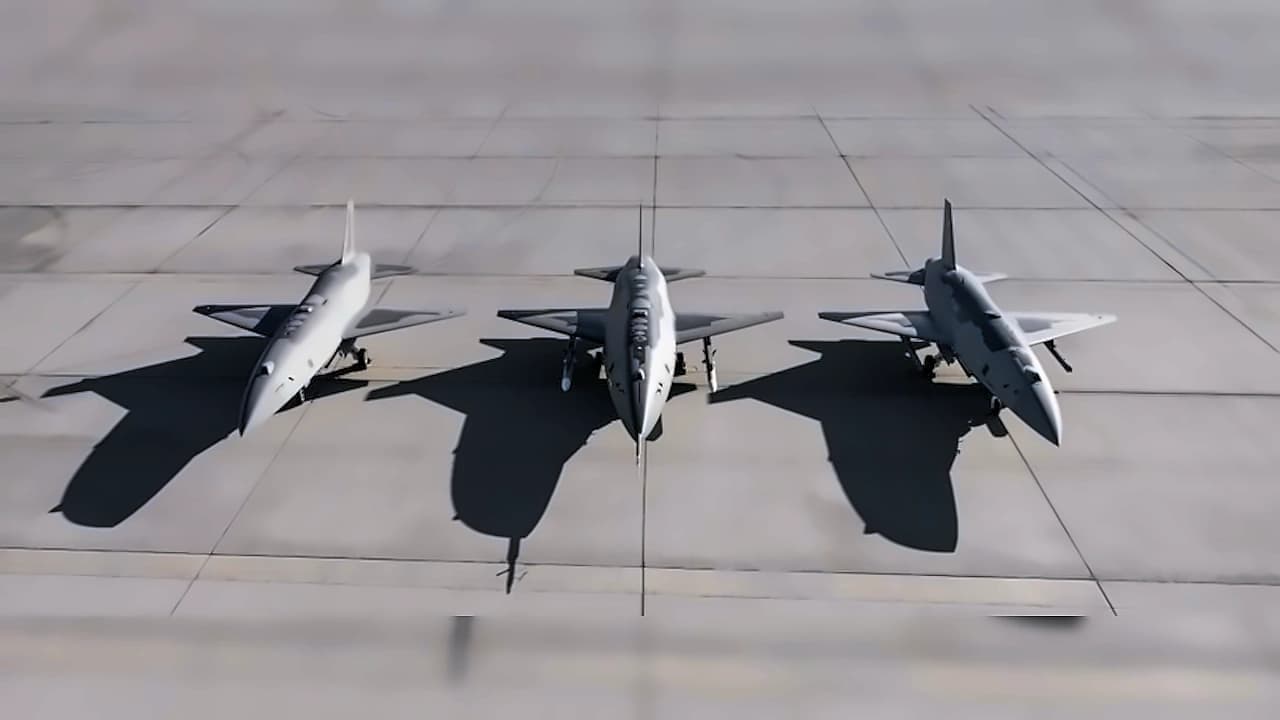
The U.S. Air Force awarded engineering and manufacturing development and production contracts to General Atomics and Anduril Industries on June 17, marking a significant milestone in the Collaborative Combat Aircraft (CCA) program. According to Reuters, the Air Force selected the company's FQ-44 autonomous fighter aircraft and FQ-42 aircraft for the production phase of the program. The contracts were awarded four months earlier than expected, demonstrating that both aircraft meet mission requirements and are ready for manufacturing. As reported by Anduril Industries, this award positions Anduril as the first new entrant in more than 50 years to win a U.S. fighter aircraft program, with the company stating it is the first time a new company has won a fighter aircraft program since the 1970s. General Atomics Aeronautical Systems boss David Alexander hailed the news as "an exciting day for our company and the nation," stating that "moving to production on FQ-42A is the result of an extraordinary partnership and many years of investments between General Atomics and the U.S. Air Force."
The CCA initiative represents a cornerstone of the Air Force's future air combat strategy, as reported by Anduril Industries. The program is designed to pair crewed aircraft such as the F-35 Lightning II and the forthcoming F-47 with lower-cost, semi-autonomous drones capable of carrying sensors, electronic warfare systems and weapons. The aircraft are specifically designed to operate as 'loyal wingmen,' extending the reach and survivability of manned platforms while reducing risks to pilots. According to Anduril's Mark Shushnar, the company has been refining, testing, and iterating on their production system in parallel with aircraft development for the past two years, implementing full rate production processes and tooling on prototype aircraft to streamline the transition into production. In its current configuration, FQ-44 has the ferry range necessary to deploy anywhere in the world, can take off and land on a short field, has a combat radius that significantly exceeds the combat radius for current crewed fighters, and the speed to keep up, as noted by Shushnar. Across hundreds of hours with Air Force experts and thousands of simulations, we have demonstrated that FQ-44 will do more than just survive the high-end fight: it will excel.
According to Reuters, the contracts were awarded four months earlier than expected, demonstrating that both aircraft meet mission requirements and are ready for manufacturing. The contract will support continued testing, validation and eventual operational deployment of the FQ-44 autonomous fighter aircraft. The Air Force ultimately intends to field approximately 150 CCAs by the end of the decade, with follow-on increments coming, with the service planning for 1,000 overall. As reported by Col. Timothy Helfrich, portfolio acquisition executive for Fighters & Advanced Aircraft, "We have production money starting in FY27, so as soon as we have funding appropriated, we [should] be able to execute first production lot." The Air Force plans to award production in fiscal 2027 once the budget is enacted, with the service wanting to move quickly on the program. Secretary of the Air Force Troy Meink described the accelerated timeline as reflecting confidence in the maturity of both aircraft designs and the urgency of delivering new capabilities to counter increasingly sophisticated threats, stating that "By moving fast from competitive selection into full-scale manufacturing, we position ourselves to field highly credible and combat-ready semi-autonomous systems to stay ahead of the pacing challenge."
The Air Force is keeping the cost of the program obscured, though Helfrich confirmed that the Air Force is beating the goal of having one CCA cost less than a third of an F-35. With the cost of a Lot 17 F-35A around $82.5 million, that would put the cost per unit for the CCA effort at under $30 million. The Air Force is requesting roughly $1.4 billion to develop CCA drones in fiscal 2027, alongside nearly $1 billion for procurement. On the autonomy side, the Air Force simultaneously moved forward on the software side of the program, awarding mission autonomy production contracts to a pool of six vendors: Anduril, General Atomics, Lockheed Martin, Northrop Grumman, Collins Aerospace and Shield AI. The decision reflects a "software sold separately" acquisition model that decouples autonomy software from the aircraft itself, creating an open architecture ecosystem where autonomy software can be upgraded independently, rapidly integrated across multiple platforms and continuously improved through competition between suppliers. The service announced that Anduril, General Atomics, Lockheed Martin, Northrop Grumman, Collins Aerospace and Shield AI have been down selected to continue developing autonomy systems for the first increment, with the other companies considered being General Atomics, Lockheed Martin and Northrop Grumman.
As reported by Reuters, the award underscores the Defense Department's growing willingness to turn to non-traditional contractors to accelerate innovation. The selection of a non-traditional defense contractor for a fighter aircraft program represents a shift in how the Pentagon approaches military technology development and procurement, potentially opening new avenues for emerging defense companies to participate in major military programs. Air Force Chief of Staff General Ken Wilsbach emphasized that "Delivering this capability to our warfighters faster ensures our forces maintain the tactical edge required to deter and, if necessary, defeat any adversary." The program is structured to provide flexibility for how lots are awarded, with the number of vehicles each vendor will be contracted for based on delivering capability at speed and scale. The CCA platforms are being developed as combat-capable force multipliers, operating alongside aircraft such as the F-35, F-22 and future F-47 Next Generation Air Dominance fighter to undertake missions including intelligence gathering, electronic warfare, air-to-air combat and strike operations while exposing fewer human pilots to risk. The program is being closely watched internationally, including in Australia, where the Royal Australian Air Force has pioneered similar concepts through Boeing Defence Australia's MQ-28 Ghost Bat, with the message increasingly clear that the future of air superiority will not be determined solely by advanced fighters, but by integrated teams of crewed and autonomous aircraft operating as a single combat system.