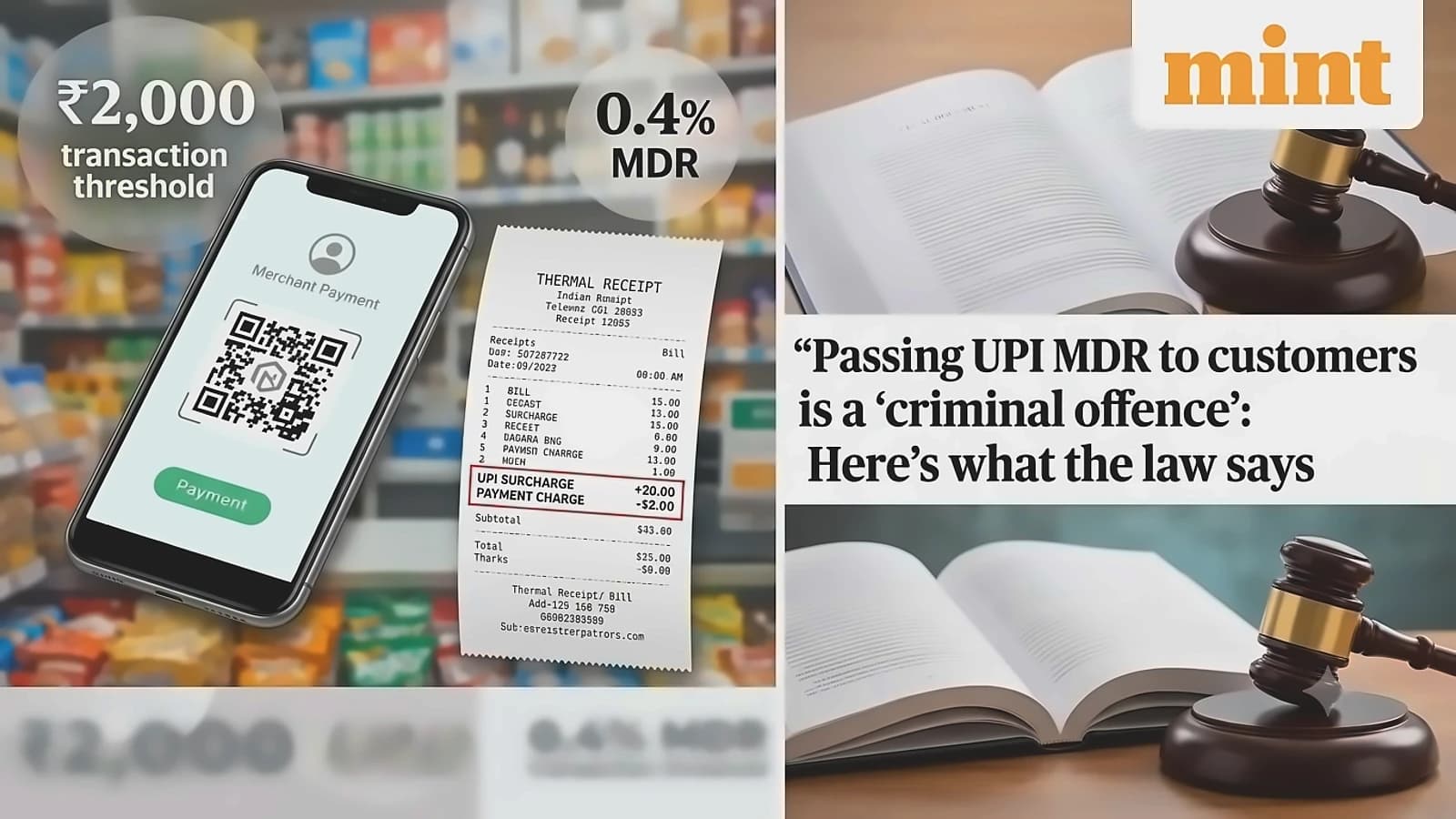
The government will closely monitor the rollout of Merchant Discount Rate (MDR) from October 15, 2026 to ensure that merchants do not pass these charges to customers, according to officials. "We are in touch with payment aggregators. The rollout would be closely monitored," an official said, adding that MDR is necessary to help the fintech ecosystem sustain and grow. The official noted that any issue with regard to levy of goods and services tax on MDR can be taken up by the GST Council, with input tax credit available for merchants to offset their tax liability. Since transactions below ₹2,000 have been exempted from the levy of MDR, small merchants would not face GST, as reported by The Economic Times.
The National Payments Corporation of India (NPCI) has introduced a revised merchant discount rate (MDR) framework for select UPI Person-to-Merchant (P2M) transactions, effective from October 15, 2026. For standard P2M transactions above ₹2,000, the MDR will be 0.4% of the transaction value, with the charge capped at ₹300 for transactions of ₹75,000 and above. As reported by Motilal Oswal Financial Services' Morning India report, the carefully calibrated move signals the end of an era for the world's largest real-time payments system, ending nearly six years of a fully free UPI network for merchants. For example, a ₹3,000 purchase would attract an MDR of ₹12, while a ₹50,000 transaction would attract ₹200. The framework is designed to leave everyday digital payments untouched, with transactions of ₹2,000 or below remaining free, accounting for more than 95% of P2M transaction volume. According to Motilal Oswal, UPI processed ₹29.82 lakh crore worth of transactions in August 2026, with P2P transactions accounting for 30% of total value while P2M transactions made up the remaining 70%. The government in a statement said the reintroduction of MDR on Unified Payment Interface is a step in protecting the country's sovereignty in the electronic payment ecosystem, rejecting charges by opposition that levy had been introduced under external influence.
For specified merchant categories, including railways, telecom services, insurance, fuel and agricultural inputs, transactions above ₹2,000 will attract a flat MDR of ₹5 rather than the standard percentage-based rate. As reported by Mint, NPCI explained the rationale for this flat-rate model: "For specific merchant categories such as railways, telecom services, insurance, and fuel, among others, a flat MDR of ₹5 per transaction shall be applicable for transaction above ₹2,000. Rather than applying a 0.4% variable rate, these specific sectors pay a fixed fee of ₹5 regardless of the transaction amount. This flat-rate model prevents cost escalations in critical public services, utility bill collection, and thin-margin sectors like fuel retail. It ensures that essential consumer services remain low-cost and digitally efficient." This means, for example, that a ₹3,000 UPI payment for a railway ticket or ₹5,000 insurance payment would attract an MDR of ₹5 for the merchant. The customer would continue to pay the transaction amount itself, with banks advised to ensure that merchants do not pass the MDR on to customers.
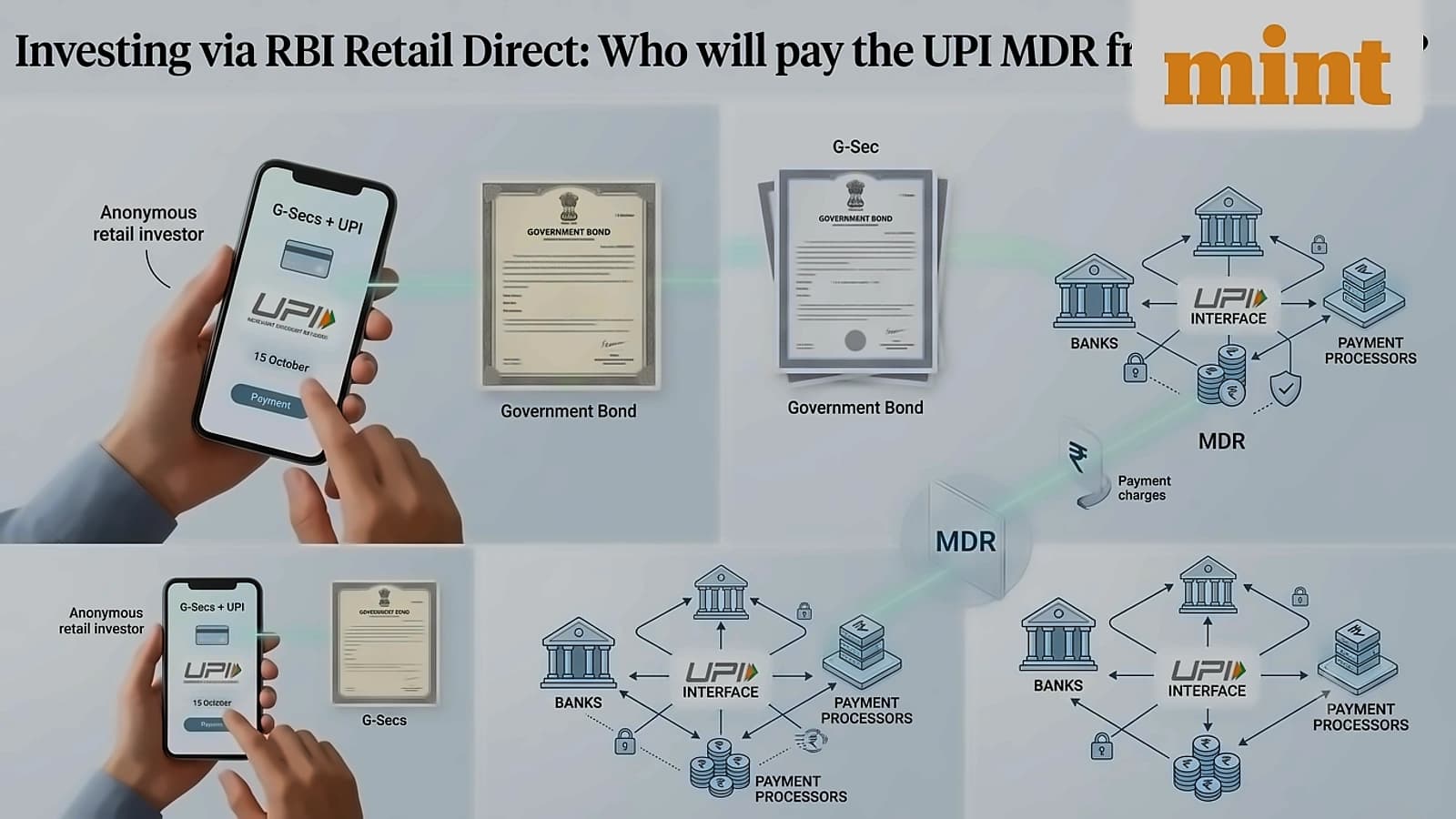
The return of MDR on UPI transactions after six years could generate ₹15,000 crore to ₹20,600 crore in annual revenue for the digital payments and banking ecosystem, according to brokerage estimates. The proceeds will be shared among issuing and acquiring banks, payment service provider (PSP) banks, and third-party application providers (TPAPs) such as Google Pay or PhonePe. Goldman Sachs estimates that 50% of the revenue pool will accrue to issuing banks and PSPs, 20% to TPAPs and 30% to acquiring banks, while Citi estimates that banks and UPI handles will capture about 60%, UPI app providers 25%, and non-bank payment aggregators the remaining 15%. Under the proposed fee structure, a merchant paying the maximum MDR of 0.4% on a ₹10,000 transaction would pay ₹40, with ₹28 flowing to the issuing bank as interchange, ₹12 to the payer-side PSP, which would pay ₹8 to the app provider. The Reserve Bank of India (RBI) backed the move, describing the introduction of MDR on large-value UPI transactions as an important step towards the long-term sustainability of the digital payments ecosystem.
Small merchants covered under the Person-to-Person-Merchant (P2PM) framework will continue to receive zero-MDR treatment. NPCI clarified that small vendors receiving up to ₹1 lakh per month through UPI QR codes directly into their bank accounts will continue with zero MDR. "Small merchants operating under the P2PM framework will continue with zero MDR. These are small vendors receiving up to ₹1 lac per month through UPI QR directly into their accounts. The P2PM category promotes digital payment acceptance among small merchants and in the unorganised retail sector," NPCI stated. The organisation emphasized that there would be no impact on small-value UPI transactions of up to ₹2,000, which account for more than 95% of the total volume of UPI P2M transactions. The new framework is designed to create a commercial mechanism within the UPI merchant ecosystem, with "Charges will apply only to person-to-merchant (P2M) transactions exceeding ₹2,000," the finance ministry stated. "A nominal merchant discount rate (MDR) of 0.4 per cent will be levied on P2M transactions above ₹2,000. This commission will be shared amongst the payment ecosystem partners including banks and app providers," the ministry added. According to Motilal Oswal, UPI app providers will not charge a platform fee or any other charge for payments made through UPI, and merchants cannot pass the MDR on to customers when accepting UPI payments.
According to the National Payments Corporation of India's (NPCI) frequently asked questions issued on September 15, mutual fund SIP payments through UPI AutoPay will not attract the prescribed merchant discount rate (MDR). As reported by Motilal Oswal, for investors with ₹10,000 monthly SIPs linked to UPI AutoPay mandates, the automatic debit process will continue without any additional charges. The new MDR framework takes effect from October 15, but recurring standing instructions do not carry the prescribed MDR, meaning investors do not need to increase their SIP amounts to account for the new framework. According to Motilal Oswal, automated recurring payments through UPI Mandates or AutoPay will not carry the prescribed MDR transaction charge, including recurring utility bills, OTT subscriptions and recurring investments. The distinction is crucial because a mutual fund SIP or other recurring investment set up through UPI Mandate or AutoPay will not attract the prescribed MDR transaction charge, with the government's clarification specifically excluding automated recurring standing instructions from prescribed MDR charges. Mukesh Pandey, Founder & MD of Rupyaapaisa.com, emphasized that "The introduction of MDR on UPI transactions starting from October 15 should not lead to higher costs for consumers. The main difference lies between one-time merchant payments and recurring UPI AutoPay mandates." Insurance payments also receive separate treatment, with insurance payments above ₹2,000 falling under a concessional flat MDR of ₹5 per transaction. According to Motilal Oswal, OTT subscriptions – Netflix, Amazon, Jiohotstar – and utility bills paid automatically through UPI AutoPay will be treated differently from one-time UPI payments. Such payments will be considered as recurring payments, and there will be no charges on these payments, meaning no extra charges will be levied for UPI AutoPay for services such as OTT subscriptions, mobile bills, electricity bills, insurance and mutual funds.
For ordinary UPI users, the most important clarification is that MDR is not a customer transaction fee. As reported by Motilal Oswal, NPCI confirms that consumers will continue to use UPI without transaction charges, and person-to-person transfers will remain free. According to Motilal Oswal, person-to-person (P2P) transfers - which make up 37% of UPI's transaction volume and 70% of its transaction value - will continue to attract zero charges, irrespective of size. Small-value transactions up to ₹2,000, which the government said account for more than 95% of total P2M volume, remain untouched. The new framework is designed to create a commercial mechanism within the UPI merchant ecosystem, with "Charges will apply only to person-to-merchant (P2M) transactions exceeding ₹2,000," the finance ministry stated. "A nominal merchant discount rate (MDR) of 0.4 per cent will be levied on P2M transactions above ₹2,000. This commission will be shared amongst the payment ecosystem partners including banks and app providers," the ministry added. According to Motilal Oswal, UPI app providers will not charge a platform fee or any other charge for payments made through UPI, and merchants cannot pass the MDR on to customers when accepting UPI payments. According to Motilal Oswal, the NPCI notification specifically says "UPI App providers shall NOT charge Platform Fee or any other charge for any payment made through UPI. UPI applications are explicitly restricted from levying platform fees on UPI transactions." Industry stakeholders believe merchants are unlikely to pass the MDR cost on to customers, given that they already absorb higher charges on other payment modes. Reeju Datta, co-founder of Cashfree, explained that "A typical credit card MDR ranges between 1.5% to 2.5% while that of debit cards is around 0.9% per transaction. It is highly unlikely that merchants will pass the UPI MDR cost on to customers, as the rate remains very low."