Industry experts are raising significant concerns about the potential introduction of merchant discount rate (MDR) on UPI transactions, warning that the policy could fundamentally alter India's digital payments landscape. According to The Economic Times, experts suggest the debate should focus on who ultimately bears the cost rather than whether payment companies need sustainable revenue models. An MDR on UPI payments would be charged to merchants for processing digital transactions and is unlikely to be fully absorbed by banks or payment platforms. Instead, it would become an additional operating cost for businesses, potentially squeezing margins, limiting investment and reducing their ability to offer discounts to consumers. While merchants may absorb the additional cost initially, experts warn it could eventually lead to fewer promotional offers, higher prices or both, undermining broader policy efforts to lower the cost of doing business and support consumption.
The Centre has confirmed the reintroduction of merchant discount rate (MDR) on select UPI transactions, marking a significant shift in India's digital payments policy after six years of free transactions. According to Economic Times reports citing people familiar with the matter, the proposal is now in its final stages and awaiting a final decision. The government is likely to peg the MDR at 0.5% of transaction value if the levy is reintroduced for large merchants, as confirmed by sources familiar with the matter. This represents a clear policy reversal from the current zero-MDR structure that has been in place since January 2020. Latest reports from Economic Times exclusively indicate that the threshold for merchant turnover may be pegged at ₹1-1.5 crore annually for transactions above ₹2,000, ensuring the levy applies only to large merchants while maintaining free transactions for smaller businesses. The proposal is expected to mark a significant change in the economics of India's dominant retail payments rail, with the zero-MDR framework having helped UPI become embedded across offline retail, ecommerce, financial services, subscriptions, utility payments and peer-to-peer transfers.
The potential reintroduction comes after the government removed MDR on UPI payments in January 2020 to accelerate digital payment adoption. According to NPCI data, this policy change has driven remarkable growth in UPI usage across the country. Annual UPI transaction volumes have increased from about 20 million in FY17 to nearly 242 billion in FY26, while the total transaction value has surged from ₹0.07 lakh crore to around ₹314 lakh crore during the same period. In June alone, UPI processed 22.72 billion transactions worth ₹28.92 lakh crore, keeping the platform above the 22-billion-monthly-transaction mark even after a sequential easing from May. To offset the absence of MDR, the government has been providing financial support to banks, with the Centre allocating ₹2,000 crore in the Union Budget for the current financial year to compensate banks for offering UPI and RuPay debit card transactions without merchant charges. Under the current government-backed incentive structure, small merchants receive support for transactions up to ₹2,000, while large merchants remain on zero MDR without incentives. However, the government has reduced the financial outlay for the UPI and RuPay incentive scheme to ₹2,000 crore for FY27, a decline of nearly 10% from the revised estimate of ₹2,196 crore for FY26.
Banks and payment companies have argued that processing such large volumes of transactions without MDR has created a financial burden, despite government subsidies. While the government has provided compensation to the industry, the allocation has reportedly fallen short of industry expectations in recent years. The zero-fee structure has compressed revenue opportunities even as transaction volumes have grown, with banks, payment apps, acquirers, payment aggregators and technology service providers arguing that processing, fraud control, dispute management, uptime, reconciliation and merchant support require recurring investment. For large merchants, MDR would become a direct payments acceptance cost, with implications for ecommerce platforms, organised retail chains, travel companies, food delivery, mobility, digital services and subscription businesses that handle high-value or high-frequency UPI flows. A carefully calibrated MDR framework for large merchants could shift incentives toward service quality, reliability, fraud mitigation and value-added merchant tools. The final structure, including threshold definitions, applicable rates, exemptions and implementation timelines, will determine whether the policy functions as a narrow sustainability mechanism or a broader reset of India's digital payments business model.
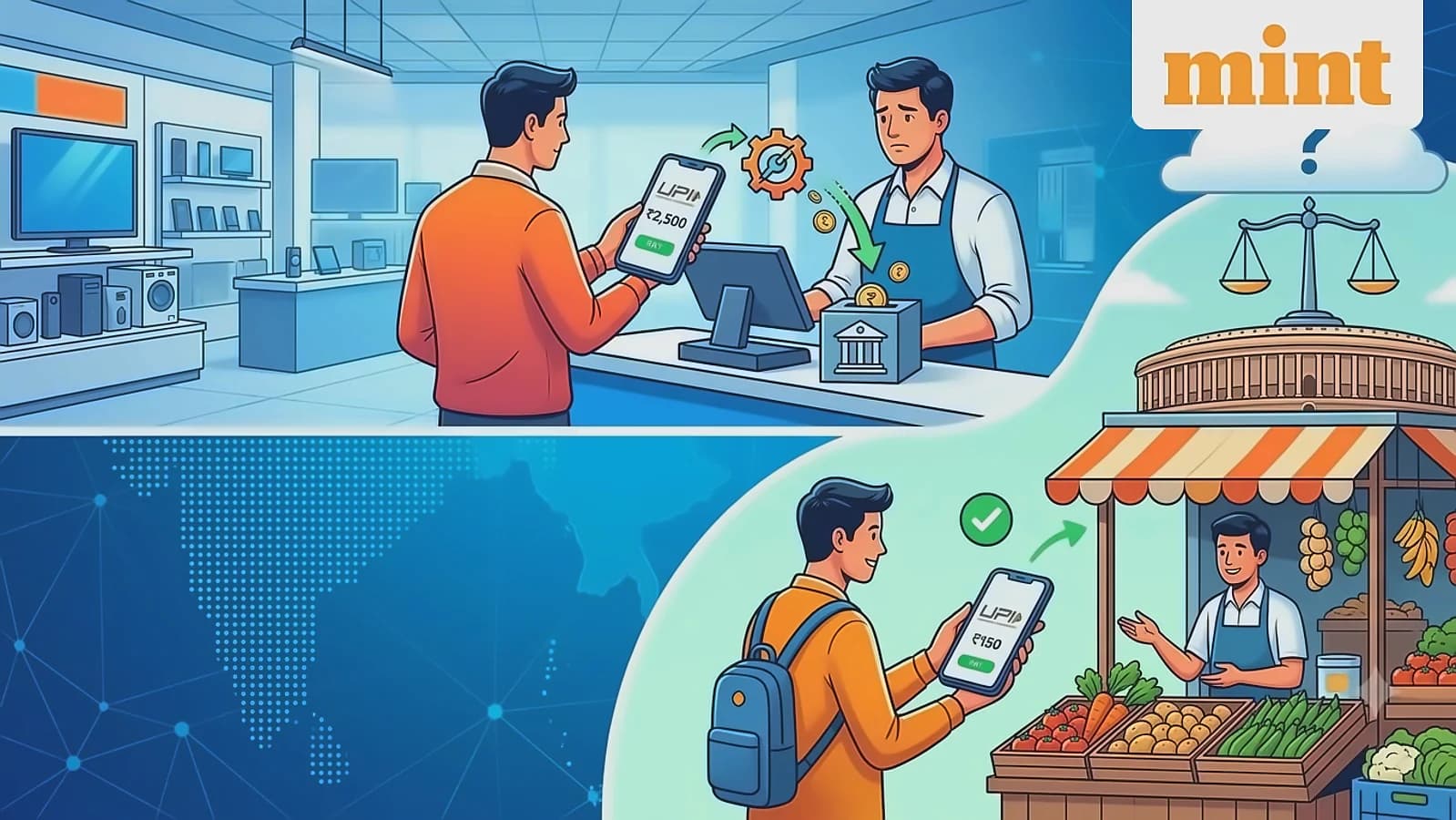
The reintroduced MDR will apply only to large merchants with annual turnover of ₹1-1.5 crore or more, while maintaining free transactions for small merchants and peer-to-peer transfers. According to Economic Times reports, the government may fix MDR at 0.5% of transaction value if the proposal is approved. The Payments Council of India had earlier recommended an MDR of 0.30% on UPI transactions undertaken by large merchants. Small merchants are unlikely to be affected, as nearly 90% of merchants accepting UPI payments fall within the small enterprise category and are expected to remain exempt. Even if MDR is restored, peer-to-peer UPI transfers and payments made to small merchants are expected to remain free under the proposed framework. Latest reports confirm that the levy will specifically apply to transactions above ₹2,000, ensuring smaller everyday payments remain unaffected. The likely exclusion of small merchants and smaller transactions is central to the proposal's policy design, allowing the government to preserve UPI's low-friction inclusion narrative while creating a differentiated commercial structure for enterprise-scale usage. Global equity research firm Bernstein estimates that a 15-basis-point MDR on person-to-merchant transactions above ₹2,000 could add about $1 billion in revenue, as transactions above that level account for only about 4% of UPI volumes but around 67% of value.
Experts emphasize that the debate extends beyond payments economics to the role of UPI as national digital public infrastructure. UPI has become one of India's most successful Digital Public Infrastructure initiatives, earning global recognition for enabling digital payments at population scale and reinforcing India's position as a leader in digital payments. Introducing MDR could weaken the simplicity and accessibility that have driven UPI's rapid adoption, making it essential for policymakers to weigh the potential impact on India's digital brand alongside commercial considerations. Unlike private payment networks, public digital platforms such as Aadhaar, GSTN and DigiLocker are typically evaluated on the economy-wide value they generate rather than their ability to earn direct profits. Experts argue that a similar framework should guide discussions on UPI's long-term funding model, noting that several large payment companies have expanded into lending, insurance, wealth management and other financial services, using payments as a customer acquisition channel. The priority should be to ensure banks, payment companies and other stakeholders have sufficient incentives to continue investing in the payments ecosystem without increasing the cost of doing business, weakening consumer demand or slowing digital adoption. Any decision on MDR should balance the long-term sustainability of the payments ecosystem with the broader economic and strategic value created by UPI, now a critical pillar of India's digital infrastructure and one of its most widely recognised technology success stories.