Union Minister for Road Transport and Highways Nitin Gadkari officially launched 'OneTag'—a pioneer portability initiative designed to let drivers change their issuer bank while retaining the RFID tag currently affixed to their windshield. According to reports from The Times of India, the facility was launched at the Global Fintech Fest 2026 in Mumbai to give FASTag users more flexibility in choosing their issuer bank and make the process of switching banks simpler. The system eliminates the procedural friction historically required when changing toll account providers, allowing commuters to preserve their physical tags while choosing banks that offer better service or rewards. The Ministry of Road Transport and Highways confirmed that once portability is successfully completed, the existing Tag ID and vehicle registration number will remain unchanged, allowing users to continue using the same physical tag with a different issuer bank. OneTag simplifies the process by enabling customers to switch their issuer bank based on their requirements, while retaining the NETC FASTag already affixed to their vehicle, contributing to a more interoperable and efficient NETC FASTag ecosystem.
The OneTag facility became available on the Rajmargyatra mobile app on September 17, expanding digital services for National Highway users. Vehicle owners can initiate and complete the bank switching process through the National Highways Authority of India's (NHAI) official Rajmargyatra smartphone application. As reported by The Times of India, the digital portal simplifies the transition by conducting eligibility evaluations, sending secure verification codes, capturing user consent, and facilitating new issuer selection. To initiate portability, drivers log into the application and enter their Vehicle Registration Number (VRN) to verify eligibility. The existing issuing bank then transmits a six-digit Mobile Verification Code (MVC) to validate the user's authorization, after which the driver selects a new bank, fulfills onboarding steps, and completes the swap. According to Mint, the process involves users receiving the six-digit Mobile Verification Code from their current issuer bank for verification, completing authorization, selecting a new issuer, completing customer verification, and onboarding with the new issuer to complete the portability process. The app will guide users through the portability process, including eligibility checks, secure verification, customer consent, selection of the preferred issuer bank and subsequent onboarding.
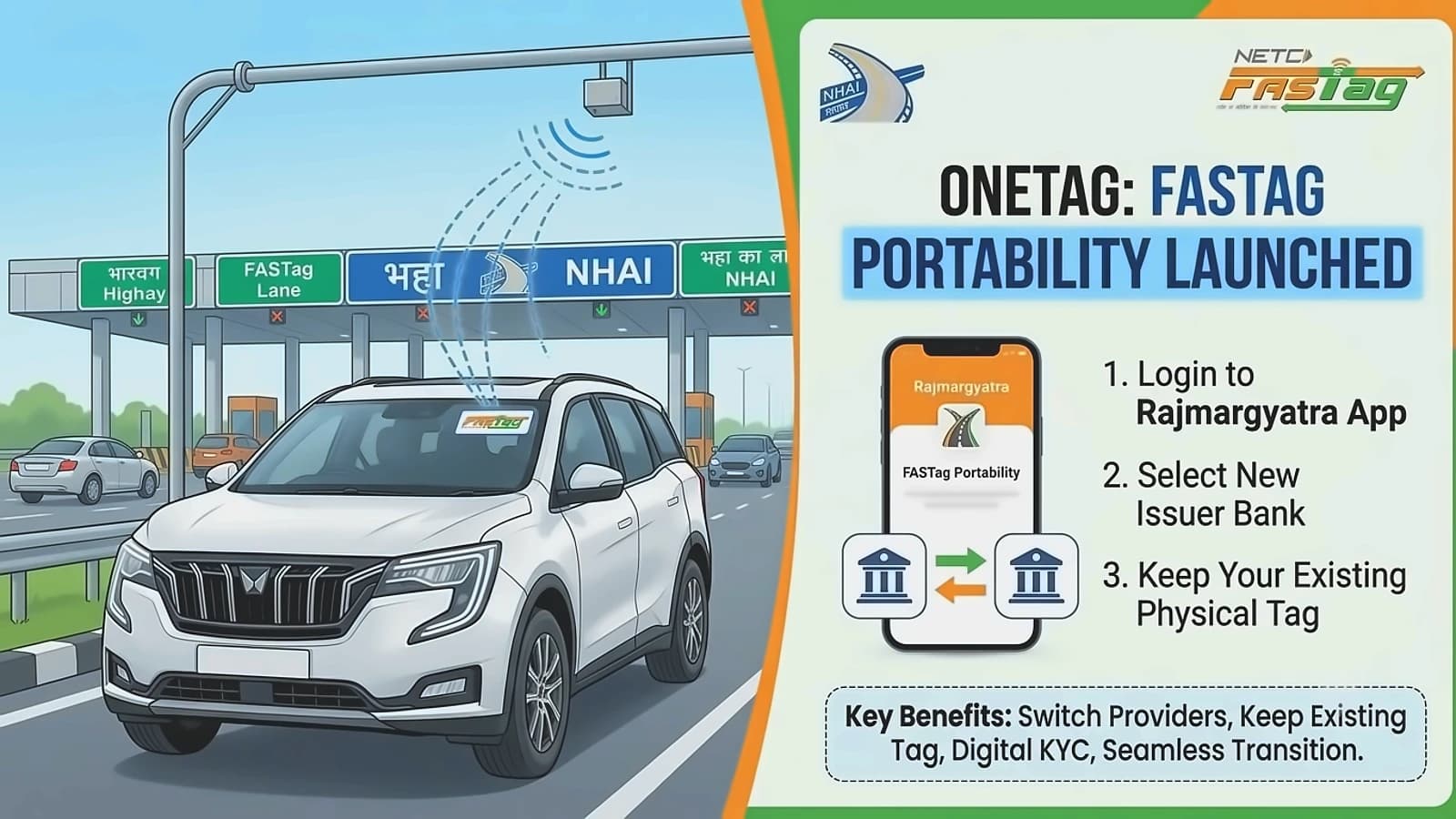
Switching issuer banks through OneTag requires fresh Know Your Customer (KYC) verification with the chosen financial institution. According to The Times of India, users switching their FASTag issuer bank through OneTag will have to complete a fresh KYC process as the Rajmargyatra app guides users through the FASTag portability procedure. The existing issuer bank will continue to be responsible for the previous wallet and matters associated with it, including refunds, pending transactions and other obligations. Regarding existing funds, the original issuer bank automatically closes the previous digital wallet upon successful portability, and any remaining balance—after adjusting for pending tolls or administrative fees—is refunded directly to the user. As noted by Mint, the statement added that after portability is completed, the previous issuer will close the existing FASTag wallet and refund the available balance (post applicable adjustments). The previous issuer will refund the balance from the wallet after making the required adjustments, ensuring consumers don't lose their remaining balance. As noted by Zee News, consumers must note the cooling-off period of six months associated with the portability service, meaning once the interoperable FASTag is switched to an issuer, it cannot be ported again to another bank until this period is complete.
FASTag has established itself as the primary electronic toll collection system on India's national highways, with around 13 crore FASTags issued and penetration exceeding 98%, according to NHAI data. Around 6 crore tags are currently active, demonstrating the widespread adoption of electronic toll collection across the country. OneTag is intended to make the FASTag ecosystem more interoperable while reducing the need to manufacture, dispatch and replace physical tags whenever users change issuers. The initiative has been developed jointly by the Indian Highways Management Company Limited (IHMCL), promoted by NHAI, and the National Payments Corporation of India (NPCI). OneTag adds another facility to the Rajmargyatra app, which already provides services such as the FASTag Annual Pass, FASTag Local Pass and emergency highway helpline 1033. According to Mint, the OneTag initiative will also help to improve FASTag lifecycle management by reducing the need for repeated tag production, thereby lowering operational costs, dispatching and reissuance expenses. The addition of OneTag expands the growing suite of citizen-centric services available on the Rajmargyatra App, including FASTag Annual Pass, FASTag Local Pass, Emergency Helpline 1033, MargMitra Help Centre and other commuter-focused services.
FASTag relies on Radio Frequency Identification (RFID) technology to process automatic, electronic toll deductions while vehicles pass through plazas without stopping. The tag mounts onto the inner windshield glass to enable instant payments and is linked directly to a prepaid wallet or bank account. Under historic updates to the Central Motor Vehicles Rules (CMVR) 1989 enacted by the Ministry of Road Transport & Highways, FASTag usage has been mandatory for all Category M and N four-wheeled vehicles carrying passengers or goods since January 1, 2021. Following successful portability, the existing FASTag ID linked to vehicle registration number will remain unchanged, allowing users to continue using the same physical tag with a different issuer bank. A six-month cooling period applies before the same FASTag can be ported again to another issuer, making the choice of new bank important for regular highway users. The applicable security deposit and minimum balance requirements vary by vehicle class, with Class 4 requiring ₹200 security deposit and Class 5 requiring ₹300 security deposit.