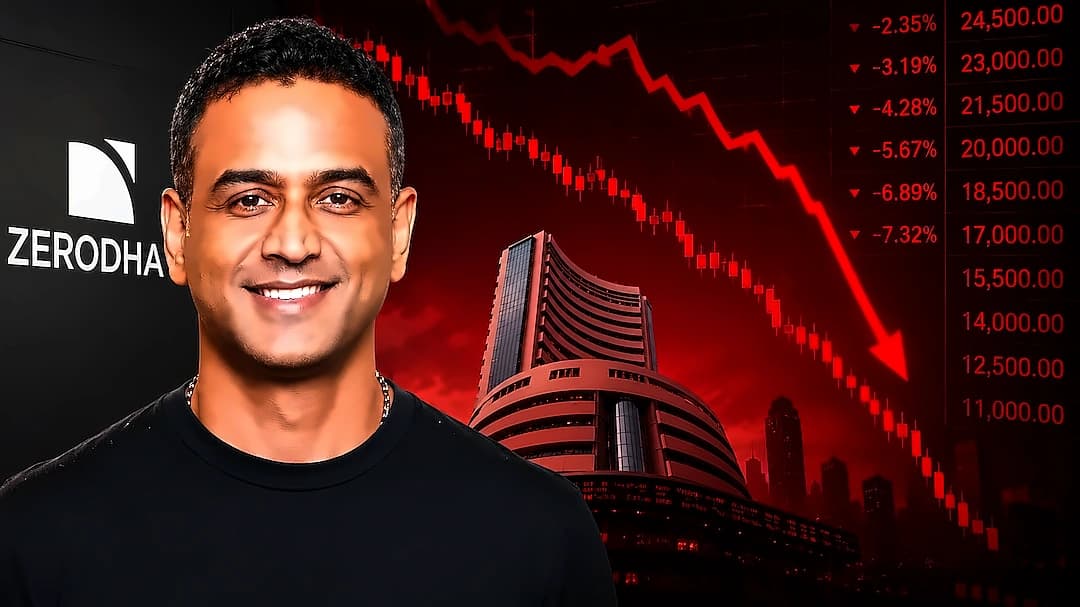
According to reports from NDTV Profit, Zerodha's Nithin Kamath has warned that rising margin trading exposure in illiquid stocks could worsen market selloffs and raise risks for brokers and investors. The concern centers on the growing use of Margin Trading Facility (MTF) across brokerages, particularly when leveraged positions are concentrated in mid- and small-cap stocks that may become difficult to sell during a crash. As reported by NDTV Profit, Kamath warned that brokers may be left with losses if stock prices fall beyond the margin provided by clients, stating that if a stock moves more than the margin provided, the bad debit is on the broker. He added that recovering losses from customers after a sharp fall may not be easy, and noted that while Zerodha's MTF book has grown over the past 16 months, it remains at around 25% of its net worth.
As reported by NDTV Profit, Kamath warned that nearly 50% of the industry's MTF exposure is in non-F&O stocks, where lower circuits and weak liquidity could make exits difficult if markets turn volatile. MTF allows investors to buy stocks by paying only part of the total value upfront, while brokers fund the remaining amount, increasing both gains and losses during market movements. According to Kamath's analysis, the risks become particularly acute in mid- and small-cap stocks because lower circuits can leave brokers with no exit route during a sharp fall. For example, an investor can buy shares worth ₹1 lakh by putting in only a fraction of that amount and borrowing the rest from the broker, which increases buying power during rising markets but also amplifies losses when stock prices fall sharply.
According to Kamath's analysis reported by NDTV Profit, the biggest risk emerges when investors pledge stocks as collateral and use that margin to take larger positions in the same stock. He cited an example where a customer pledges Stock A, gets 80% margin on it, and uses that to take further positions worth 400% in the same stock. Some brokers may have MTF books close to 500% of their net worth, which is the maximum level allowed by regulations. While Zerodha currently does not allow collateral margin for MTF trades, Kamath warned that competitive pressure could force the brokerage to offer it in the future. This would increase the risks further as it allows investors to take even larger positions relative to their initial investment.
As reported by NDTV Profit, Kamath emphasized that MTF may appear to be an easy source of revenue for brokers, but risk management teams must ensure firms do not face large losses during a market shock. He warned that if markets crash, brokers could end up holding losses from MTF positions they can't exit, which puts the entire ecosystem at risk. Kamath noted that recovering losses from customers after a sharp fall may not be easy, and stressed that if markets crash, brokers could end up holding losses from MTF positions they can't exit and that puts the entire ecosystem at risk. Despite broader markets remaining flat, MTF books are growing across brokers, creating potential systemic risks during volatile market conditions.
According to Kamath's assessment reported by NDTV Profit, MTF may appear to be an easy source of revenue for brokers, but risk management teams must ensure firms do not face large losses during a market shock. He emphasized that if markets crash, brokers could end up holding losses from MTF positions they can't exit, which puts the entire ecosystem at risk. Despite broader markets remaining flat, MTF books are growing across brokers, creating potential systemic risks during volatile market conditions. The growing use of MTF across brokerages, even though broader markets have not moved significantly higher, indicates that investors are increasingly using leverage to amplify their market exposure, potentially increasing systemic risks during market downturns.