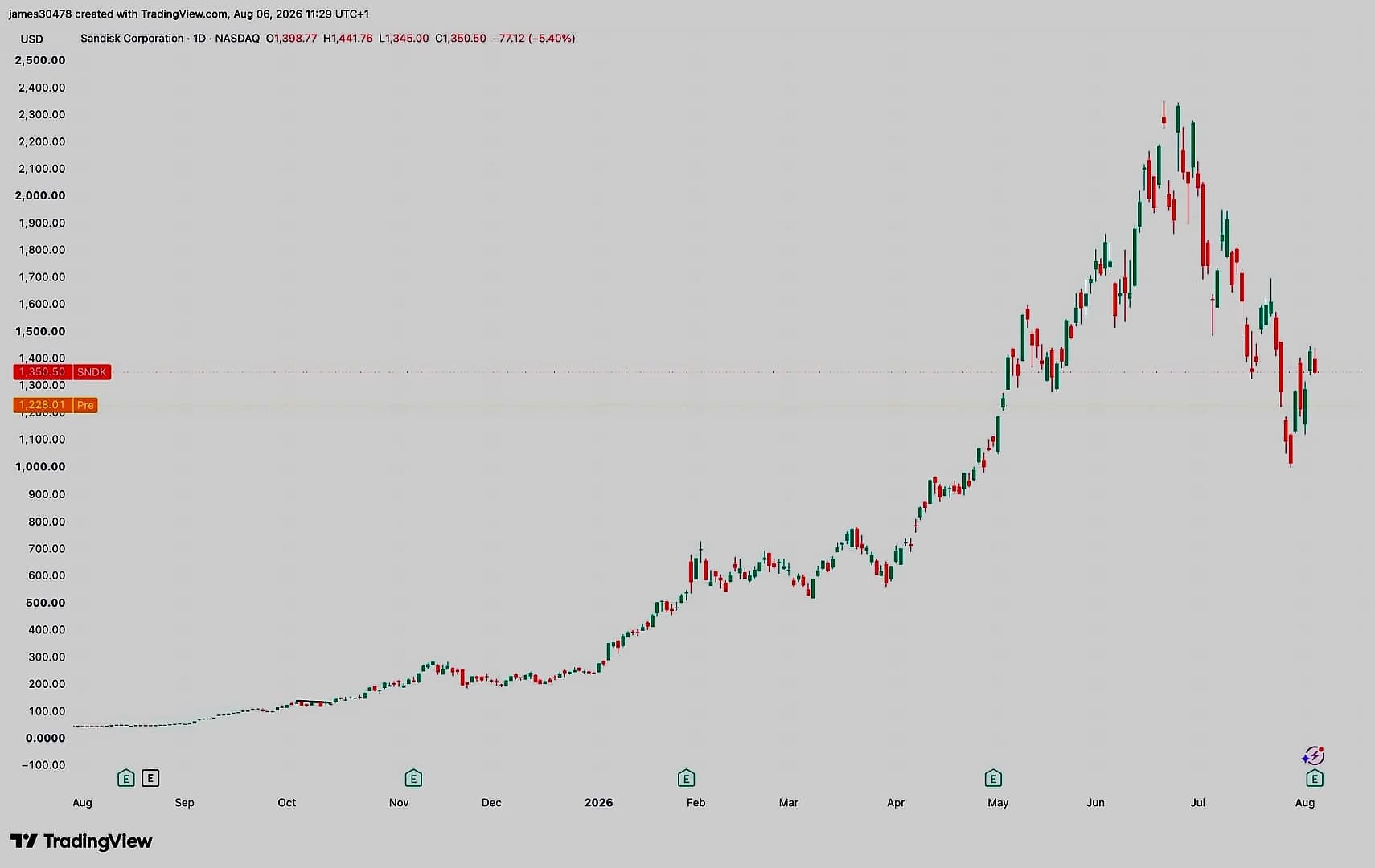
SanDisk shares plunged 14% to $1,163 on Thursday, August 6, despite delivering exceptional fiscal fourth quarter results that significantly exceeded Wall Street expectations. The memory chip maker reported revenue of $8.97 billion for Q4, nearly five times higher than the $1.9 billion reported in the corresponding period last year and surpassing analyst estimates of $8.39 billion. Adjusted earnings came in at $39.25 per share, comfortably beating Wall Street's estimate of $34.96 per share, with the company posting a net income of $6.9 billion or $43.97 per share compared to a net loss of $23 million in the year-ago quarter. However, investor concerns about sustaining exceptionally high profit margins after the sharp rally in the stock and significant jump in AI-driven demand overshadowed the strong quarterly performance.
The stock decline was primarily driven by SanDisk's disappointing revenue forecast for the first quarter of fiscal 2027, with the company expecting revenue in the range of $10.3 billion to $10.8 billion. This forecast fell short of investor expectations, despite the company's strong Q4 performance. The company expects adjusted earnings per share of $44.00-$46.00 for Q1, broadly in line with analysts' estimate of $44.20 per share. According to LiveMint, the performance was largely driven by a surge in spending by cloud hyperscalers such as Meta, Amazon, Alphabet, and Microsoft, which continue to purchase large volumes of memory chips to power AI data centres. The company also highlighted that it has eight long-term agreements with six customers worth at least $93.9 billion, with a median contract duration of four years.
Despite Thursday's sharp decline, SanDisk's stock has delivered remarkable gains over the past year, surging from $47 to Wednesday's closing price of $1,350, translating into a 2,772% gain. The stock has also rallied 443% so far in 2026, crossing the $2,300 mark to hit a record high of $2,354 before witnessing a pullback. However, the stock had corrected 46% in June, reflecting the volatility in AI chip stocks. The sharp turnaround underscores how enterprise storage has evolved from a commoditised hardware business into a critical component of AI infrastructure, driven by rising demand for training and deploying large language models and generative AI applications.
Wall Street experienced a significant rally to reach near-record levels, with the S&P 500 jumping 1.5% and just 0.1% below its record set earlier this summer. The Dow Jones Industrial Average surged 649 points (1.2%) while the Nasdaq composite climbed 2.2%, according to Associated Press reports. The rally was driven by easing oil prices, with Brent crude sinking 5% to $83.52 after President Trump decided to hold off on new strikes against Iran at the urging of regional allies. The 10-year Treasury yield fell to 4.68% from 4.75% as oil price stability helped ease inflation concerns that had been weighing on markets throughout July.
The current volatility in AI chip stocks reflects investor uncertainty over heavy artificial intelligence spending by big tech companies and pressures from new domestic chip production and memory IPOs in China, according to market experts. As per NDTV Profit, Harshal Dasani, Business Head at INVasset PMS, noted that "the opening weakness in chip stocks looks more like an expectations reset than a breakdown in AI demand." He explained that while companies like SanDisk and Western Digital delivered strong quarters, valuations had already priced in sustained acceleration in memory prices, margins and data-centre demand. The market is now demanding execution rather than just participation in the AI boom.