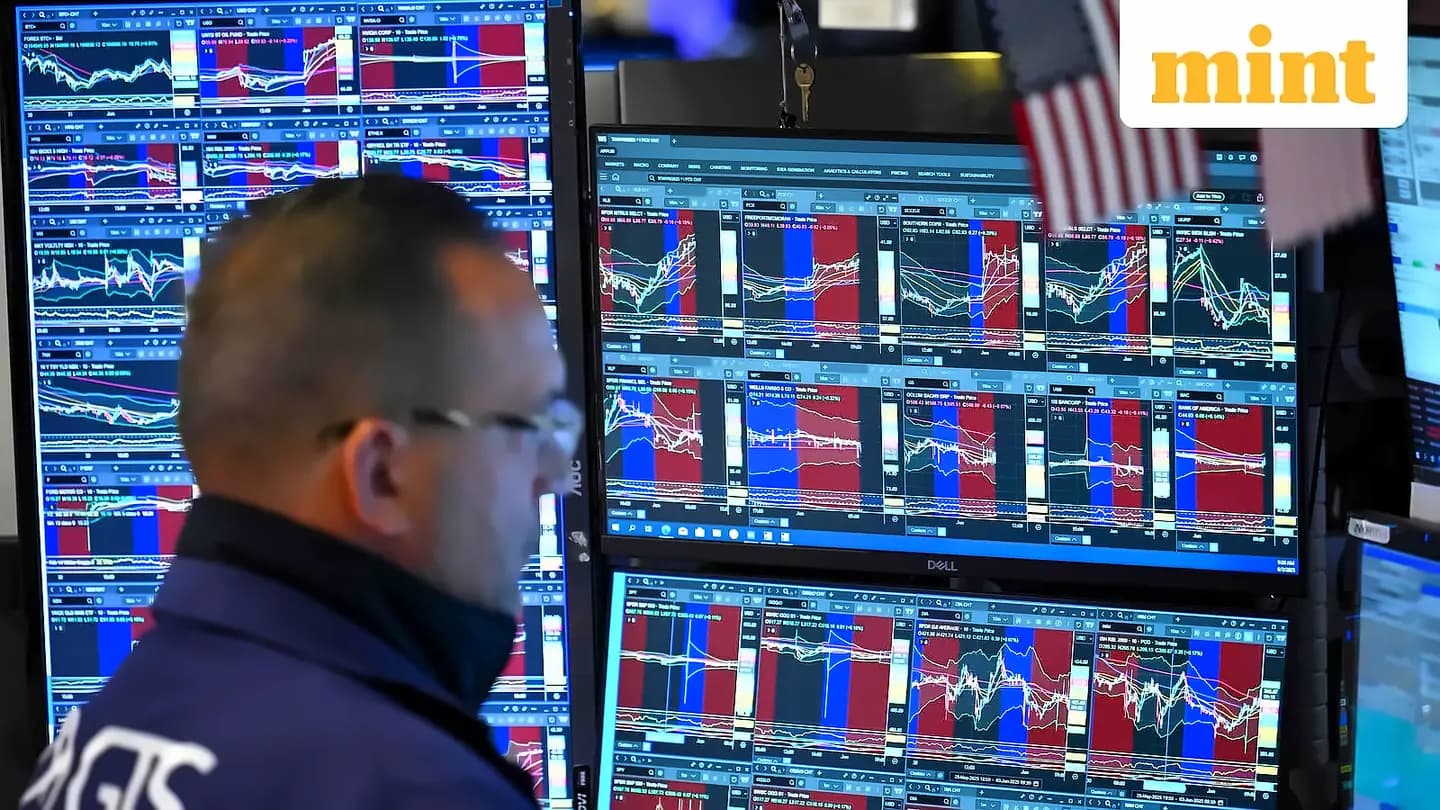
US stock futures indicated a positive start to Friday's trading session, with Dow Jones Industrial Average futures rising 138 points, or 0.3%, while S&P 500 and Nasdaq 100 futures gained 0.1% each after paring earlier gains. According to CNBC TV18, Wall Street sentiment remained cautiously positive following reports that US and Iranian negotiators had agreed on a 60-day memorandum of understanding to extend the ceasefire. The optimism comes despite fresh developments showing Iran's armed forces launched missiles late Thursday, even as US President Donald Trump weighed a possible extension of the ceasefire arrangement. The S&P 500 rose 38 points to 7,511 in early afternoon trading on Tuesday, while Dow Jones Industrial Average slipped 109 points to 50,471 after initially rising in morning trading. KOSPI led Asian gains at +2.96% and reached a new record high despite being closed on Monday. The S&P 500 is poised to notch its ninth straight weekly gain, its longest winning streak since December 2023, with all three major indexes set to register monthly advances according to Reuters.
President Donald Trump stated that negotiations to end the three-month war with Iran are 'proceeding nicely,' as reported by LiveMint. An official who was briefed about the visit revealed that Iran's top negotiator, as well as its foreign minister, were in Doha to discuss a possible deal with the U.S. for the end of the war. However, the optimism was heavily checked by news of fresh US defensive air strikes against Iranian missile sites and boats, which had clouded the outlook for oil flows through the Strait of Hormuz. US and Israeli jets struck Iranian vessels in the Strait of Hormuz and other targets, hours after Donald Trump said talks with Tehran on an interim deal were progressing. The strikes came a day after both nations had signalled willingness to end the conflict, with the Iranian foreign ministry condemning them as ceasefire violations. Sources told Reuters that the United States and Iran had agreed to extend their ceasefire and lift shipping restrictions as peace negotiations proceed, but U.S. President Donald Trump had yet to approve the deal which, according to Iranian state media, has not yet been finalized. President Trump said on Saturday that a peace agreement had been 'largely negotiated,' but it's not clear when or how the deal might be finalized. Iranian authorities confirmed that 'the situation is fully under control,' signaling their commitment to the truce despite the US violations.
Crude oil prices showed significant recovery on Tuesday, with Brent crude futures gaining $3.92, or 4.1%, to $100.06 a barrel while benchmark US crude oil declined $2.76, or 2.9%, to $93.84 a barrel. Brent crude fell 5.24% last week to $103.54/bbl while WTI fell 8.37% to $96.60/bbl in the previous week. Brent futures are trading towards the upper end of a $94.36-97.08/bbl range while WTI Jul'26 sits in a $89.41-93.90/bbl band. Separately, The Nikkei reported that the two parties were discussing plans to open up the Strait of Hormuz around 30 days after a ceasefire agreement was reached. Since the escalation of the conflict in late February, the Strait of Hormuz has effectively remained shut, with a full reopening providing significant relief to major Asian economies. Brent crude prices eased as the market awaited confirmation that the United States and Iran have extended their truce, with U.S. crude falling 1.73% to settle at $87.36 per barrel and Brent settling at $92.05 per barrel, down 1.77% on the day according to Reuters. Average gasoline prices declined in 40 states over the last week as falling oil prices helped offset earlier price cycling, with the average price for a gallon of gasoline standing at $4.49 on Tuesday, down from $4.53 a week earlier, according to AAA.
Investors are also assessing the outlook for Federal Reserve policy as elevated oil prices continue to fuel inflation concerns. According to LiveMint, investors increasingly expect that the Fed may need to tighten monetary policy after the Iran conflict triggered the biggest inflation surge since 2023. The US Federal Reserve's latest policy meeting showed that most officials believe a rate hike this year could still be warranted if inflation remains above the central bank's 2% target. The yield on benchmark U.S. 10-year notes fell 1.8 basis points to 4.437%, from 4.455% late on Thursday, with the 30-year bond yield falling 0.5 basis points to 4.9796% and the 2-year note yield falling 2.5 basis points to 4% from 4.025% late on Thursday. Treasury yields were lower for the fourth straight session, closing out a week in which reported progress in U.S.-Iran peace negotiations fueled market optimism. The market has been pricing about a coin flip odds of a hike (in the fourth quarter) for a couple of weeks now, with Ross Mayfield from Baird noting that 'It's a high bar to clear' and expecting the Fed to wait for more data before making any moves. Market pricing for the probability of the Bank of Japan raising interest rates by a quarter percentage point at next June's meeting is currently stable around 60%, with investors awaiting further data on inflation, unemployment, and wage levels in Japan to reassess those probabilities.
Global markets responded positively to the potential ceasefire developments, with MSCI's gauge of stocks across the globe rising 5.92 points, or 0.53%, to 1,130.64 according to Reuters. The pan-European STOXX 600 index rose 0.14%, while Europe's broad FTSEurofirst 300 index rose 2.53 points, or 0.10%. Emerging market stocks rose 26.90 points, or 1.56%, to 1,751.59. The dollar dipped, and remained on course for a small weekly loss in the wake of reports of a U.S.-Iran interim agreement, with the dollar index falling 0.11% to 98.89, with the euro up 0.12% at $1.1665. Against the Japanese yen, the dollar strengthened 0.01% to 159.23. Gold got a boost from ceasefire optimism but remained on course for a monthly drop, with spot gold rising 1.51% to $4,559.94 an ounce and U.S. gold futures rising 1.28% to $4,556.90 an ounce according to Reuters. Even so, the indexes had pared from session highs as the closing bell drew near, with Ross Mayfield from Baird noting that 'This administration watches the markets and they like to do big things when the markets are closed to control the messaging before the market has a chance to react'.