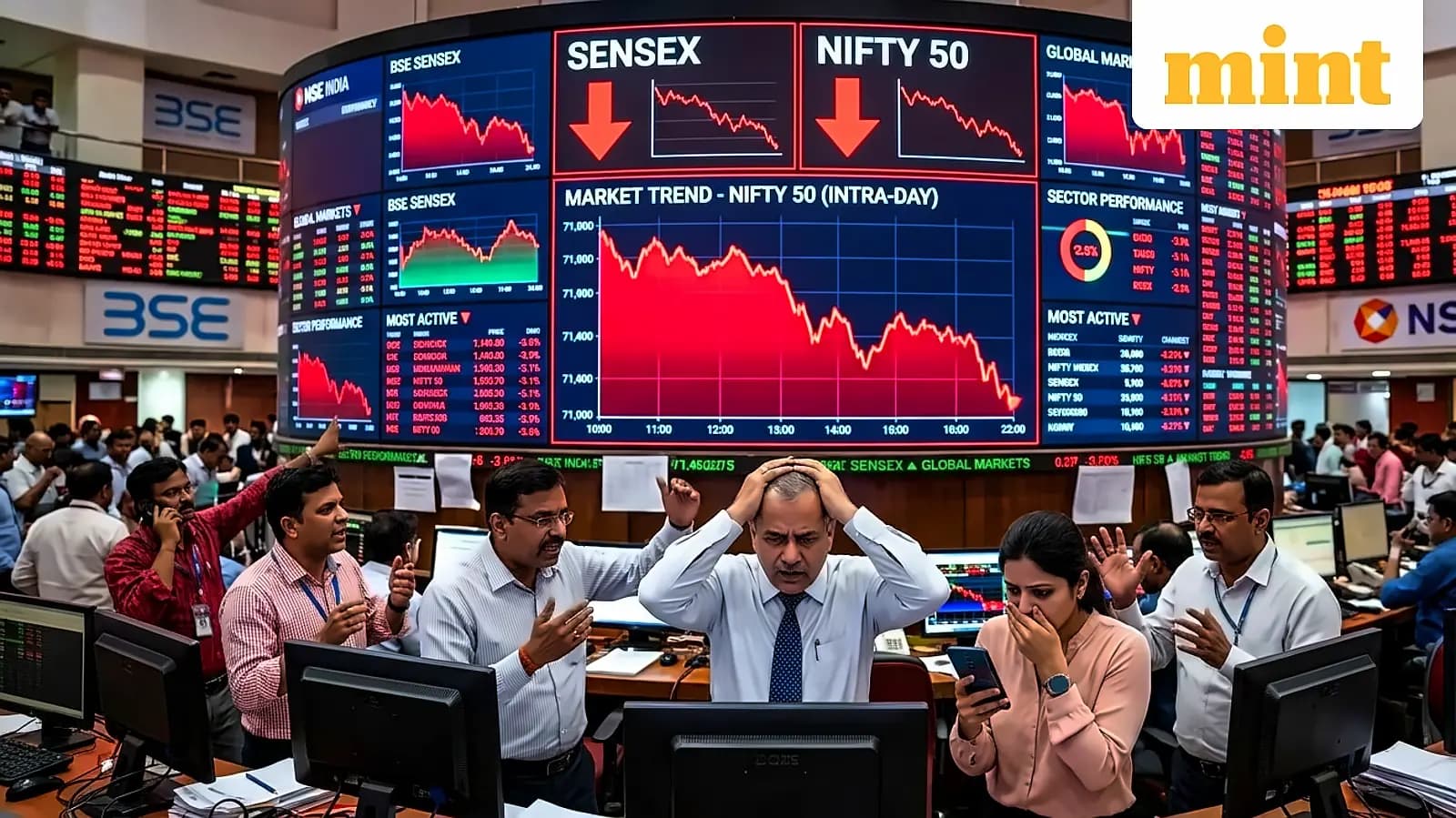
Indian equity markets opened lower on Monday as Brent crude prices jumped more than 2% to trade above $90 a barrel following escalating tensions between the United States and Iran. The latest developments came after American forces targeted two rocket launches on Iran's Larak Island, killing and wounding several Iranian fighters and civilians. According to RTT News, Washington took limited, precise action against IRGC minelaying forces posing an imminent threat in the Strait of Hormuz, as reported by the U.S. Central Command. The Nifty 50 declined 0.42% to 24,073.85, while the BSE Sensex fell 0.28% to 77,042.87 in early trade. Market weakness was broad-based, with 14 of the 16 major sectors recording losses, and the IT sector was among the biggest drags, falling around 1.5%. The immediate trigger for the cautious sentiment was the renewed jump in global crude prices, with the development heightening concerns about potential disruptions to energy supplies and shipping through the strategically important Strait of Hormuz, a critical route for global oil trade.
As reported by Mint, oil prices at $90 per barrel may be manageable for India, but analysts warn of significant risks above this threshold. V K Vijayakumar, Chief Investment Strategist at Geojit Investments, stated that while crude oil at $90 is manageable due to good foreign exchange reserves and controlled current account deficit, "if it flares up beyond $100, that will become an issue." G Chokkalingam, founder and head of research at Equinomics Research, believes oil prices represent the bigger risk for Indian markets, noting that "there is enough evidence to suggest that the correlation between US bond yields and the Indian stock market is not very strong." For India, higher crude prices are particularly important because the country relies heavily on imported oil, with a sustained increase in energy costs raising the import bill, putting pressure on the rupee and contributing to inflation. The latest surge in oil prices, driven by the US military action against Iranian forces, has intensified these concerns about energy supply disruptions.

According to Mint reports, oil prices pose direct macroeconomic risks to India as the world's third-largest importer of the commodity. Higher oil prices can directly impact India's trade deficit and current account deficit, potentially straining the fiscal position. Harshal Dasani, Business Head at INVAsset PMS, explained that "oil at $90 can widen the current account, pressure the rupee already near 96, add 25 to 30 basis points to inflation for every sustained $10 move, and steadily shrink the RBI's room to ease." For equities, the impact of higher yields is more sentiment-driven, primarily affecting debt markets rather than directly impacting stock valuations. The Indian rupee is already facing pressure from elevated oil prices and stronger expectations of higher US interest rates, with the rupee opening around ₹95.56 against the US dollar, weakening from its previous close. The latest military action by the United States has added another layer of uncertainty to an already challenging environment for Indian markets.
U.S. Treasury Secretary Scott Bessent has pushed back against concerns about turbulence in the U.S. government bond market, arguing that worries about rising debt and yields overlook the strength of the U.S. economy and its fiscal outlook. In an interview with Reuters, Bessent stated that "I'm not sure where the bond market turmoil is" and noted that the U.S. bond market was "the best performing" among global peers this year. Benchmark U.S. Treasury yields were little changed over the past week, with the 10-year note ending Friday near 4.73% after hugging a tight range. Bessent attributed the recent rise in yields to energy prices and inflationary pressures stemming from the Iran conflict, factors he expects to fade over time. He added that higher yields reflected confidence in the U.S. economy, with the United States in a stronger position than many advanced economies because it continues to grow even while running large budget deficits.