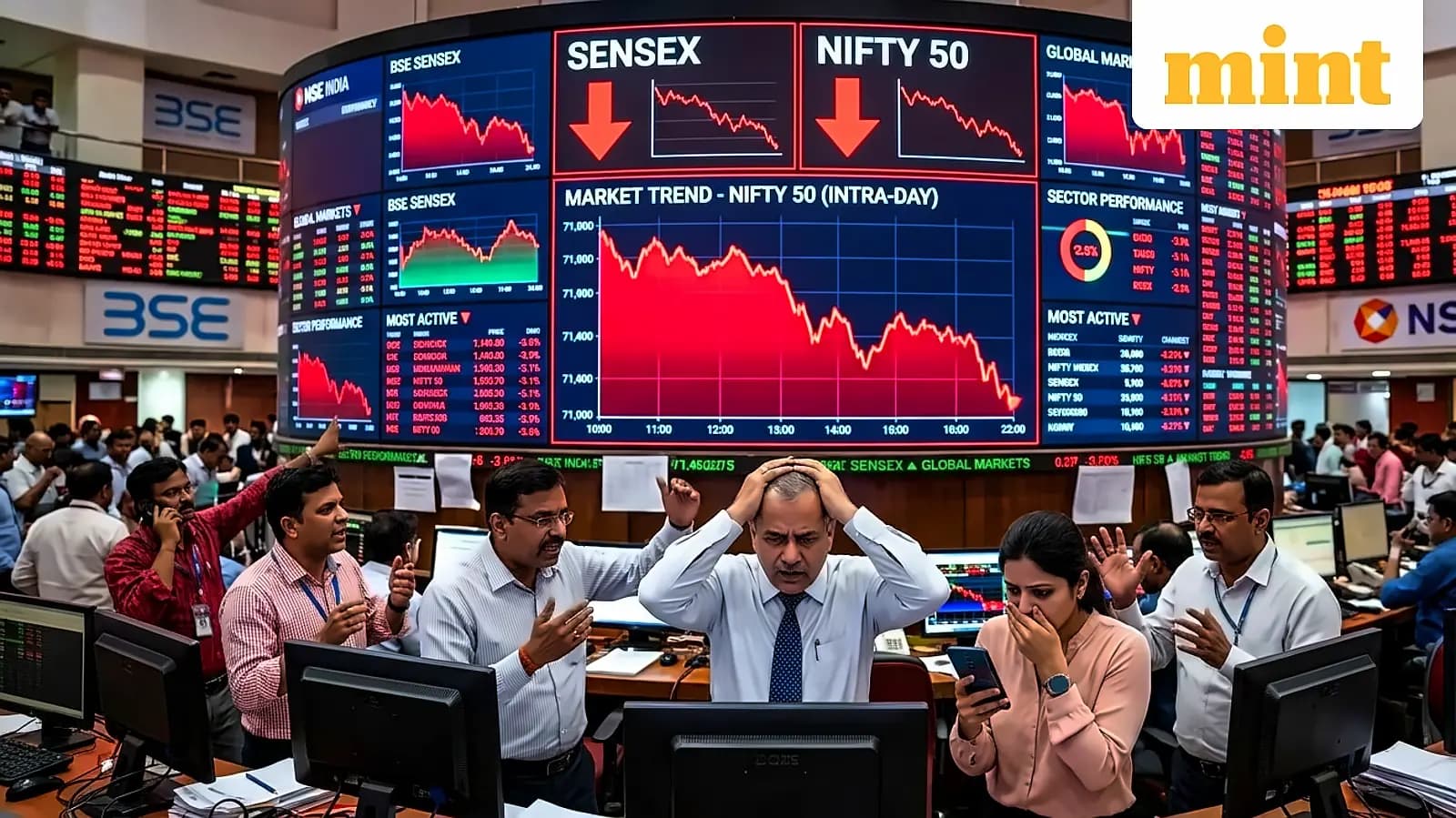
Indian stock market benchmark indices extended their losing streak on Wednesday, with BSE Sensex dropping 325.78 points or 0.42% to 76,909.68 and NSE Nifty50 losing 76.60 points or 0.32% to 24,078.30. According to Business Standard, the Sensex declined 1.49% in four consecutive trading sessions, while the Nifty fell 2.05% in seven consecutive trading sessions. From the Sensex pack, Reliance Industries (down 0.83%), ICICI Bank (down 0.71%) and HDFC Bank (down 0.41%) were major Nifty drags, while IT stocks provided notable support amid bargain hunting, with the Nifty IT index gaining 0.8% after falling around 4% over the previous three sessions. Broader markets also remained weak, with the BSE 150 MidCap Index falling 0.44% and BSE 250 SmallCap Index dropping 0.67%, as reported by Business Standard. Market breadth was negative with 1,807 shares rising and 2,483 shares falling on the BSE, indicating broad-based selling pressure across the market.
Crude oil prices continued their upward trajectory with Brent crude for October 2026 settlement gaining 97 cents or 1.07% to $91.99 a barrel as uncertainty over the US-Iran conflict and the Strait of Hormuz kept supply concerns in focus. Brent crude remained elevated near $92 a barrel as the temporary 60-day U.S.-Iran ceasefire expired without any meaningful diplomatic breakthrough, renewing concerns over a prolonged disruption to energy supplies. The average price of the Indian crude oil basket for August, so far, is $88.51 per barrel, significantly up from $69 per barrel in February before the conflict began. With India meeting more than 85 percent of its crude needs through imports, a sustained price rally would inflate the country's import bill and stoke inflation, analysts warn. Investor sentiment remained subdued as Brent crude climbed above $91 per barrel following the expiry of the temporary US-Iran ceasefire, with Iran adopting a more aggressive stance and the US ruling out an extension, according to Religare Broking. The expiry of the temporary 60-day U.S.-Iran ceasefire without any meaningful diplomatic breakthrough has renewed concerns over a prolonged disruption to energy supplies, driving crude oil prices higher and pushing long-term U.S. Treasury yields to multi-year highs, said Ponmudi R, CEO of Enrich Money.
Most sectoral indices closed in the red as defence and energy stocks led the decline, while IT shares bucked the trend and gained amid bargain hunting. According to Business Standard, thirteen of the 16 major sectoral indices were trading in the red as of Wednesday's session. Nifty Energy emerged as one of the weakest pockets as Brent crude remained elevated, falling close to 1%, while Nifty Metal was down about 0.51%, and financial services also remained under pressure with the Nifty Financial Services index declining 0.5%. However, IT stocks provided notable support to the market, with the Nifty IT index gaining 0.8% after falling around 4% over the previous three sessions. Pharma and Media also traded marginally higher at different points during the session, as reported by DSIJ. Stock-specific action remained strong despite the weak headline indices, with Prism Johnson rallying 5.10% after the company was declared the successful bidder for supply of 1,28,000 metric tonnes of coal per annum by subsidiaries of Coal India. City gas distributors also gained after the government announced incentives to increase domestic connections for piped cooking gas, with Indraprastha Gas rising 3.1% and Mahanagar Gas advancing 3.8%.
India's crude import bill has already surged 61 percent to $49.8 billion in April-June from the year-ago period, even as import volumes declined by 4 percent, according to PPAC data. The Budget had pegged fiscal deficit at 4.3 percent of GDP, a projection based on oil trading at $75 a barrel. India imports nearly 90% of its crude oil requirement, and every $1 per barrel increase in prices adds about ₹18,000 crore to its annual import bill. As per Icra's Prashant Vasisht, if crude oil prices continue to remain high, there will be an impact on the overall profitability of OMCs. The bigger risk for India, the world's third-biggest oil importer, is not the availability of crude but persistently higher landed prices that could inflate the import bill, widen the current account deficit and weigh on the broader economy. India's retail inflation rose to a 19-month high of 4.45% in July, driven up by higher food and fuel prices, with the impact of the supply crunch potentially offset by a fall in global demand.
The selling in the markets came after reports highlighted Iran's indication that it could adopt a more offensive posture and US President Donald Trump's ruling out an extension to the ceasefire arrangement, which have intensified concerns over potential disruptions to energy supplies. US President Donald Trump said on Tuesday that no negotiations were underway with Iran, while also stating that the Strait of Hormuz remained open, contradicting Tehran's claim that the strategically important shipping route was closed. A senior Iranian official told Reuters that Iran was moving towards a "fully offensive" military stance amid the diplomatic deadlock, with no fresh attacks reported on Tuesday. The temporary ceasefire between the two sides expired on Monday, with the expiry of the temporary 60-day U.S.-Iran ceasefire without any meaningful diplomatic breakthrough has renewed concerns over a prolonged disruption to energy supplies. Amid concerns over access to the Strait of Hormuz, Iraq's cabinet approved a new mechanism to export its crude oil through specialised international and domestic companies using multiple export routes, with contracts valid for three months beginning September 1.