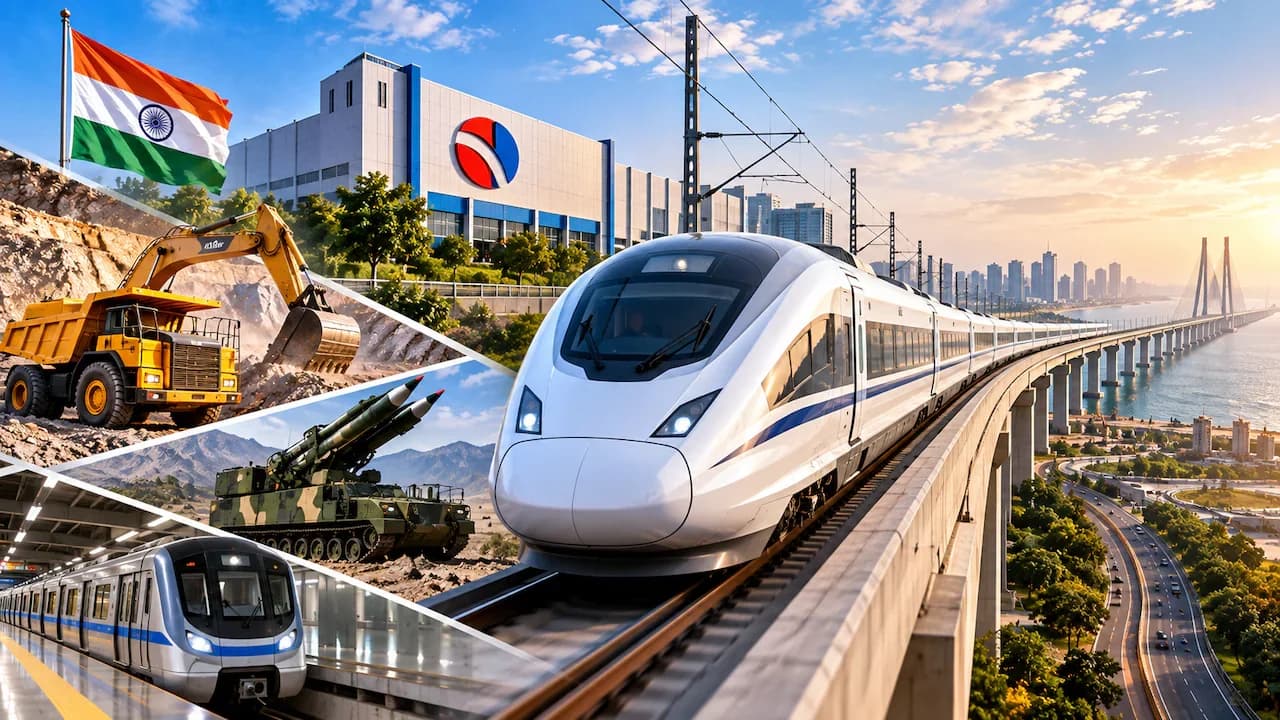
Railway stocks experienced a significant surge on Thursday, with shares of railway companies including IRCTC, Ircon, Titagarh Rail Systems, RVNL, and IRFC rallying up to 4% following the Cabinet Committee on Economic Affairs approval of major multitracking projects. According to The Economic Times, RVNL gained 2% to ₹211 per share, while Ircon International surged over 3.6% to trade at ₹119 per share. Titagarh Rail Systems gained 2% to ₹894, with IRCTC up over 1% and IRFC shares trading over 1% higher in Thursday's session. The rally was triggered by the approval of five railway multitracking projects worth around ₹10,021 crore across Tamil Nadu, Andhra Pradesh, Karnataka and Telangana.
The approved projects will significantly expand India's railway infrastructure, adding about 540 km to the existing Indian Railways network and are planned for completion by 2029-30. As per The Economic Times, the approved works include the 77-km Arakkonam-Renigunta third and fourth lines, the 47-km Whitefield-Bangarapet third and fourth lines, the 147-km Hosur-Omalur doubling project, the 159-km Salem-Karur-Dindigul doubling project and 110 km of multitracking between Secunderabad (Ghatkesar) and Kazipet. The projects cover 17 districts across the four states and are expected to increase rail capacity, improve operational efficiency and service reliability while easing congestion. Prime Minister Narendra Modi emphasized that the projects will ensure better rail connectivity in South India, stating they will benefit lakhs of people through faster passenger movement and stronger connectivity.
Indian equity markets remained volatile and under pressure through the week, with the Nifty 50 extending its losing streak to four consecutive weeks — its longest run in five months. According to The Economic Times, the Nifty 50 closed at 23,897.70 on Friday, rising 0.10% after four consecutive sessions of losses. Despite the late-week recovery, the index declined around 1.2% during the week and remained below key moving averages, keeping the broader technical setup weak. The 24,000–24,200 range remains the immediate resistance zone, with the 24,000 level particularly important as the index has repeatedly failed to sustain gains above the psychological mark. For the week, the Nifty 50 declined around 1.15% while the Sensex slipped nearly 1.0% to settle at 76,515.43, both benchmark indices registering their fourth consecutive weekly decline amid persistent foreign investor selling and concerns over higher energy costs.

The railway expansion projects are strategically positioned to enhance India's freight transportation capabilities, with the approved works expected to support additional freight traffic of 47 million tonnes per annum (MTPA). As reported by The Economic Times, the routes are crucial for transporting commodities such as coal, cement, iron and steel, containers, automobiles, food grains, petroleum products and fertilisers. Additionally, three more projects worth ₹10,783 crore were cleared across five states, adding around 656 km to the Indian Railways network and expected to enable incremental freight movement of around 27 million tonnes per annum. The projects have been planned under the PM Gati Shakti National Master Plan, with a focus on additional rail networks that will improve connectivity to around 2,121 villages with a combined population of about 52 lakh.
NSE has implemented new pre-open session rules effective September 7, 2026, fundamentally changing how trading begins in Indian equity markets. Under the new framework, the 15-minute pre-open session (9:00 AM to 9:15 AM) will be divided into phases, with market orders restricted during the second phase. The changes are designed to align the pre-open session with SEBI's introduction of the Closing Auction Session (CAS) in the equity cash market on August 4. The revised norms apply to various equity securities including SME shares, partially paid-up shares, InvITs and REITs, not just large-cap companies, ensuring broader market coverage. These changes aim to improve coordination between cash and derivatives segments and facilitate smoother market operations.