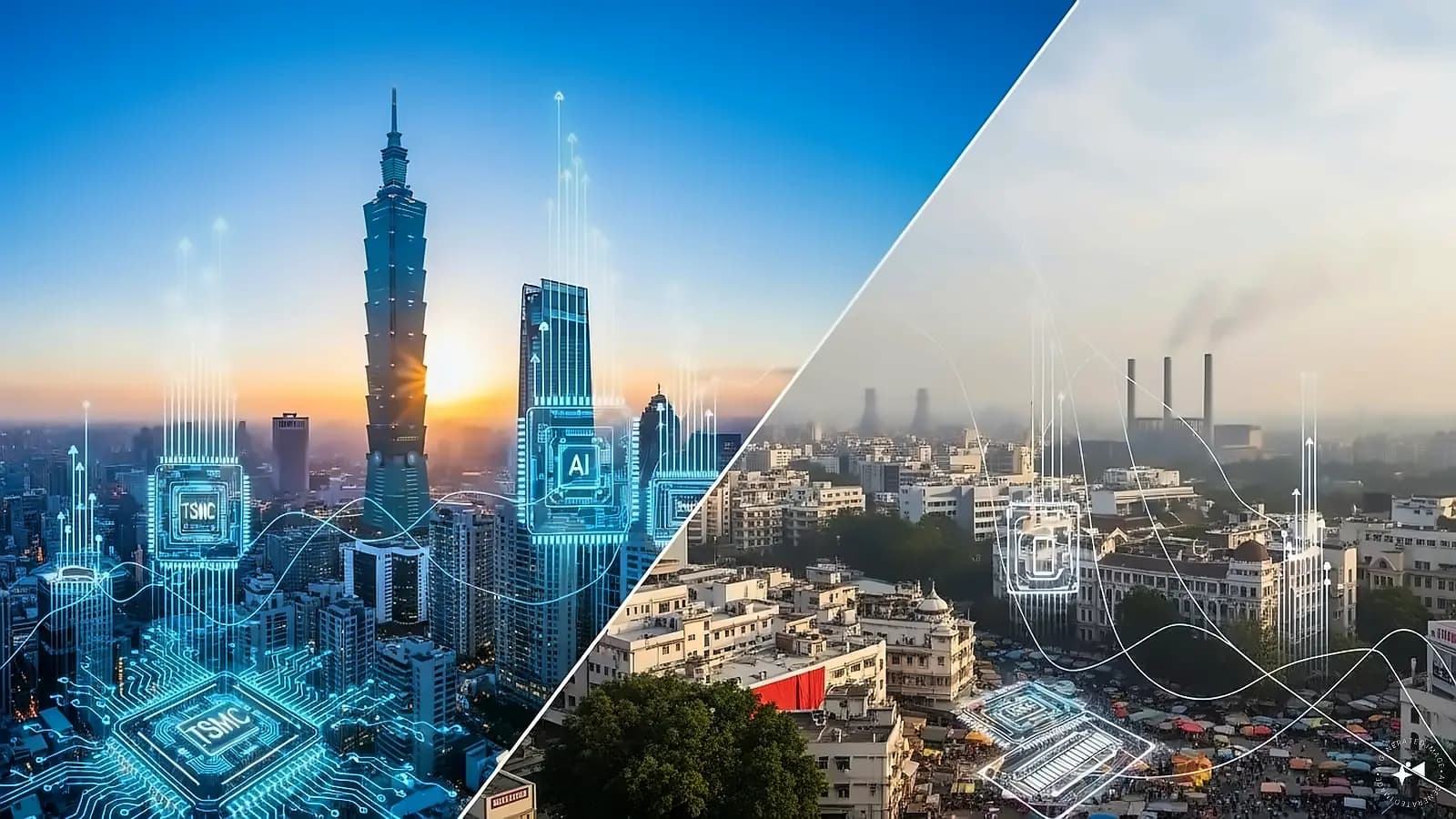
The global artificial intelligence boom is fundamentally reshaping international equity market hierarchies. According to Bloomberg data, Taiwan has overtaken India to become the world's fifth-largest stock market, with Taiwan's market capitalisation standing at $4.95 trillion ($4952.22 billion) and India's at $4.92 trillion ($4920.51 billion). This dramatic shift reflects the massive investor rotation toward AI-linked technology stocks, with Taiwan's market capitalisation surging 52% this year compared to India's decline. The rise has been powered largely by Taiwan Semiconductor Manufacturing Company (TSMC), which has emerged as the single biggest force behind Taiwan's stock market rally. South Korea remains the seventh largest market with a market capitalisation of $4.54 trillion ($4544.42 billion), having surged 69% this year and closing in on India's position.
TSMC has crossed the $2 trillion market capitalisation mark, making it one of the world's most valuable companies and the engine behind Taiwan's remarkable market performance. As the world's largest contract chipmaker, the company manufactures advanced semiconductors for global technology leaders such as NVIDIA, Apple, and AMD. Its dominance in advanced AI chip production has placed Taiwan at the centre of the global technology supply chain. The company's market capitalisation has jumped 45% this year, with Samsung Electronics and SK Hynix also driving South Korea's remarkable performance. TSMC accounts for over 42% of Taiex, underscoring the company's dependence on one stock, while TSMC alone represents almost 40% of Taiwan's market value. This performance underscores the scale of the AI-driven rally, with leading AI companies estimated to spend nearly $1 trillion in capital expenditure over this year and next.
India's market position has been significantly impacted by foreign investor sentiment. Foreign portfolio investors have been cutting exposure to India since October 2024, as reported by The Economic Times, partly because of the absence of AI capabilities, slower earnings growth and rich valuations compared to its peers. The firm noted that since April 2025, foreign flows had rotated toward South Korea and Taiwan to play the AI trade, largely at the expense of India and partially China. India is increasingly being viewed as a relative laggard in the AI-led rally, lacking meaningful representation in the global semiconductor and AI supply chain. Unlike Taiwan, whose rally has been driven by a concentrated semiconductor boom, India's market remains more diversified and dependent on domestic consumption, financials, manufacturing, and services, which has played a major role in the ranking shift.

Despite the AI rally's momentum, experts caution about concentration risks in the current market environment. Samsung Electronics and SK Hynix account for nearly half of South Korea's market capitalisation, while TSMC alone represents almost 40% of Taiwan's market value. However, Taiwan continues to face geopolitical challenges because of tensions involving China and the United States, with the Taiwan Strait remaining one of the most closely watched geopolitical flashpoints in global markets. Investors are also monitoring export controls, technology restrictions, and supply-chain vulnerabilities. In contrast, India maintains greater diversification, with Reliance Industries accounting for only about 4% of India's total market capitalisation. However, as long as AI-linked stock momentum remains strong, investors appear willing to overlook concentration risks and rotate capital from India to these markets.
India faces additional headwinds beyond market concentration. India is the only major emerging market that imposes a capital gains tax, which further impacts foreign investor returns, particularly in an environment where the currency is also at risk of weakening further given an elevated current account deficit this year. According to Kotak Institutional Equities, India is currently neither a pure AI play nor a high-growth outlier, reducing its relative appeal versus markets like Korea, Taiwan, or even Brazil. India's stock market remains fundamentally strong, but investors have become cautious because of elevated valuations and slower earnings momentum in some sectors, contributing to the shift in global market rankings.