Taiwan has overtaken India in stock market value, with the island's market capitalization climbing to $4.95 trillion as of Monday, according to Bloomberg data. India's market value has dropped to $4.92 trillion, pushing Taiwan into fifth position globally behind the US, mainland China, Japan, and Hong Kong. This shift reflects intense optimism in artificial intelligence that is triggering a global rally in tech shares, particularly benefiting manufacturing hubs such as Taiwan and South Korea. As Franklin Templeton's Yi Ping Liao explains, Taiwan's rising market capitalization is fundamentally a reflection of its heavy concentration in tech hardware, which is currently at the center of the AI investment cycle. The massive AI-driven structural rotation is reshaping emerging market equities, triggering record foreign capital flight from India toward East Asia's tech manufacturing hubs.
Taiwan's ascent is largely driven by Taiwan Semiconductor Manufacturing Co. (TSMC), which now accounts for about 42% of the benchmark index, representing intense market concentration. The chipmaker's shares have rallied 49% this year as it has benefited from the artificial intelligence trade, where its semiconductors have a dominant market position. According to Franklin Templeton's Yi Ping Liao, markets with limited exposure to tech hardware are increasingly being overshadowed by tech hardware-heavy markets such as Taiwan and Korea. The surge in the island's market value highlights intense optimism in AI that is triggering a global rally in tech shares, disproportionately benefiting manufacturing hubs such as Taiwan and South Korea.
New regulations are favoring TSMC through Taiwan's financial regulator, which last month increased the limit that domestic funds can invest in a single stock. Under the new guideline, funds that invest solely in Taiwanese stocks can hold up to 25% of their net assets in any listed company whose weighting exceeds 10% in the Taiwan Stock Exchange, up from a previous limit of 10%. Currently, only TSMC meets this criterion. According to JPMorgan Chase, the change may help attract more than $6 billion of inflows to Taiwan. The change reflects what Nomura calls a "commodity memory and high-bandwidth memory supercycle" that is driving AI-driven export surpluses and higher household incomes in Korea.
South Korea is rapidly emerging as the next major beneficiary of the AI boom, with Nomura dramatically raising its 2026 KOSPI target to 10,000–11,000, up from a prior range of 7,500–8,000. The brokerage expects AI-driven earnings to deliver 200% year-on-year growth for Korean corporates in 2026, followed by 29% in 2027. Korea's exports from January through April 2026 hit a historical high of $306 billion, led by semiconductors. Nomura sees the possibility of a self-reinforcing cycle taking hold in Korea: AI-driven export surpluses feeding into higher household incomes, stronger domestic consumption, potential won appreciation, and improved fiscal capacity — a virtuous loop that could sustain returns well beyond the current cycle.
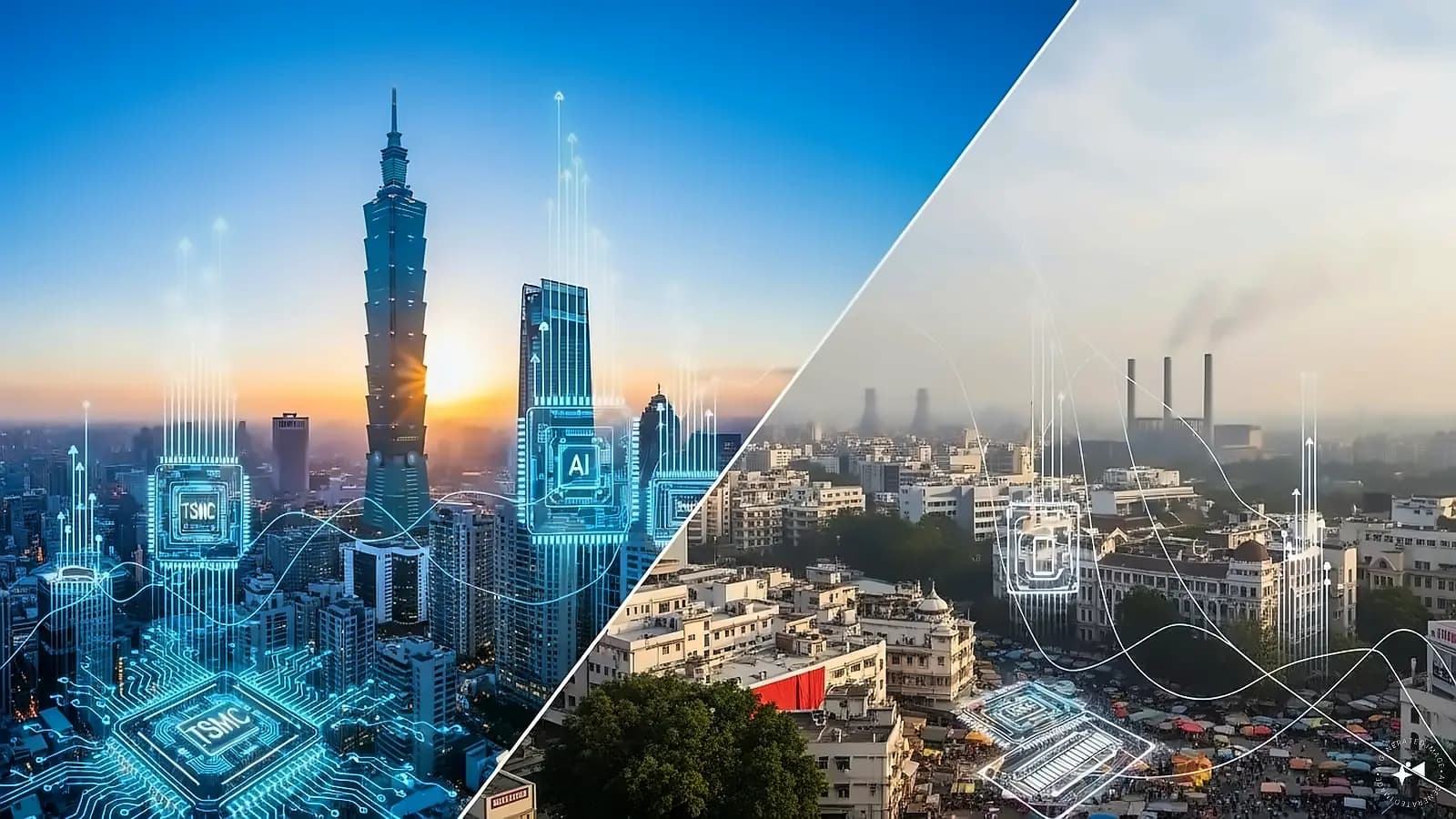
While Taiwan has overtaken India in market value, India's $4.15 trillion economy still trumps the island's $977 billion gross domestic product according to International Monetary Fund estimates. Indian stocks have fallen this year amid record foreign outflows, driven by elevated valuations and a weakening rupee. Higher energy costs have also stoked inflation concerns and clouded growth prospects. Global funds have sold nearly $24 billion of local equities so far this year as they chased the AI boom in Taiwan and Korea. India's weight in the MSCI emerging markets index has collapsed from 19% last year to about 12%, reflecting both the market's underperformance and the reallocation of global capital toward AI-linked economies. Elara Securities echoes concerns about India's structural disadvantages, pointing to the same trio of headwinds — earnings quality, AI-cycle exclusion, and commodity sensitivity — as structural rather than cyclical challenges.
India's gauge is down 8% this year, heading for its first annual drop after a decade of gains. India's weight in the MSCI emerging markets index has also fallen to about 12% from 19% last year. Alison Shimada from Allspring Global Investments told Bloomberg TV that India has been quite ignored for the better part of two years, noting that while it is an expensive market requiring selectivity, people are moving into financial assets due to financialization of savings in India. Despite India's economic challenges, its $4.15 trillion economy remains among the fastest growing globally, highlighting the contrast between its fundamental strength and current market performance. The contrast underscores how the AI supercycle is reshaping global markets, with capital flowing toward semiconductor-heavy economies while traditional manufacturing and services markets face headwinds.