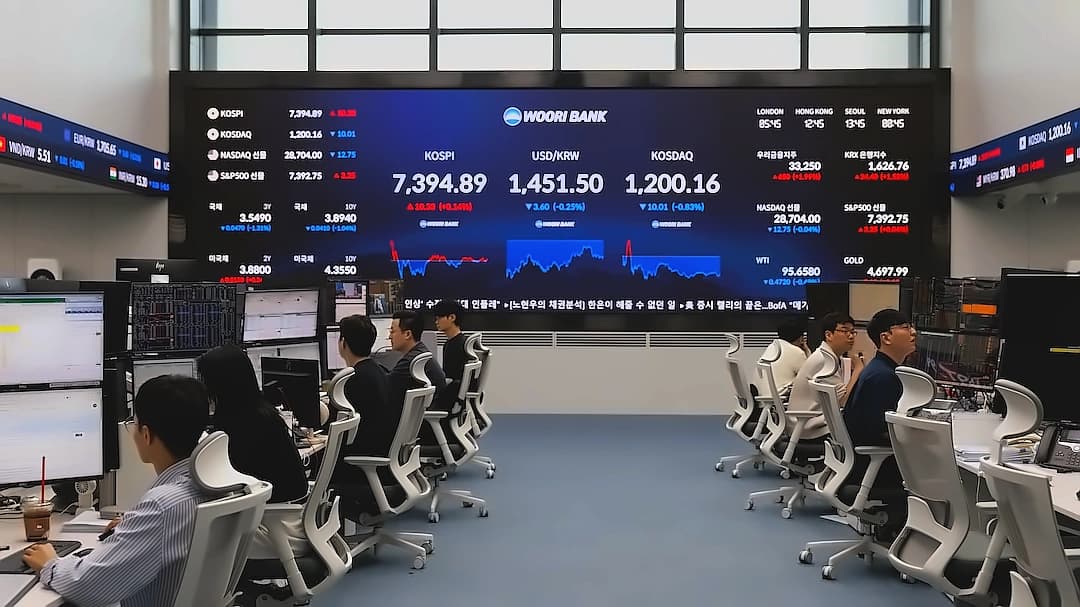
South Korean and Taiwanese equity markets are significantly outperforming India in 2026, with South Korea's market cap growing 81% and Taiwan's expanding 54% compared to India's market cap shrinking 7% amid substantial foreign portfolio investor outflows. According to The Economic Times, this divergence stems largely from concentrated technology stock performance, with Samsung and SK Hynix together contributing 46% to South Korea's $4.8 trillion market cap while Taiwan's top five companies account for half of its $5 trillion total market cap. In contrast, India's top three stocks - Reliance Industries, HDFC Bank and Bharti Airtel - contribute only 9% to the country's $4.9 trillion market cap, with the top 10 stocks accounting for just over 18%.
South Korean stocks have delivered an unprecedented 100% surge in 2026, with the benchmark Kospi hitting 8,228 points on May 27, 2026 in a 4.65% single-session surge. This breathtaking rally has eclipsed even the historic run-ups seen before the dotcom bubble burst and during Korea's industrial boom in the late 1980s. The gauge jumped as much as 5.1% on Wednesday, demonstrating the continued momentum in Korean equity markets. The KOSPI is now 119% higher than it was exactly a year ago, building on an already historic 75% gain in 2025 - the benchmark's strongest annual performance since 1999, leaving the index up over 200% across just 17 months.
The supercharged rally has been supervised by advances in memory makers SK Hynix and Samsung Electronics, as reported by Business Standard. These chip giants have been the primary drivers behind the benchmark's remarkable performance. Samsung Electronics has surged 149% year-to-date, while SK Hynix has climbed 215%, serving as the primary engines of the entire KOSPI rally. The combined weight of these two stocks in the KOSPI has now surpassed 47%, and excluding them, the year-to-date gain of the index's remaining hundreds of constituents narrows sharply to approximately 30%. The memory chip sector's strength has been a key factor in the broader market's ability to maintain its exceptional momentum throughout the year.
The KOSPI's daily average trading value has surpassed 40 trillion won for the first time this month, reaching a record 48 trillion won, but Samsung and SK Hynix alone account for 43% of that total. This concentration deepens the large-cap dominance in the Korean market. The extreme volatility has been comparable to that seen during the 1997 Asian financial crisis, the 1999 dot-com bubble, and the 2008 global financial crisis. The index plunged as much as 12% on one day during the brutal March 2026 correction triggered by geopolitical shock, then staged a near-10% rebound the very next session - marking its best day since 2008.
In stark contrast to the Asian markets' performance, India's market cap has shrunk by nearly 7% since the beginning of 2026 amid significant foreign portfolio investor selling. According to The Economic Times, FPIs have sold equities worth $24.3 billion (₹2.3 lakh crore) till May 27, significantly exceeding their outflow of $18.9 billion (₹1.7 lakh crore) in 2025. Each of the top 10 stocks based on market cap has failed to earn returns so far this year. This compares unfavorably to the concentrated gains in South Korea and Taiwan, where technology companies catering to the artificial intelligence ecosystem have attracted FPI investments. Taiwan's market cap growth is trimmed to 48% when excluding TSMC, MediaTek and Delta Electronics, while South Korea's growth is reduced to 40% after excluding Samsung and SK Hynix.